
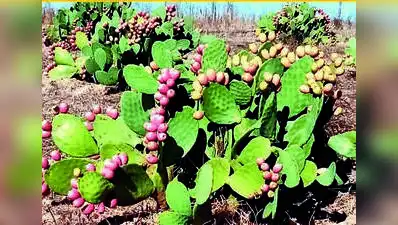
Spineless cactus
The region has 53.6 lakh livestock animals and needs around 20,125 tonnes of fodder every day. Its animals include 6.5 lakh calves, 26.5 lakh large animals and 20.6 lakh sheep and goats. By the end of Sept, the administration had estimated Marathwada’s fodder availability at 44.8 lakh tonnes. Modern research at Texas A&M and University of California has reported fresh biomass yields of over 150 tonnes per hectare.
Indra Mani, Vice-Chancellor of Vasantrao Naik Marathwada Agricultural University, Parbhani, said, “The hardy plant can survive with little water and continue producing fleshy, moisture-rich pads even when conventional green fodder becomes difficult to grow. ” For drought-prone Marathwada, that resilience could be crucial. “The cactus can be included in efforts to restore rainfed and degraded land because it survives in low-rainfall conditions,” Gopchade said. “Apart from fodder security, it also has potential for biogas and bio-fertiliser production,” he added.
Chhatrapati Sambhajinagar : In drought-scorched Marathwada, the cactus could do more than survive. It could help livestock survive too. Agriculture scientists are pitching spineless fodder cactus as a drought-time alternative for cattle, buffaloes, sheep and goats. Parts of the region are already staring at an early fodder crunch after a poor monsoon. Official estimates indicate stocks in some areas could begin running out from Dec. That includes kharif and rabi crop residue and grass available on bunds, fallow land and in forest areas. However, prolonged dry weather can rapidly dwindle the stock. That is where cactus could help. Studies in the United States have similarly explored prickly pear as emergency forage for livestock since the 1900s.
Mexico has a long history of cactus use under arid conditions, while northeast Brazil grows select cultivars like Orelha de Elefante Mexicana over 6 lakh hectares. The idea is not new. Countries battling chronic drought have long turned to cactus as livestock feed. Research from Brazil has also found that cactus intercropped with sorghum can yield high quantities of fodder.