
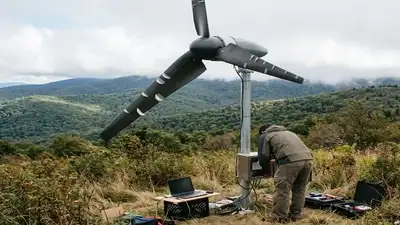
AI-generated representative image showing aerodynamic blade deflectors fitted to a small wind turbine prototype during outdoor testing. Credits – Gemini
Rutgers University engineers in New Jersey took up that question in a project whose final report was published in 2015. The team’s target was a 10% gain in power when the deflectors were added to new or existing turbines, according to the project summary . Rutgers said a 1 MW turbine could rise from about $90,000 a year to $126,000, and early water-channel tests showed power increases of 8% to 12%.
Arturo Villegas oversaw the project, which Rutgers CAIT, the university’s transportation and infrastructure research division, ran with funding through the US Department of Transportation’s University Transportation Centres program. His group created aerodynamic flow deflectors, small, slightly curved fins attached to turbine blades.
They fastened fine silk threads to the blades of a miniature turbine, recorded them with a high-speed camera and saw that the airflow tilts by about 5 to 20 degrees. Two identical 3D-printed turbines, each about 0.4 meters across, were tested at wind speeds from 3 to 6 meters per second, one with deflectors and one without. The team transported a Whisper 100 turbine to the Wind Application Centre at Appalachian State University on Beech Mountain, North Carolina, at an altitude of around 1,556 meters, where typical winds at 30 meters are approximately 7 meters per second. The final report, published by the US Department of Transportation , shows a 7.7% improvement in the average power coefficient over the entire curve. The best single point was at 8 metres per second, where the coefficient rose from 0.25 to 0.30, a 20% relative gain at that wind speed. The team itself proposes computer simulations and longer testing, first on turbines more than 10 meters across and then on full-scale machines over 100 meters, before anyone talks about commercial application.
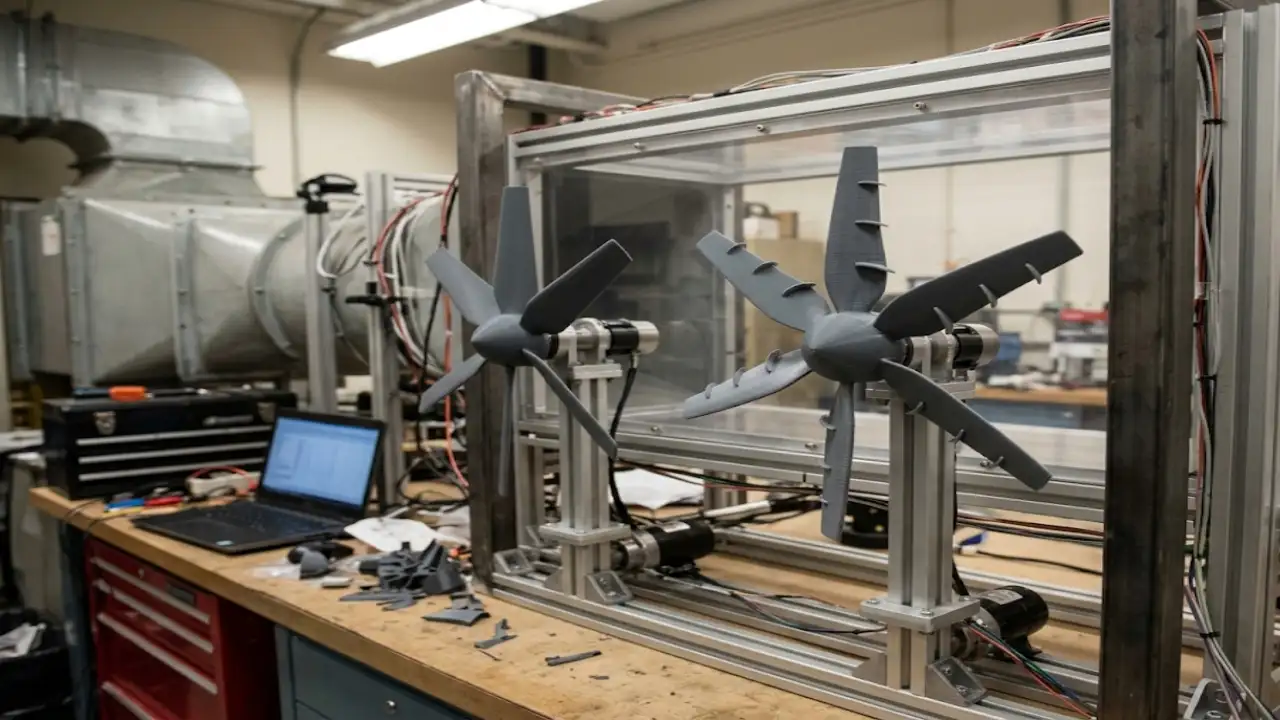
Because it took place in real weather, the second test was harder. Air doesn’t slide smoothly on a rotating blade. It also drifts sideways along it, from the root towards the tip. Conventional design views such drift as a loss. But the Rutgers team didn’t see it that way. Their idea was to capture that sideways flow with a narrow, winglike deflector and convert it into more torque, the twisting force that drives the generator. The first took place in the wind tunnel at Rutgers. It ran as is for two weeks. Then the team lowered the turbine tower and added the deflectors, and it ran for another two weeks. AI-generated representative image showing miniature wind turbine models, with and without aerodynamic blade deflectors, arranged for a wind-tunnel performance test. Credits – Gemini The limitations matter too. So far, only two experiments have been carried out, one on a small model and one on a small turbine. And it advises that a poorly formed or badly located deflector can actually decrease power rather than increase it.
The power coefficient measures how much of the wind’s available power a turbine extracts.