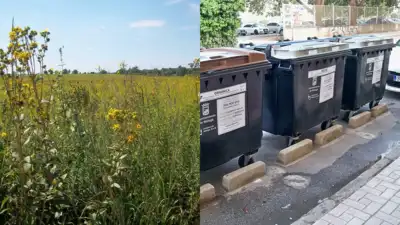
Native prairie grasses grew more successfully in plots that were treated with high doses of a processed household-waste by-product | Wikimedia Commons
When it came to soil chemistry, phosphorus and lead concentrations increased in the upper 10 centimetres of soil at the highest application rates where the material had been mixed in. The research was published in Communications in Soil Science and Plant Analysis in 2010, and its authors included researchers from the US Army Engineer Research and Development Center, the US Department of Agriculture’s Agricultural Research Service and the University of Illinois. The authors reported few environmental effects during the trial and concluded that the material improved the establishment of perennial grass and plant nutrition at the highest rate.
It is important to note that the study does not infer that every processed household-waste product would be suitable for every restoration site, or that the same application rate would be safe under all soil conditions. The Fort Campbell trial found that processed household waste could help native grasses establish on disturbed land, particularly at the highest rate tested, but also cautioned that the results could not be universally applied. The increase in soil lead and phosphorus also means that any wider use would require testing of the material and the receiving soil, as researchers would need to consider nutrient needs, soil chemistry, and the possibility of contaminants accumulating before applying the approach at other sites. The study supports further investigation of processed organic waste as a soil amendment, and its findings are specific to the product, site, and conditions tested over two growing seasons.