
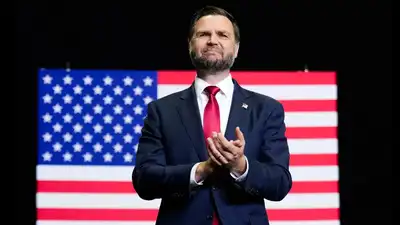
File photo: US Vice President JD Vance (Picture credit: AP)
TOI correspondent from Washington: US Vice President JD Vance has conceded that his rhetoric on H-1B visas was “imperfect,” but his attempt to distinguish his criticism of corporate hiring practices from hostility towards immigrants has exposed a deeper contradiction in the Trump administration’s immigration politics, one that is becoming personal for a man married to the daughter of Indian immigrants. “To the extent that my rhetoric has been imperfect, that’s on me,” Vance replied, insisting his target was not foreign workers but companies exploiting the visa system, and adding that he loved his Indian-American wife and in-laws and did not intend to dehumanise immigrants. At a CBS News town hall over the weekend, an Indian-American woman who voted for Vance asked him why he is scapegoating immigrants for the issues he was supposed to be solving.
Earlier reporting noted: “If you are working as an H-1B visa in the United States of America, you are earning $20,000 less than an American citizen hired in the same position. If you were brought in by one of these foreign outsourcing firms, you are making $48,000 less than an American citizen in a similar position,” the vice president said.
Earlier reporting noted: ‘That’s on me’: Rebuked by India, JD Vance walks back ‘indentured servants’ remarks over H-1B workers Washigton DC: Following strong criticism from India over the language used to describe Indian professionals working in the United States, US Vice President JD Vance has acknowledged that his description of H-1B visa workers as “indentured servants” was poorly worded. Yet Vance stood by his larger argument: Americans are entitled to want communities with people who share something in common, immigration policy should promote social cohesion, and there is a legitimate case for scrutinising employers who exploit visa-dependent workers, suppress wages, or replace American employees while continuing to recruit abroad.
Earlier reporting noted: He also accused companies of replacing American workers with foreign employees brought into the country through the visa programme.
Abdul El-Sayed, the Egyptian-American Democrat running for the Senate in Michigan, whose spouse is also Indian-American, argues that Vance cannot champion a privileged status for the “heritage American” by invoking his white “papaw,” while expecting his own wife and children to be exempt from the implications of that worldview. Over the weekend, Vance further inflamed the debate by blaming “Western liberals” for “importing the third world into France and other countries in the name of diversity and compassion” without adequately addressing assimilation and cultural compatibility, while warning Americans to learn from the resulting unrest. “Didn’t you marry someone from the 3rd world though?” one troll clapped back. Critics also cite Vance’s defence of a DOGE staffer associated with the call to “normalise Indian hate” as evidence that he has not adequately confronted racism within his political camp. Meanwhile, in a related development, Democratic Congressman Raja Krishnamoorthi has drawn attention the debate on right-wing social media on the so-called “Indian Question,” and warned about its implications for Indian-Americans. The phrase evokes the historical “Jewish question” through which European antisemites portrayed Jewish existence as a problem to be solved.
But critics say Vance’s language has blurred the distinction between corporate practices that merit investigation and foreign professionals cast as threats to American workers. In fact, Microsoft, the tech giant Vance accused of laying off American workers in favour of H1Bs, has implicitly suggested Vance mischaracterised data, countering that most of its H-1B applications involved extensions or changes of status for existing employees, not new recruitment. Microsoft also argued that access to international talent was essential to its competitiveness in artificial intelligence and other advanced technologies, the very reason the company’s CEO Satya Nadella was honoured by President Trump at the White House the same day Vance lashed out at it. the controversy is becoming increasingly personal for a man positioning himself to run for the White House While the US vice president has been unrelenting in his attacks on tech companies like Microsoft. Vance’s wife, Usha, is the US-born daughter of Indian immigrants, and their children, Ewan Blaine, Vivek, Mirabel Rose, and Alec Neel, have mixed heritage. Votaries of a multicultural America argue his insistence on cultural commonality sits uneasily with the identity of his own family. “Multiculturalism works beautifully at his dinner table but suddenly becomes a national crisis at the border? Fascinating,” one online critic quipped about the bind Vance has put himself in. In fact, Vance is facing a backlash both left and right. Far-right extremists, including white nationalist Nick Fuentes, have targeted Usha’s Indian heritage and questioned Vance’s marriage. The comparison is not that the two situations are identical, but that framing an ethnic community’s belonging as a national problem can legitimise exclusion and persecution. For India, the Vance episode is testing the durability of a relationship built partly on technology, trade and the Indian-American community’s role as a bridge between the two countries. Vance himself faces a political trap: he wants to argue that his target is corporate exploitation, not Indian workers, while some of his most vocal supporters see Indian ancestry itself as a reason to question belonging. You use AI every day. Now get your AI Quotient. Take the AIQ test.
the electoral cost of anti-immigrant rhetoric remains uncertain While the 2026 midterms are expected to be dominated by economic concerns.