
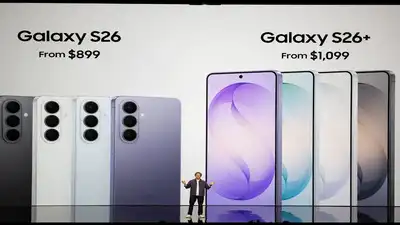
Mason Page from Samsung Electronics’ Product Marketing participates in the presentation of the Galaxy S26 smartphones in San Francisco, California, U.S.
India’s smartphone market shipments are estimated to have declined 26% year-on-year (YoY) to 35.8 million units in third quarter of 2026, marking their lowest third-quarter shipment volume since 2016 despite the start of the festive season, according to an Omdia report. This has disproportionately affected Chinese OEMs, whose combined market share fell to approximately 68% in 3Q26 from 75% in 3Q25. “Following a tough 2026, India’s smartphone market is expected to decline by a further low-single-digit percentage in 2027, testing vendors’ ability to revive replacement demand as higher prices and longer device lifecycles become structural challenges. Vivo slipped to second place with shipments of 6.4 million units, down 34% YoY, the sharpest decline among the top five. Oppo ranked third with shipments of 4.9 million units, down 24% YoY, as rising prices and cautious retailer stocking weighed on its core A-series volumes. Xiaomi ranked fourth with shipments of 4.7 million units, down 28% YoY, as rising component costs forced trade-offs in pricing and RAM/storage configurations, weakening its traditional value proposition. The Redmi 15A and A7 supported shipment volumes, while the Redmi Note 17 series, POCO X8 and X8 Power contributed to its higher-value portfolio.
“India’s smartphone market is shifting from online-led shipment expansion during the festive period to more selective, channel-driven growth, challenging vendors’ traditional volume strategies,” said Sanyam Chaurasia, principal analyst at Omdia. Nearly four in ten respondents in India say useful AI capabilities could make them willing to pay more for a smartphone, according to Omdia’s User Innovation Readiness research. As per Omdia Smartphone Market Pulse 3Q26, “Higher smartphone prices and cautious consumer spending weighed on replacement demand, prompting vendors to adopt conservative inventory strategies. Weakening online-focused shipments added to the pressure, while the later timing of Diwali amplified the quarterly contraction by shifting a significant portion of offline festive inventory build-up from September into October. Fewer exclusive launches, limited affordable SKUs and narrowing promotional differences reduced the online channel’s traditional festive advantage. In contrast, Samsung and Apple strengthened their positions through premium portfolios, strong consumer demand, established channel partnerships and structured upgrade programs. Pricing pressures are likely to persist through at least 1H27, making compelling device experiences increasingly important in driving upgrades. As premiumization continues, vendors must move beyond incremental hardware improvements toward AI-led experiences that evolve from basic assistance to more proactive, personalized capabilities. Stronger channel partnerships, financing, trade-in and upgrade programs will be equally important in translating these innovations into purchases and reducing barriers to replacement,” concluded Chaurasia. Repeated price hikes disrupted channel inventory planning, while constrained entry-level supplies weakened competitiveness. Shipments were mainly supported by the Y11 5G and Y21 5G, while the returning S-series, led by the S2, also contributed to volumes. The Reno16 series supported its premiumization strategy, with camera-led differentiation and financing offers helping sustain demand at higher price points.
“September, historically a critical inventory build-up period for major online sales events, saw weaker shipment momentum.