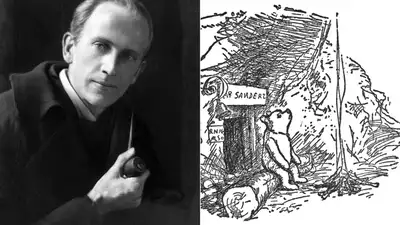
Milne is pictured on the left, alongside an illustration by Ernest Howard Shepard from Winnie-the-Pooh (1926) on the right. A. A. Image credits: Wikimedia Commons
The archive’s reported total was £95,000, according to BBC reporting. It is worth noting that the figure should be distinguished from the £87,470 combined result reported by ITV for the 28 lots specifically related to Winnie-the-Pooh . Among the individual sales, a group of printers’ proofs and annotated material connected to The House at Pooh Corner and Now We Are Six fetched £18,000, while a draft manuscript for The Christopher Robin Birthday Book sold for £9,500. The auction house’s published results confirm those individual prices and state that the overall total, after calculating the standard 26.3% buyer’s premium on top of the £95,000 hammer price, reached £120,000.
The director of Fieldings, Will Farmer, told the BBC that about two-thirds of the collection would stay in the United Kingdom while the rest of the collection would go to collectors from America. The outcome surpassed his expectations, according to Simon Smith. In an article in the Guardian before the auction, Simon Smith said that he was planning to use the money raised from the sale for research on Milne’s work.
The collection had caught the attention of buyers from both Britain and the United States.
In January 2025, a collection of previously unseen letters, manuscripts and illustrations connected to Winnie-the-Pooh creator A.A. Milne sold at auction for £95,000, bringing renewed attention to documents that had remained among a publisher’s private papers for decades. The archive was found by Simon Smith while he was sorting through the attic of his late father, Leslie Smith, who passed away in November 2023. The auction was held almost 97 years after the letter was written, even though the papers were discovered in 2023. The auction house divided the archive into 34 lots for its January 16, 2025, sale.
Among the papers was a letter dated March 28, 1928, where Milne jokingly defended Pooh in response to an article in which a newspaper called the bear a “fabulous monster”. The collection consisted of original manuscripts, sketches, proof sheets and correspondence intended for the original publisher Methuen & Co., but which eventually ended up in the archives of later publisher Frederick Muller. The discovery was made by Simon Smith, who found the materials among the possessions of his father in Malvern, Worcestershire, England. Some other letters describe the nitty-gritty of the book illustrations. For instance, Milne was reportedly dissatisfied with some of Shepard’s illustrations and wanted them to be changed. In particular, he reportedly wrote to Muller saying, “The illustrator must do new drawings for April and September as the originals are very poor. Such letters, together with the drafts and corrected proofs, help understand how the author, illustrator, and the publisher worked out the final results. Following the discovery, Simon Smith took the archive to Fieldings Auctioneers in Stourbridge, England. Clive Farahar, an expert on books who is well known for his work on the BBC show Antiques Roadshow, helped to value the items. Its catalogue described the collection as material from the estate of Frederick Muller that had passed down through subsequent ownership.