
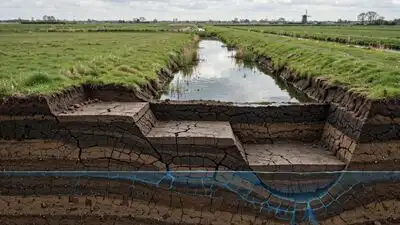
PC: AI Generated
Peat soils in the Netherlands sank by an average of 0.7 centimetres a year over 50 years, according to measurements taken at 29 sites across seven locations. Researchers measured soil surface subsidence and changes at different depths over 50 years using levelling and subsidence plates. The study covered 29 sites across seven locations in the Netherlands. Over the measurement period, the soil surface at these sites dropped by an average of 0.7 centimetres per year. These layers extended to less than 0.8 metres below the soil surface. The study found that average subsidence rates during 1970-1990 were higher than those recorded between 1990 and 2024. Across the 29 measurement sites, the soil surface had dropped by an average of 0.7 centimetres a year over the 50 years.
According to a study published in the Netherlands Journal of Geosciences titled “ The relationship between ditch water level and peat subsidence: 50 years of measurements with levelling and subsidence plates in the Netherlands ”, subsidence rates were higher between 1970 and 1990 than between 1990 and 2024. Researchers tracked changes in the land surface and measured subsidence at different depths to understand how the soil had shifted over time. The results showed a significant relationship between ditch water levels and the rate at which the land surface sank. About two-thirds of the subsidence occurred in soil layers where oxygen could reach, while the remaining third occurred in layers that stayed saturated with water. The researchers also found a significant relationship between measured ditch water levels and the rate of soil surface subsidence. Deeper drainage of peat soils is associated with increased surface subsidence. The measurements allowed researchers to examine the contribution of different soil layers to the overall decline. However, subsidence rates varied considerably between sites, showing that site-specific conditions had a substantial influence on the amount of land surface subsidence. Subsidence plates installed at different depths helped researchers compare how individual soil layers contributed to the decline in the land surface. The measurements showed that about two-thirds of the subsidence occurred in layers where oxygen could penetrate. Oxidation and shrinkage were the most important subsidence processes in these layers. The findings identified these oxygen-accessible layers as the main contributors to the measured decline. The study also recorded subsidence in soil layers that remained saturated. These deeper layers accounted for the remaining third of ground-level subsidence, showing that changes in the soil profile were not limited to layers where oxygen could penetrate. The researchers found that one-third of ground-level subsidence occurred in soil layers that remained saturated. In these layers, consolidation and creep were the main processes responsible for subsidence, with a contribution from anaerobic decomposition. The findings showed that subsidence continued even in soil layers that were always saturated. By installing subsidence plates at different depths, researchers could compare changes throughout the soil profile and identify the contribution of individual layers to the overall decline. The measurements provided a clearer picture of the processes associated with peat subsidence. However, the researchers recorded substantial differences between sites, highlighting the influence of local conditions on subsidence rates. The findings also identified three requirements for monitoring peat subsidence in the Netherlands and elsewhere. Monitoring needs to continue over the long term, measurements need to cover different soil depths, and multiple sites must be included. You use AI every day. Now get your AI Quotient. Take the AIQ test.