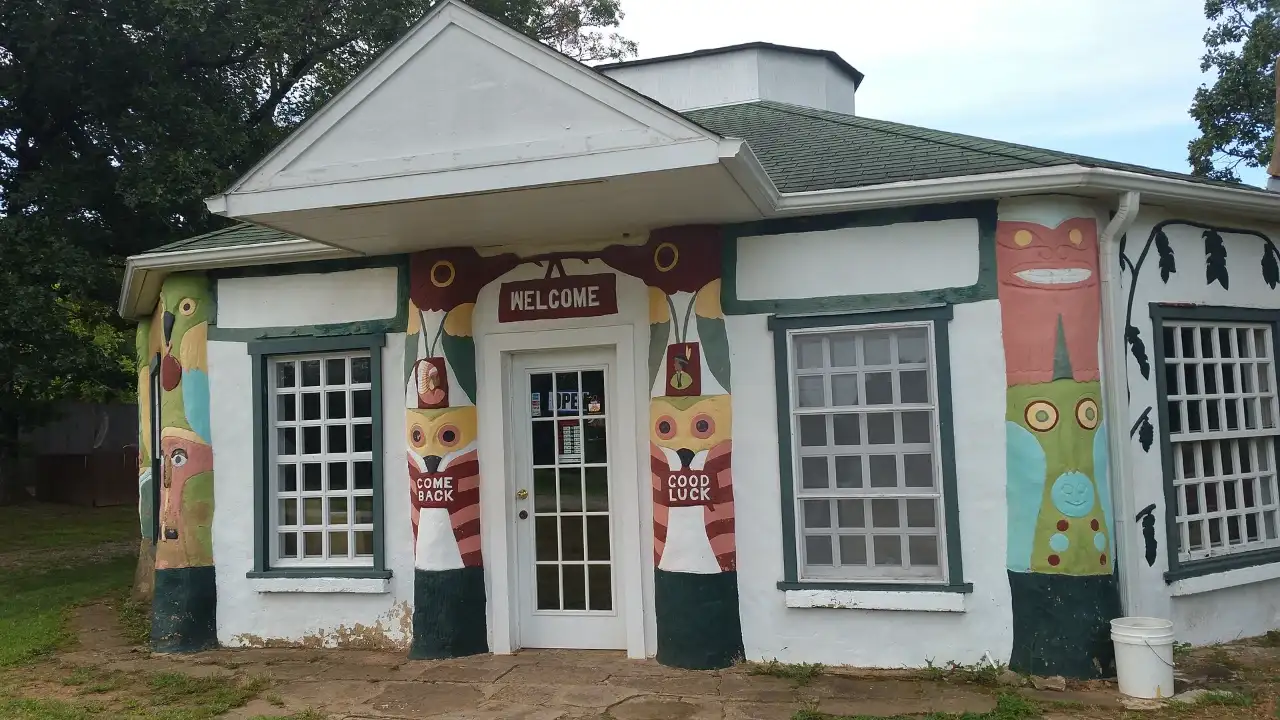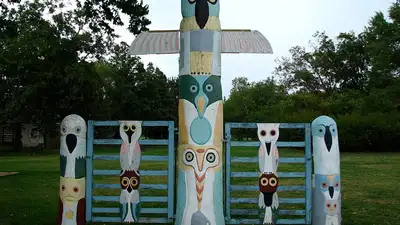
The main totem pole stands among the concrete sculptures at Ed Galloway’s Totem Pole Park. Image credits: Wikimedia Commons
Ed Galloway’s Totem Pole Park sits on Oklahoma State Highway 28A, east of town and near Route 66, the historic road connecting Claremore and Tulsa. Ed Galloway’s move to the Foyil farm The National Park Service states that Galloway was born in 1880 in Springfield, Missouri and later worked at Sand Springs Home, where he taught manual arts to orphaned boys. The National Park Service page on Ed Galloway’s Totem Pole Park , a National Register of Historic Places entry , records that he retired to that property in 1937.
Foyil is a small town in Rogers County, in northeastern Oklahoma. Travelers who took the turnoff found themselves on a farm that looked quite different from the surrounding fields and grassland. A group of painted concrete sculptures stands on the land, including a totem pole that towers over the surrounding trees. After his retirement to a farm that he and his wife had been cultivating for years, he undertook a project that would consume the rest of his life. He purchased the property near Foyil along with his wife, Villie, in the early 1920s, as explained in the Rogers County Historical Society biography of his life. The Spaces Archives notes that Galloway began creating large sculptures from tree trunks, incorporating human figures, fish and reptiles into the carvings. One of those early trunk pieces, shown in the archive photographs reproduced in the NPS paper Restoration of Ed Galloway’s Totem Pole Park , sits on the back of a turtle. The paper notes that Galloway later reused that turtle motif for the tall concrete pole. The paper gives the larger context behind that detail, noting that the trunk sculpture appears in an archive postcard and that the turtle base became a recurring structural idea in Galloway’s later concrete work.
An eleven-year build from 1937 to 1948 using 28 tons of cement According to Legends of America, Galloway erected the pole in eleven years between 1937 and 1948, using 28 tons of cement, six tons of steel and 100 tons of sand and rock. The most common height of the pole is 90 feet, as claimed by the NPS web page and the Historical Society, although preservation literature offers lower measurements, such as 78 feet. More than 200 carved figures arranged toward the four directions The restoration paper talks about more than two hundred hand-carved bas-relief animals and portrait busts on the pole. Decline after Galloway’s death The date of death varies between sources, with the NPS citing 1961 and the restoration paper citing 1962. Restoration work of the park started in the early 1980s under the Kansas Grassroots Art Association, while NPS cites 1988 through 1998 as the period for major restoration work, according to the restoration paper. Ed Galloway’s Totem Pole Park preserves a collection of concrete and stone folk-art sculptures near Route 66 in Rogers County, Oklahoma. Image credits: Wikimedia Commons By around 1989, ownership of the park had passed to the Rogers County Historical Society, according to the society’s information on the Totem Pole Park website. The landmark was added to the National Register of Historic Places in 1999.
The hollow pole stands on a sandstone formation, which was found at the site of the pole and which Galloway sculpted into a turtle due to its resemblance to one, according to Oklahoma Magazine. Because it was resistant to water and algae and did not peel or fade, silicate paint was used.
The pole passes through nine stories, with the ground story being nine feet wide, according to the NPS web page. The NPS page says that the sculptures usually depict birds and figures of Northwest Coast, Alaska and Plains cultures. The NPS page says that Galloway used postcards and National Geographic magazines as his source material for the faces and symbols that he carved onto the wet concrete and then painted. The Foyil Heritage Society is also involved in fundraising and groundskeeping, according to Legends of America. It is the oldest and largest folk art environment in Oklahoma, according to the page on the NPS website. The eleven-sided Fiddle House is where Galloway showcased his handcrafted fiddles and furniture, according to the Legends of America.
It also places the piece within his early wood-carving period, before he shifted to the massive concrete totem that rose over the sandstone outcrop. Its height is also inconsistent. There are four nine-foot-high portraits at the top of the pole; these include portraits of Quanah Parker, Sitting Bull, Geronimo and Chief Joseph. The decorations are generally oriented towards the four cardinal directions. His source material was quite mundane. The park started deteriorating after that time. Maintenance arrangements under the society continued to change into the early 1990s. Mineral silicate paint applied in two layers during the restoration Restoration paper by the National Park Service shows that the restoration of the deteriorated paint of the poles was done through the use of mineral silicate paint. The upper part of the pole received painting in two layers, while the bottom twenty-five feet was left for a later phase of work. There are fourteen other concrete sculptures around the main pole, including the bird gateposts, totem picnic tables and fish-shaped arch. You use AI every day. Now get your AI Quotient. Take the AIQ test.