
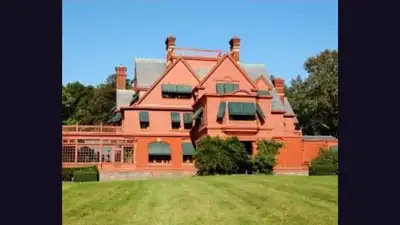
PC: National Park Service
In 1886, Thomas Edison purchased Glenmont, a 15-acre estate in New Jersey’s Llewellyn Park, as a home for his new wife, Mina Miller. More than a century later, the property remains distinct within the private residential community, which spans 420 acres and contains more than 170 private homes. Built in 1880, the estate later became a family home and is now preserved alongside Edison’s laboratory as part of Thomas Edison National Historical Park. Its layout also incorporated a 50-acre preserved woodland known as The Ramble, intended for the shared enjoyment of residents. Visitors initially needed calling cards to enter through the main gate, although the requirement was relaxed in 1873 to allow respectable strangers and visitors to enter without one. Glenmont was also linked to Edison’s nearby laboratory: the house was wired for electricity in 1887, and underground wires were installed to connect it to the laboratory. Edison died at Glenmont on 18 October 1931, while Mina continued to live there until she died in 1947. In 1963, at the family’s request, their remains were moved from Rosedale Cemetery in Orange to the Glenmont estate. Its 15-acre grounds form part of the 420-acre Llewellyn Park, where it remains the only home owned by the National Park Service.
Therefore, document Glenmont as both the former home of the Edison family and a property preserved within a private residential community.
Glenmont is the only home in the community owned by the agency, according to the National Park Service (NPS). Its history also reflects the household and family life of one of America’s best-known inventors Glenmont is situated within Llewellyn Park, a private residential community that was marketed as “Country Homes for City People” in 1857. The community was designed as a country retreat for intellectuals and businessmen, with large residential plots and winding roads, according to the NPS.
These features formed part of the community’s original design and distinguished it as a planned residential development. The community’s early rules governed both its buildings and access to the grounds. The NPS audio tour explains that the original deed prohibited properties from being used as a hotel, slaughterhouse, brewery, distillery or hat factory. The NPS states that Llewellyn Park remains a private residential community, governed by its deed of trust and managed by a committee of managers elected by the proprietors. The grounds also contained facilities that supported the household, including a garage, barn, greenhouse, potting shed and gardens. The family grew fruits and vegetables and kept chickens and cows, although the estate was not completely self-sufficient.