
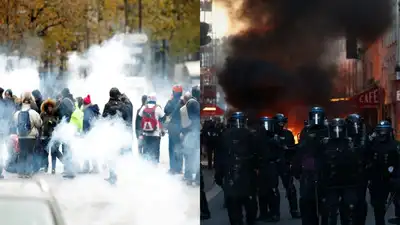
France is witnessing widespread protests over rising living costs, wages and education funding, prompting authorities to tighten security amid fears of renewed violence
Hundreds arrested
Before the protests began, interior Minister Laurent Nuñez had said that up to 70,000 officers would be deployed nationwide, supported by helicopters, armoured vehicles and water cannons. These massive security arrangements came in the backdrop of last weekend when around 3,000 shops across France were damaged or looted during last weekend’s unrest. French police arrested 135 people in connection with protests and seized various weapons, French iterior minister Laurent Nuñez said, as authorities stepped up security amid fears of renewed violence. At Bastille, the original starting point, police used a megaphone to instruct people to leave or face a 135-euro fine. Thousands of people marched in Orléans, about 110 kilometres (70 miles) south of Paris to protest against the far right. Student groups are demanding 250,000 additional higher-education places and an end to selection through Parcoursup, France’s national university admissions system. Their joint 10-point plan also calls for more teachers and repairs to schools and universities. Students are seeking additional financial support, including an extra 200 euros a month in student grants and a rent freeze in public student housing. The demonstrations have added to pressure on Macron during the final stretch of his current presidency, with his popularity at its lowest since he took office in 2017. Italy deployed an additional 500 soldiers to Milan ahead of fresh protests on Saturday, a week after looting and clashes with police. Around 5,000 police and other law enforcement personnel were expected to support security operations in the city. More than 300 people, including police officers, have been injured since the protests began, according to AFP.
However, they called for protests to continue until concrete measures were formally announced. The deployment, announced by Premier Giorgia Meloni, came alongside tighter security measures, including drone surveillance, railway station checks and rapid-response units.
“The money is now concentrated in the hands of very few people,” said Victoria Ambrosini, an art critic and art teacher at Saint-Denis University. Authorities restricted a major march in Paris to the city’s southeastern edge, closed prominent museums and banned demonstrations in several cities to prevent a repeat of last weekend’s violence. Security was tightened in Paris and other major cities after more than half a million people took to the streets the previous Saturday. He offered to resign, but President Emmanuel Macron refused. The route restrictions were imposed to keep demonstrators away from central areas affected by last weekend’s violence. Paris police ordered a union-organised march to be moved at the last minute from central Bastille to Porte d’Italie on the capital’s southeastern outskirts. Unions reluctantly agreed to the change, while the Yellow Vests, the protest movement that staged disruptive demonstrations against Macron eight years ago, indicated they would defy the order. The Grand Palais is hosting a major Cézanne exhibition. Protest marches were scheduled in Paris and Marseille, while local authorities banned some rallies in Lyon, Nice and Montpellier. Trade unions criticised the bans, describing them as violations of freedom of expression, a right protected by the French constitution. The restrictions came as authorities sought to prevent a repeat of last weekend’s violence, which saw masked groups target businesses and public buildings across the country. The demonstration took place alongside a two-day congress of Marine Le Pen’s National Rally party ahead of next spring’s presidential election. The rally added to a day of demonstrations across France, where public anger over living costs and public services has increasingly intersected with political tensions. The protests began last month over staff shortages at a high school southeast of Paris but have since expanded into a broader movement over living standards. Workers and unions are demanding higher wages and pensions to help households cope with rising costs. “And it’s not possible anymore. The government has defended restrictions on demonstrations as necessary to protect city centres, businesses and public buildings, as France faces mounting anger over living costs and public services. In Rome, authorities tightened security around luxury shopping streets and major public spaces ahead of planned demonstrations, including an anti-war march and a rally by right-wing students. Protests were also scheduled in several other Italian cities amid concerns over possible violence. Demonstrators have demanded better education facilities, lower tuition fees and action against corruption, while also calling for the resignation of Prime Minister Edi Rama. organisers urged students and other groups to join the latest rally Although tensions had eased in recent days. Meanwhile, thousands of retirees and supporters marched in Spain capital to demand protection for public pensions ahead of next month’s snap election. In Lisbon, protesters prepared to march for affordable housing, opposing government measures they say could leave tenants more vulnerable to rent increases and eviction. You use AI every day. Now get your AI Quotient. Take the AIQ test.
France mobilised a massive security force on Saturday as protests over school funding, wages and soaring living costs spread across the country, a week after violent unrest left shops looted, cars burned and public buildings damaged. Nuñez acknowledged on Monday that police had lost control in some cities during the violence. Paris police changed the route of a union-organised march on Friday, replacing the planned Bastille-to-Nation route with one between Porte d’Italie and Porte de Vincennes on the capital’s southeastern edge, reported AP. Major Paris landmarks, including the Louvre, Orsay Museum, Picasso Museum and Grand Palais, were closed on Saturday amid security concerns. French media reported that police used tear gas in Lyon on Saturday morning to disperse demonstrators. Macron met high school representatives on Friday, who said he had promised to overhaul the university admissions system. In Albania, student-led protesters planned a fresh anti-government rally in the capital, Tirana, on Saturday after days of violent unrest.
Near Saint-Lazare train station, contractor Akram Ahmed, 34, was securing an optician’s shop on Saturday. Because of the threat of unrest, art Basel, a prominent contemporary art fair, opened to the public on Friday but cancelled its weekend programme.
“I got the call last night,” he said. He said I was saving his life.” Shopkeepers across Paris also boarded up storefronts ahead of the demonstrations. “The owner seemed desperate.