
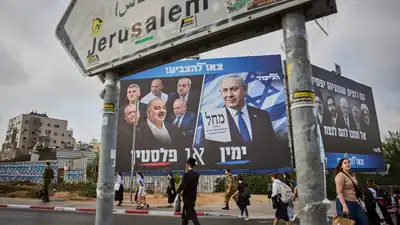
People walk past a Likud party campaign billboard featuring Israeli Prime Minister Benjamin Netanyahu alongside opposition party leaders and bearing the Hebrew slogan “Right or Palestine,” ahead of Israel’s general election, in Beni Brak, Israel (AP Photo)
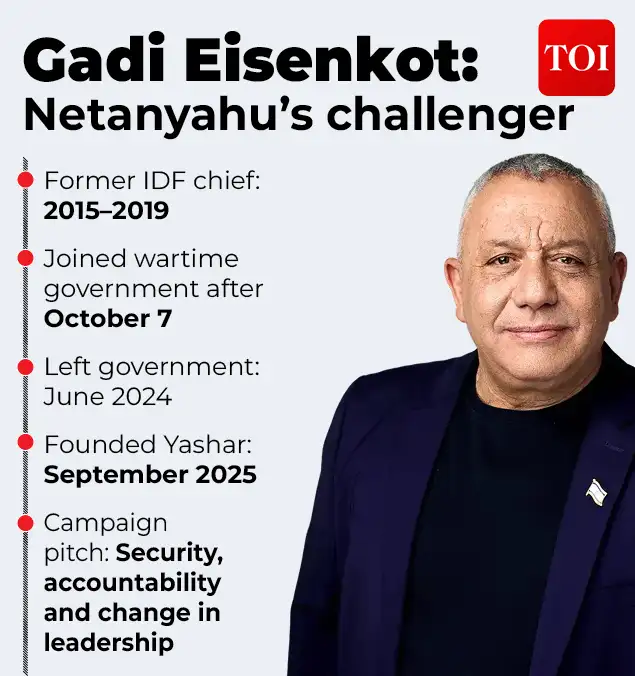
Three years after the October 7 attack, Benjamin Netanyahu faces a crucial electoral test over security, political accountability and the direction of Israel. Israelis vote on Tuesday, October 27, in the country’s first general election since Hamas’s October 7, 2023, terrorist attack. Yet neither the prime minister’s coalition nor the main opposition bloc is projected to secure the 61 seats needed for a majority in the 120-member Knesset. Yashar was projected to win around 22-23 seats, against 19-21 for Likud. Netanyahu’s coalition was projected at about 50 seats, while the main opposition bloc was estimated at 52-56. Arab-led parties could win another 14-16 seats. He served as military chief from 2015 to 2019 and joined the wartime government formed after the October 7 attack. He left the government in June 2024, arguing that political considerations were influencing decisions on the war. He subsequently broke with Benny Gantz and established Yashar in September 2025. His criticism centres on Netanyahu’s handling of the war, the failures that preceded October 7 and the government’s domestic agenda. The October 7 attack remains the defining test of Netanyahu’s leadership. Netanyahu has beaten unfavourable surveys before, including in 2015, when the final polling picture underestimated his eventual performance. Smaller parties could also alter the balance if they unexpectedly cross or fail to cross the 3.25% threshold required to enter the Knesset. Israel’s next government will have to manage the confrontation with Iran, maintain its relationship with Washington, address the aftermath of the Gaza war and respond to questions about the security failures that preceded October 7. For Netanyahu, Tuesday’s vote is a test of whether his security-first strategy can survive the failures of October 7 and the consequences of the wars that followed.
Because his opponents cannot agree on a replacement, netanyahu could therefore survive even if his coalition falls short of a majority, simply.
Sharma said countering Iran’s nuclear ambitions and regional influence, maintaining military superiority and preserving the US-Israel strategic partnership would remain central priorities under any government. “An opposition victory would therefore be more likely to change Israel’s diplomatic style and regional engagement than fundamentally alter its strategic orientation,” Sharma said. Donald Trump’s endorsement and the unresolved confrontation with Iran have raised the stakes, but a divided opposition may struggle to turn its challenge into power. The outcome could determine whether Bibi, Israel’s longest-serving prime minister, extends his political career or loses power after three years of war and domestic turmoil. The final opinion polls suggest a close contest. These are projections, not results. But they point to the central question of the election: can Netanyahu survive the verdict on his leadership and can his opponents agree on an alternative? Eisenkot, a former chief of the Israel Defence Forces (IDF), has emerged as Netanyahu’s principal challenger. Eisenkot’s appeal rests on military experience, greater accountability and the argument that Israel needs a change of leadership without abandoning its security priorities. He is not a conventional left-wing challenger. Like several other opposition figures, he takes a hard line on Hamas and argues that Israel needs more effective security leadership. This distinction matters. The election is not a straightforward contest between hawkish and dovish approaches. Many of Netanyahu’s opponents argue that his decisions have weakened Israel’s security rather than strengthened it. The final polls are not guarantees. If no candidate can assemble a viable majority, Israel could face another election. Netanyahu would remain caretaker prime minister in the interim, leaving the country with many of the same unresolved questions. The consequences would extend beyond domestic politics. Those challenges will remain regardless of who wins. An opposition victory, however, would not necessarily mean a fundamental change in Israel’s security and foreign policy. He also expects Israel’s strategic relationship with India to remain largely unaffected by a change of leadership, given the established cooperation in defence technology, cybersecurity, intelligence and emerging technologies. An opposition government could place greater emphasis on diplomatic coordination with Washington, European partners and regional states, but the broader strategic direction would likely remain intact. For Eisenkot and the opposition, the challenge is to convert dissatisfaction with the prime minister into a stable governing majority. Trump’s endorsement and the Iran confrontation have given Netanyahu a powerful argument for continuity. But they have also exposed the limits of his control: Israeli military decisions remain tied to American calculations, while the costs of prolonged conflict continue to shape domestic politics.
Surveys published by Israel’s three major television networks on Friday put Gadi Eisenkot’s Yashar party ahead of Netanyahu’s Likud.
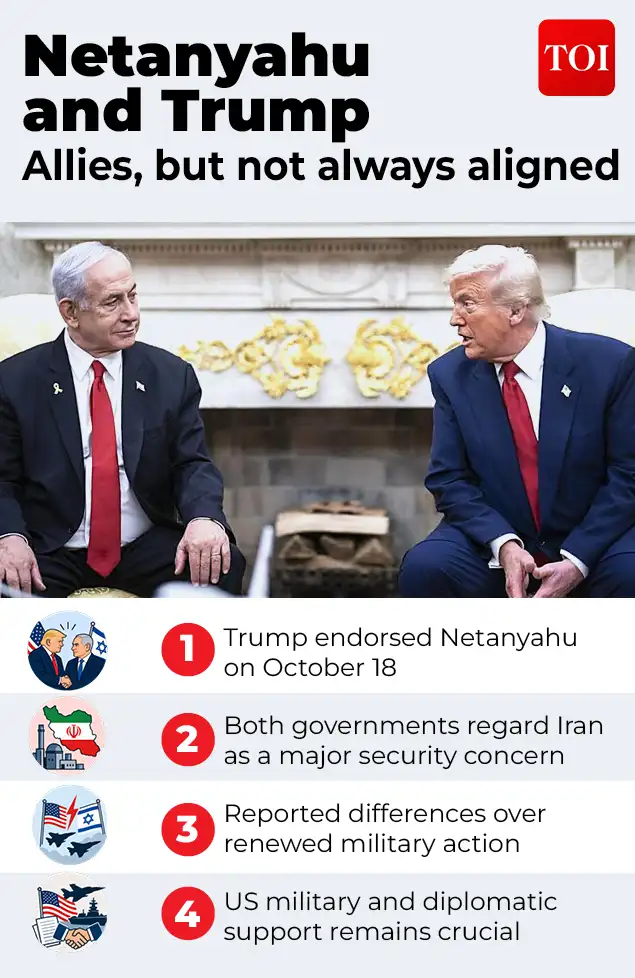
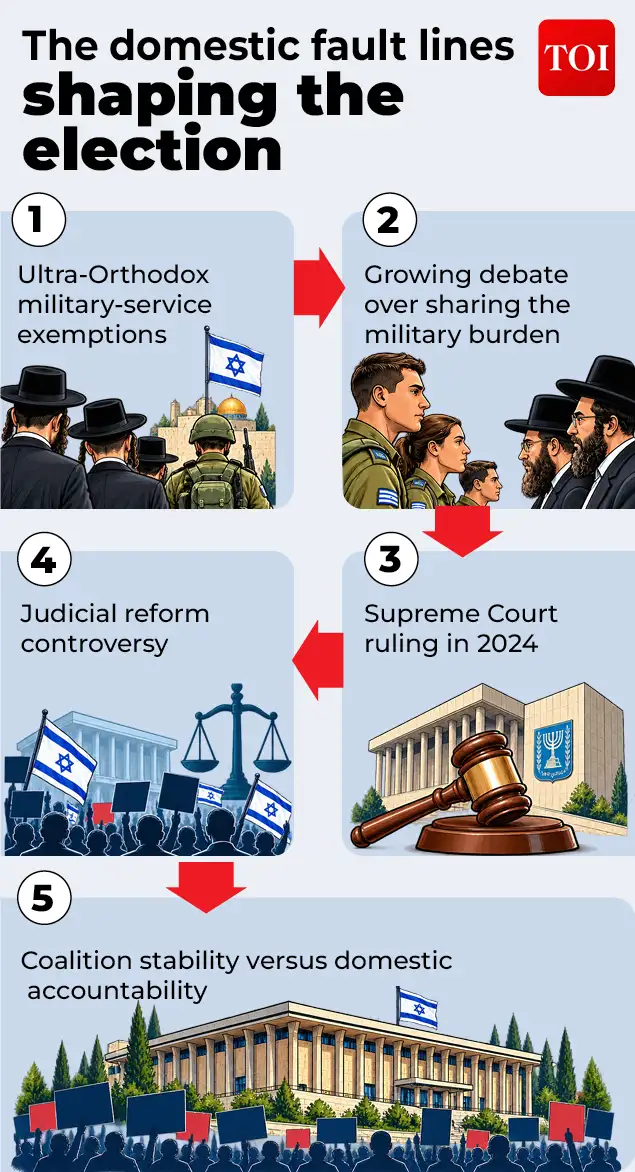
Hamas-led militants killed about 1,200 people in southern Israel and took 251 hostages, according to Israeli figures. In November 2025, he asked President Isaac Herzog for a pardon without admitting guilt, following public pressure from Trump. Dr Ashok Sharma, a visiting fellow at the University of New South Wales in Canberra, said the October 7 attacks had damaged Netanyahu’s reputation as Israel’s most experienced security-oriented leader. The election will test whether accountability for October 7 outweighs confidence in Netanyahu’s ability to confront continuing threats. Israel and the United States launched military operations against Iran on February 28, targeting its nuclear and military infrastructure. Citing people familiar with the plans, it reported that Netanyahu had instructed the Israeli military to prepare a major offensive against Iran for the weekend of October 10. The newspaper said Trump opposed restarting the fighting before the November 3 US midterm elections. On October 18, he publicly endorsed Netanyahu’s re-election, praising him as a strong leader and arguing that another prime minister might leave Washington to confront Iran alone. Israel’s Supreme Court ruled in 2024 that the broad legal basis for the exemptions could not continue as it had. Netanyahu’s government pursued controversial changes to the judicial system in 2023, prompting mass protests and warnings that the proposals would weaken checks on executive power.
The reported disagreement over a possible renewed offensive against Iran suggests that Washington’s calculations, including the US domestic political calendar, may not always align with Netanyahu’s military priorities.
In recent weeks, reports said he had advance warning from the UAE and Egypt that Hamas was planning an attack. “His supporters increasingly assess his leadership through Israel’s subsequent military campaigns against Hamas, Hezbollah and Iran,” Sharma said, adding that these operations had demonstrated Israel’s military capabilities and determination to confront regional threats. For conservative and nationalist voters, he said, security remains a priority. Sharma said the campaign had demonstrated Israel’s intelligence capabilities, technological superiority and ability to project military power. “Military achievements alone cannot guarantee lasting security,” he said, arguing that the campaign’s ultimate success would depend on whether military gains could be translated into sustainable deterrence, diplomatic arrangements and regional stability. Sharma said the endorsement strengthened Netanyahu’s image as an internationally experienced leader capable of maintaining Washington’s support. Sharma said the endorsement could consolidate Netanyahu’s support among conservative and security-conscious voters, but Israeli elections would still be shaped by domestic security, economic conditions and coalition politics.
The attack exposed major failures in intelligence, military preparedness and the government’s assessment of Hamas’s intentions. Netanyahu has emphasised the military campaigns that followed, presenting his government as determined to dismantle Hamas and confront threats from Iran and its regional allies. His critics argue that the attack happened under his watch and that the government has yet to provide an adequate account of how Israel’s security establishment failed to prevent it. Opposition parties and critics have demanded an independent state commission of inquiry. Netanyahu has resisted such an investigation, which could scrutinise decisions taken by his government as well as the military and intelligence services. He calls the claims libellous and is taking legal action against the outlets that published them. His personal legal troubles add another layer. Netanyahu is on trial on charges of bribery, fraud and breach of trust, which he denies. The trial remains a separate legal process. He is also subject to an International Criminal Court arrest warrant over alleged war crimes in Gaza, which he rejects. For his supporters, Netanyahu remains an experienced leader facing extraordinary security challenges. For his opponents, his political survival has become inseparable from questions of accountability. However, he cautioned against underestimating the prime minister’s political resilience. Security is Netanyahu’s central campaign argument, and Iran is where it has become most consequential. The conflict widened into a regional confrontation before a Pakistan-mediated process produced a ceasefire arrangement and a memorandum of understanding in June. The pause has not resolved the underlying disputes. Iran’s nuclear programme, sanctions and the Strait of Hormuz remain sources of tension, while pressure on Iranian ports and continuing regional uncertainty have kept the risk of renewed fighting alive. Netanyahu has presented the campaign against Iran as a strategic achievement, arguing that military action has weakened a major threat to Israel. He maintains that further action may be necessary to prevent Tehran from rebuilding its capabilities or pursuing a nuclear weapon. But the war also raises questions about its costs, its long-term results and whether military operations have delivered a sustainable outcome. However, he cautioned that Iran retained the capacity for asymmetric retaliation and could rebuild its military capabilities. The conflict has also highlighted Israel’s dependence on American military assistance, intelligence cooperation and diplomatic support. Sharma described this as a strategic partnership rather than simply a vulnerability, while noting that the long-term outcome would depend on how effectively Israel converts its military gains into lasting security. Netanyahu subsequently rejected the account as incorrect and biased. The episode highlights a central question for Israeli voters: how much freedom does Netanyahu have to pursue his preferred military strategy without American backing? The US is Israel’s most consequential international partner, providing military assistance and diplomatic support. Even when the two governments agree on the threat posed by Iran, they may differ over the timing and consequences of further attacks. For Netanyahu, the Iran campaign supports his longstanding argument that Israel needs a leader prepared to take decisive action. His opponents can counter that successive rounds of military escalation and ceasefires do not amount to a durable security strategy. A change of government would not necessarily bring a major shift in policy. Eisenkot and other opposition figures have also taken a hard line on Iran and have mostly attacked Netanyahu from the right, calling him soft on security. Hence, the difference may lie less in whether Israel regards Tehran as a threat than in how a new government chooses to manage it. Trump has made his preference clear. Netanyahu has used the endorsement to reinforce his claim that his personal relationship with Trump helps protect Israeli interests. He pointed to the wider record of US-Israel cooperation, including American recognition of Jerusalem as Israel’s capital and Israeli sovereignty over the Golan Heights, as well as the Abraham Accords. But the relationship is not unconditional. Netanyahu has disputed the reporting, but the broader tension remains relevant. Trump’s endorsement also allows Netanyahu to present the election as a choice between continuity in Israel’s relationship with Washington and a potentially less predictable alternative. Yet American support cannot by itself resolve his domestic difficulties or guarantee a parliamentary majority. Netanyahu has also used his campaign to portray his opponents as aligned with forces hostile to Israel. In August, he shared an image of a Likud campaign billboard featuring New York Mayor Zohran Mamdani alongside Iran’s Supreme Leader Mojtaba Khamenei, Turkish President Recep Tayyip Erdoğan and Hezbollah leader Naim Qassem. The message suggested that these figures wanted Netanyahu to lose and urged voters not to let them win. Mamdani, a vocal critic of Israel’s conduct in Gaza, has called Netanyahu a war criminal and urged the US government to enforce the International Criminal Court’s arrest warrant if he travelled to New York. The billboard illustrated Netanyahu’s attempt to frame the election as more than a domestic contest over governance. For his supporters, it reinforced the argument that Israel needs a leader prepared to confront its adversaries. Critics may see it as an effort to shift attention away from accountability and domestic problems. The US relationship itself has become more politically contested, particularly over the war in Gaza. Even if Netanyahu remains in office, he will have to manage American political divisions alongside the strategic partnership. Netanyahu’s political strength has long depended on alliances among right-wing, far-right and ultra-Orthodox parties. These partnerships have enabled him to govern but have also constrained his room for manoeuvre. One of the sharpest disputes concerns military service. Ultra-Orthodox parties have defended exemptions for many men engaged in full-time religious study. As prolonged military operations have increased the demands on reservists and their families, the exemptions have become a more contentious political issue. Critics argue that the burden of defending the country should be shared more fairly, while ultra-Orthodox parties regard protecting religious study as a core commitment. Eisenkot has made broader military service one of his priorities, putting him at odds with parties that want to preserve the exemptions. The election also reopens the dispute over judicial reform. The war interrupted that confrontation but did not settle it. These disputes could complicate coalition negotiations even if Netanyahu’s Likud performs strongly. They also give the opposition an opportunity to argue that a change of leadership could address domestic divisions without abandoning Israel’s security priorities.
A Financial Times report published earlier this week added a new dimension to the election.
That candidate normally has 28 days to assemble a coalition, with a possible 14-day extension. The key requirement is support from at least 61 of the Knesset’s 120 members. Arab-led parties could prove pivotal, with final polls projecting them at 14-16 seats combined. A national unity government is another possibility, although the failed 2020 power-sharing arrangement between Netanyahu and Benny Gantz offers little assurance of stability.
Sharma said the opposition’s ideological differences could prove a major obstacle even if it secures enough seats collectively to challenge Netanyahu. Sharma said another fragmented Knesset, prolonged negotiations or political deadlock remained realistic possibilities. Israel’s parliamentary system means that winning the most seats does not automatically make a party’s leader prime minister. The president consults political factions after the election before asking a candidate to form a government. This is where the opposition faces its biggest obstacle. Its parties may collectively win more seats than Netanyahu’s coalition, but they disagree over which partners they are willing to accept. But Eisenkot and other opposition figures have faced pressure over whether they would rely on their support to form a government. That leaves several possibilities: an opposition-led government relying on Arab parties from outside the coalition, unexpected alliances or defections from Netanyahu-aligned parties. Netanyahu has portrayed cooperation between his opponents and Arab parties as a threat, arguing that the election is a choice between the political right and a government that would concede too much to Palestinian interests. His opponents say the priority should be accountability and effective governance, but their divisions make it difficult to present a clear alternative. Disagreements over national security, judicial reform, religious issues and relations with the Palestinians could also undermine the stability of any coalition it manages to form. Netanyahu, meanwhile, has extensive experience in coalition negotiations and has repeatedly demonstrated political resilience.
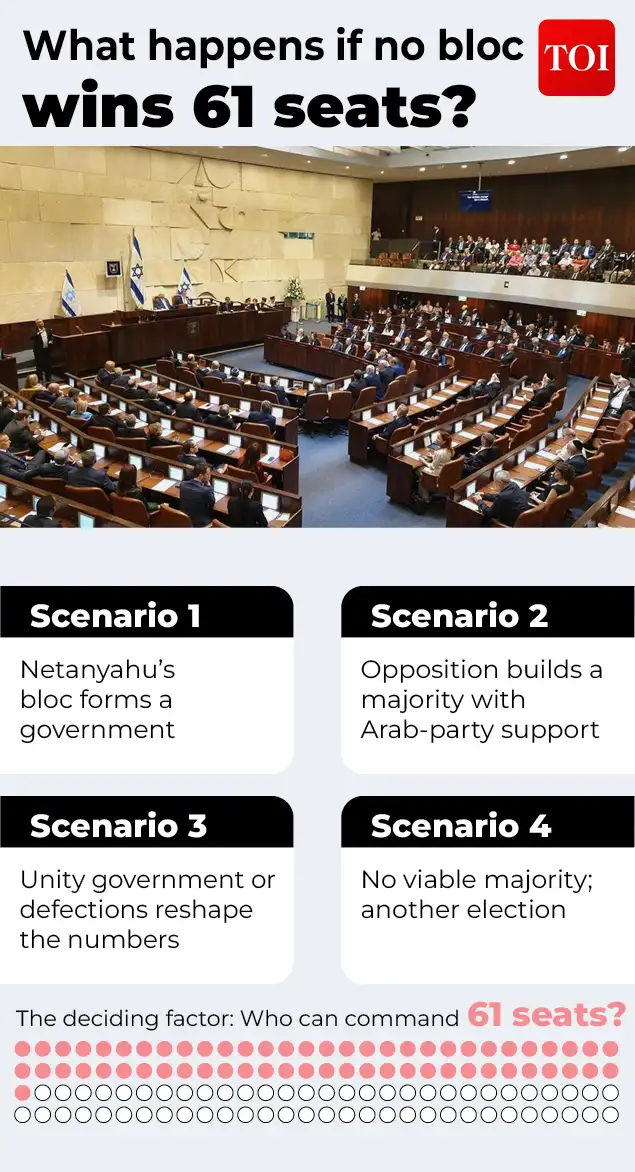
Whether Israel’s political direction changes with it will depend not only on the votes cast but on who can assemble the 61 seats needed to govern. Netanyahu’s future is on the ballot. You use AI every day. Now get your AI Quotient. Take the AIQ test.