
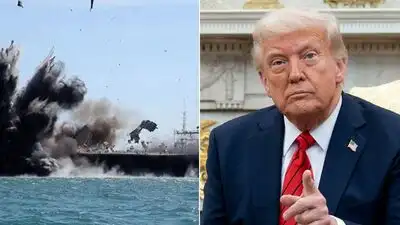
US President Donald Trump ruled out immediate military strikes against Iran on Sunday
US President Donald Trump on Sunday ruled out an immediate military strike against Iran, saying Washington had no plans to launch an attack that day, even as conflicting intelligence assessments and uncertainty over diplomatic efforts continued to shape the US approach to Tehran.
On Brazil’s presidential election, the US president refrained from endorsing either candidate, saying his administration was “watching” the race.
Contrasting the situation in Europe with US border controls, he claimed that the United States had prevented unauthorised crossings over the preceding 18 months.
There will not be a strike,” Trump told reporters as he departed the White House for a campaign rally in Michigan, responding to a question about whether military action against Iran could take place as soon as Sunday. “We have two very different sets of intelligence reports,” Trump said, describing the incoming information as “very advanced. The president maintained that Washington was doing “well with Iran,” although an unnamed US official told Israeli news channel i24NEWS that Trump was prepared to “shift gears on Iran” and that military strikes no longer appeared to be “a question of if, but of when. You know that we’ve had zero infiltration,” Trump said, asserting that “zero illegal aliens” had entered the country during that period. Referring to his conversations with French President Emmanuel Macron, Trump said he had previously warned the French leader about the consequences of immigration policies. You’re letting people come in that hate your country.'” Trump said he had told Macron. “They stole our chip business, all of it, 100%, because they made chips at a ridiculous price, and they just pushed them in,” Trump said.
“Would I tell you that? But the answer is no. The remarks came after Trump presented Tehran with a stark choice between reaching a diplomatic agreement and facing further military action. Trump also criticised immigration policies in European countries, linking protests and unrest in France, Italy, Belgium and Spain to what he described as inadequate border enforcement. “I closed the border. He also claimed that previous US administrations had allowed millions of people to enter illegally. “‘You are destroying France. He also cited migrant arrivals in Spain as evidence of what he described as wider instability across Europe. On semiconductor manufacturing and trade, Trump accused Taiwan of taking over the US chip industry through low-cost production, renewing his criticism of the island’s position in the global semiconductor supply chain. He argued that stronger executive leadership in Washington could have prevented broader tensions with China over trade and technology. Trump’s comments come amid continuing US efforts to strengthen domestic semiconductor manufacturing and address Washington’s strategic competition with Beijing. You use AI every day. Now get your AI Quotient. Take the AIQ test.
That’s the only question,” Trump told Fox News, framing the next phase of the conflict as a choice between negotiations and escalating military operations. “We’re going to be having some pretty soon, and I think they both want to make a deal,” he said, expressing optimism about the prospects of negotiations between Moscow and Kyiv. “Do I make a deal with them, or do I finish them off? Trump also asserted that American forces had established maritime dominance over the Strait of Hormuz, a key global shipping route and a major point of contention in the conflict with Iran. “Remember, we now control the Hormuz Strait. They get nothing. Yes, we get everything. He maintained that commercial activity through the chokepoint had exceeded pre-war levels and described the US Navy’s enforcement of a blockade on Iranian ports and shipping as “unbelievable. He questioned whether Iran would honour any commitments under a potential deal, while arguing that either outcome would amount to an American victory. Control over the Strait of Hormuz remains a central point of friction in the conflict, which erupted in late February following joint US-Israeli strikes. The confrontation has continued despite a ceasefire and a memorandum aimed at securing a final peace agreement. Turning to the war in Eastern Europe, Trump indicated that high-level diplomatic engagements involving the United States, Russia and Ukraine could take place soon. Trump did not provide further details about the proposed engagements or specify when the talks would take place.
Despite ruling out a strike on Sunday, Trump has continued to signal that Washington could pursue further military action if negotiations fail to produce an agreement. On Saturday, Trump had suggested that Washington could either launch fresh military strikes or secure a comprehensive agreement with Tehran.