
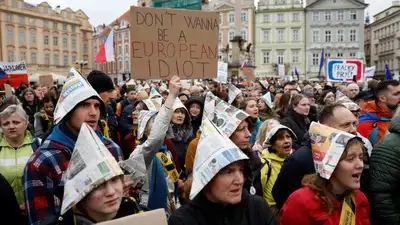
People attend a protest rally in support of public media
Some opponents have compared the plans with changes introduced in Hungary under former prime minister Viktor Orban, whose government oversaw an expansion of pro-government media, and reforms in Slovakia under Prime Minister Robert Fico.
Demonstrators chanted slogans including “We’ve had enough” and “Resignation”, demanding that the draft be withdrawn and that the government allow a thorough public debate. The demonstration in the historic Old Town Square and surrounding streets followed an overnight vote in the lower house of parliament that advanced legislation to abolish licence fees paid by households and businesses and replace them with direct funding from the state budget. The bill, backed by Prime Minister Andrej Babis’s governing coalition, received initial approval in the early hours of Saturday after lawmakers moved it unexpectedly onto the agenda and curtailed debate. The legislation is now at the committee stage and must clear further parliamentary votes, including approval by the upper house, before becoming law. Protesters accused the government of pushing through the changes without adequate public scrutiny. The proposal has drawn criticism from opposition parties and international media organisations, which have called for greater scrutiny of the legislation. Czech President Petr Pavel has called for greater expert scrutiny, saying the country was among the few in central and eastern Europe where public-service and private media systems worked well.
Thousands of people gathered in Czech Republic capital Prague on Sunday to protest against thec government’s plans to overhaul the funding of public television and radio, warning that the changes could undermine media independence and expose broadcasters to political pressure.
The proposed reform would cut funding for Czech Television and Czech Radio by around 15 per cent, potentially from next year. Critics argue that replacing licence fees with allocations from the state budget would make public broadcasters more vulnerable to political interference.