
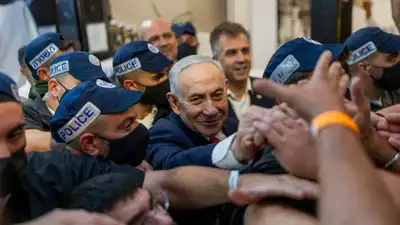
Israel set to vote for the first time since Oct 7 attack; Netanyahu faces major test
Leadership is likely to be a decisive factor, with voters weighing Netanyahu’s experience and security record against criticism of his handling of October 7 and the wars that followed.However, neither of the main political blocs is advocating a major shift on the Palestinian question: both are dominated by parties that support Jewish settlements in the occupied West Bank and oppose the establishment of a Palestinian state. With no party expected to win an outright majority in the 120-seat Knesset, the outcome will also depend on which leader can assemble a governing coalition. Benjamin Netanyahu: Israel’s longest-serving prime minister, Netanyahu has been in power for much of the period since 2009. His supporters see him as a strong leader capable of defending Israel, but his political standing has been weakened by the security failures surrounding Hamas’ October 7, 2023, attack, his corruption trial and an International Criminal Court arrest warrant over alleged war crimes in Gaza, which he denies. Naftali Bennett and Yair Lapid: Former prime ministers Bennett, 54, and Lapid have joined forces under a new party called Together. Despite their different political backgrounds, the two previously worked together to oust Netanyahu in 2021. Avigdor Lieberman: The former defence minister, 68, leads the right-wing Israel Our Home party, which draws considerable support from Israel’s ex-Soviet immigrant community. Once a close ally of Netanyahu, Lieberman left his government in 2018, accusing him of being too soft on Palestinian militants in Gaza.
His Likud party has faced a decline in opinion polls, though Netanyahu remains a formidable political survivor and is seeking to form a broad national government. Bennett is a former commando and a right-wing politician, while Lapid comes from the centre. Their campaign has focused on national unity and getting Israel back on track after years of conflict and political division. He has since become one of the prime minister’s most vocal critics.
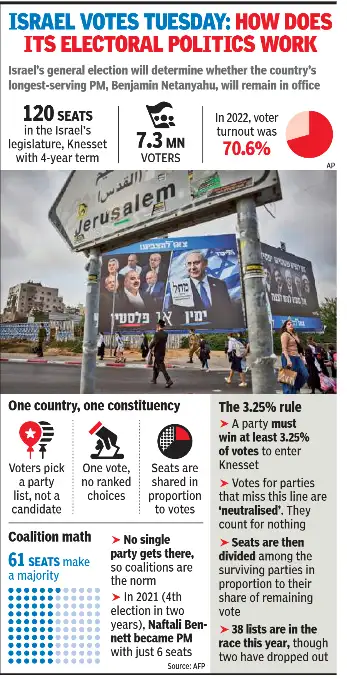
Israel follows a proportional representation system to elect the 120 members of its parliament, the Knesset. Parties must secure at least 3.25% of the vote to enter parliament.
Voters choose political parties rather than individual candidates, and seats are distributed according to each party’s share of the national vote.
Israel is set to vote on Tuesday, marking its first national election since Hamas’ October 7, 2023, attack, with Prime Minister Benjamin Netanyahu ’s leadership, security record and political future at the centre of the campaign. However, with no single party expected to win a majority in the 120-member Knesset, the next government will depend on post-election coalition negotiations as much as the vote itself. Israel’s first national election since Hamas’ October 7, 2023, attack is widely seen as a referendum on Prime Minister Benjamin Netanyahu’s leadership.
the debate has focused largely on Netanyahu’s accountability, his handling of the aftermath and his leadership rather than Israel’s military conduct in Gaza, Lebanon and Iran, which has broad domestic support While the attack and the security failures surrounding it remain central to the campaign.