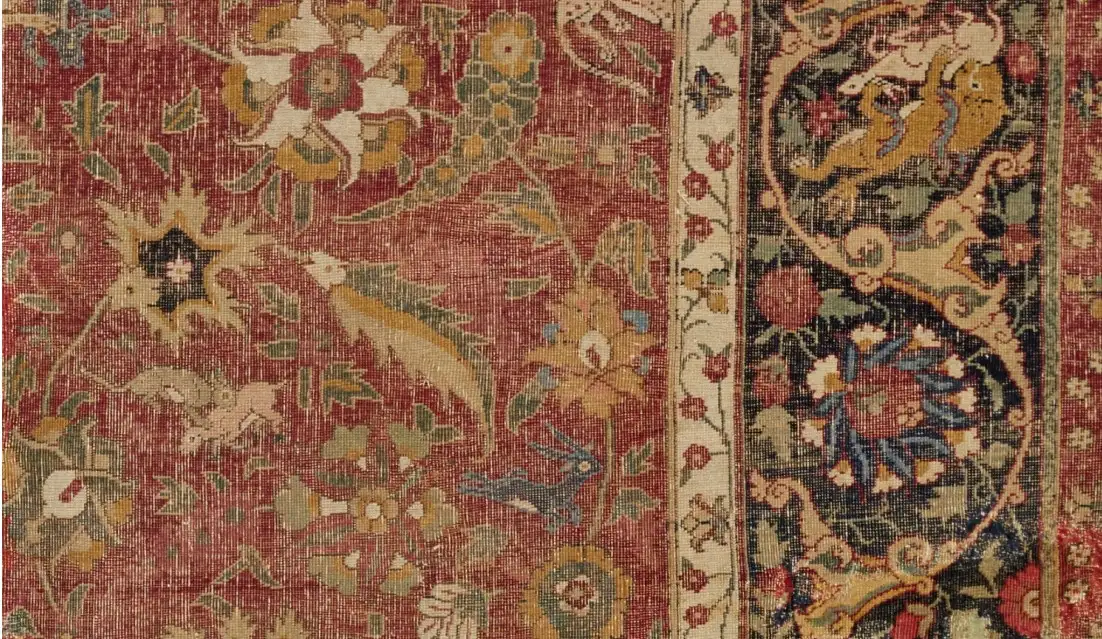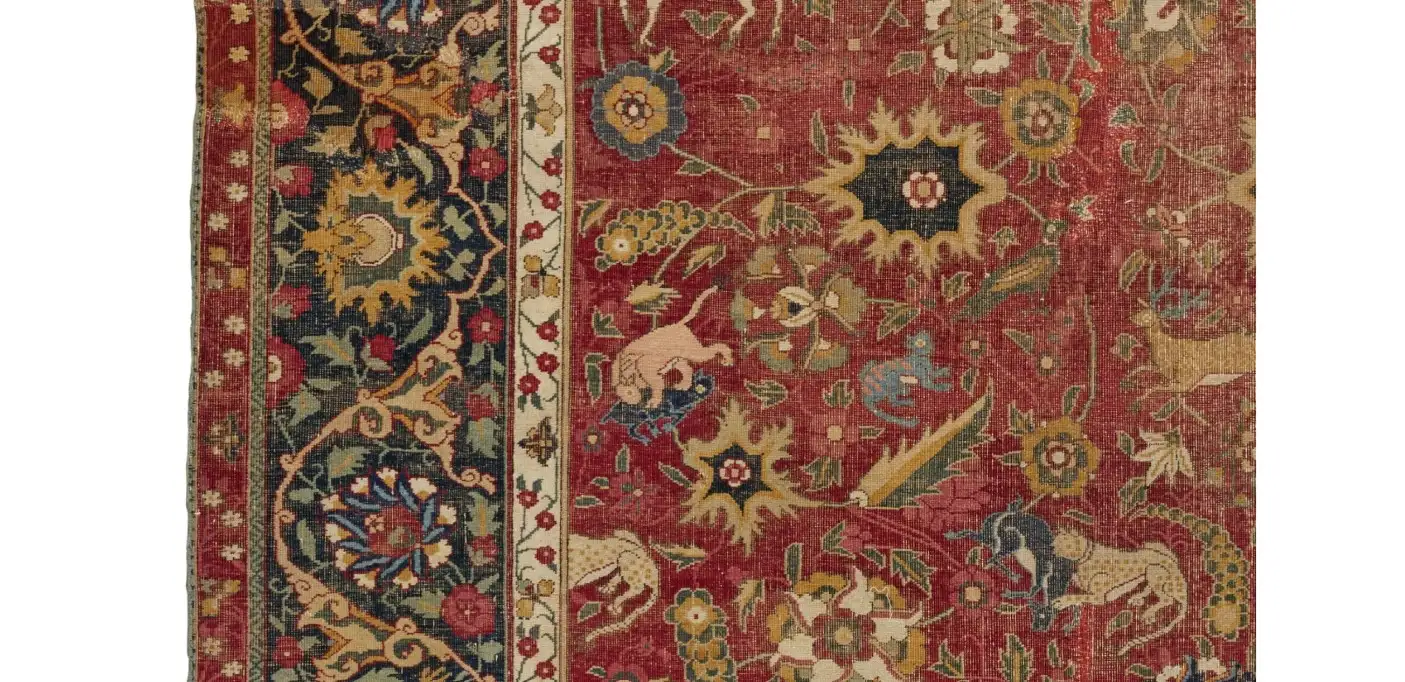
Mughal hunting carpet (Sothebys)
Imagine getting your hands on a carpet that was nearly 400 years ago in India! More about the historic carpet Also known as the ‘Yerkes-Remarque’ Mughal hunting carpet, the piece is listed as lot 43 in Sotheby’s Magnum Opus | Evening Auction, held in New York on October 21, 2026. The auction house placed its estimate at 250,000–350,000. The textile measures approximately 473 cm by 200 cm, (15 feet 6 inches by 6 feet 7 inches). Sotheby’s 2013 catalogue suggested that the accomplished workmanship points towards a court design workshop. Yerkes (1837–1905), an American financier whose business dealings and controversial reputation made him a prominent figure of his time. After Yerkes’s death, his collection went under the hammer in 1910. Carpet’s other famous owners The carpet’s next famous owner was Erich Maria Remarque (1898–1970), the German novelist best known for All Quiet on the Western Front. Its ownership history subsequently included a private Swiss collection and The Textile Gallery in London before it entered the Thyssen-Bornemisza Collection in 1986. The Thyssen family connection Heinrich, Baron Thyssen-Bornemisza (1875–1947), assembled a substantial collection of artworks, including important historical carpets. His son, Hans-Heinrich Thyssen-Bornemisza (1921–2002), later worked to rebuild and expand the family collection. Sotheby’s 2013 report recorded repairs and areas of wear. The carpet had already achieved a notable auction result in 2013. Offered by Sotheby’s in London with an estimate of £100,000–£150,000, it sold for £314,500, including the buyer’s premium, according to specialist carpet publication HALI. Its return to Sotheby’s New York auction calendar in October 2026, with an estimate of 250,000–350,000, brings the story full circle.
The motivation was a personal appreciation of textiles, according to Sotheby’s historical catalogue. Now this historic Mughal-era carpet is making headlines again. It’s not just the age but also the design that makes it special. It features hunting scenes, flowering vines and richly coloured motifs. The textile has seen generations and passed through the hands of American financier Charles T. Yerkes, German novelist Erich Maria Remarque and the famous Thyssen-Bornemisza family. A glimpse into the artistry of 17th-century India The carpet dates to the first half of the 17th century. It is a period linked with the flourishing of courtly art and architecture under the Mughal Empire. The best part about this textile is that it was woven using a wool pile on a cotton foundation. When you first look, its wine-red background offers a perfect setting for flowers, leaves and animals. Then the design goes on to divide into four nearly identical sections. One can see palmettes and rosette blossoms connected by elongated leaves making it more a piece of art. Deep blue, ivory and other vivid shades create contrast adding the perfect colour. The hunting scene Mughal carpet (PC: sothebys) However, it’s the hunting scenes that make the carpet compelling. In one section, a tiger appears ready to pounce on a white zebu bull, then you can also see a spotted leopard biting into a blue deer. The border of the carpet features lions attacking or feeding on fawns. Art historian Friedrich Spuhler also noted that the treatment of the corners indicates the involvement of skilled court designers. The American financier who built a collection to be envied One of the earliest documented owners of the carpet was Charles T. Yerkes was known for assembling an extraordinary collection of Oriental carpets. He wanted to build a collection so exceptional that others would envy it. The Mughal hunting carpet was documented in The Yerkes Collection of Oriental Carpets, published in London that year, where it appeared as Plate IX. The sale became an important moment in the history of carpet collecting. The carpet was then associated with Remarque in Ascona, Switzerland, where it remained for several decades. The original pile remained, but the textile showed signs of age and restoration. For a textile created in India centuries ago, the journey of the carpet is extraordinary. You use AI every day. Now get your AI Quotient. Take the AIQ test.
Carpet’s value today The Hunting Carpet (PC: sothebys) The carpet’s significance lies in the combination of its age, design, craftsmanship and its famous owners.