
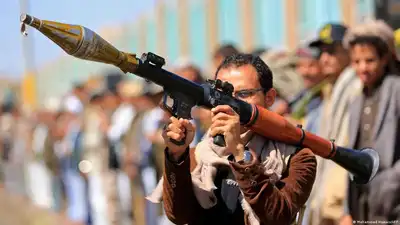
The Houthi group has been fighting in a civil war in Yemen as well as against Saudi Arabia and other Gulf states since 2015 (Mohammed Huwais/AFP)
The support includes intelligence and targeting assistance, with between 100 and 200 US troops reportedly deployed as part of a joint force command. At the centre of the reported effort is the US military’s Maven Smart System (MSS), an artificial intelligence platform developed under Project Maven, launched by the Pentagon in 2017. Deutsche Welle (DW) reported that a US missile strike on a school in Iran, which killed nearly 200 people, mostly children, was among the targets associated with the US military’s AI-assisted targeting operations.
American personnel are helping Saudi military officers use an AI-assisted battlefield targeting tool similar to the US military’s Maven Smart System, according to CNN report that quoted unnamed US officials. These tactics could allow Houthi fighters to relocate before an AI-assisted system can help commanders identify and authorise a strike, according to Deutsche Welle (DW) report. Antony Loewenstein, an independent journalist who has researched AI-assisted military technology, told DW that he did not believe such tools would make a significant difference in defeating the Houthis, warning of the risk of large-scale civilian casualties.
Saudi Arabia is turning to artificial intelligence to sharpen its battlefield edge against Yemen’s battle-hardened Houthis, betting that US-backed targeting technology can help it track mobile missile launchers, detect drone threats and strike faster. But as the kingdom seeks a technological advantage against a group that has withstood years of military pressure, a critical question remains: can AI change the course of a war that advanced weapons alone have failed to win? The move comes as Saudi Arabia faces persistent security threats from Yemen’s Houthi movement, which has used drones and ballistic missiles to target military installations and critical infrastructure. Despite years of military operations, the group has retained the ability to launch attacks, highlighting the challenge of tracking mobile weapons and identifying targets before they can be moved or concealed. The system uses AI to analyse intelligence, surveillance and reconnaissance data, including satellite imagery and drone footage, helping military personnel identify potential targets and assess battlefield activity more quickly. Unlike traditional intelligence analysis, which often requires personnel to manually review hours of surveillance footage, Maven can process large volumes of data, identify patterns and flag potential military targets such as vehicles, missile launchers and other equipment. For Saudi Arabia, the technology could help track Houthi missile launchers, detect drone activity and identify threats to military bases, airports and oil infrastructure. By reducing the time between detecting a potential target and deciding how to respond, AI-assisted systems could give Saudi forces a better chance of acting before mobile weapons are relocated or concealed. It brings information from multiple sources into a shared interface, helping commanders build a clearer picture of the battlefield and make decisions faster. The system could also improve coordination between intelligence analysts and military commanders by combining surveillance feeds and threat assessments in one place. This could help Saudi forces prioritise emerging threats, allocate surveillance resources and coordinate responses more efficiently, particularly when facing multiple drone and missile threats in quick succession. Despite its ability to accelerate target detection, the US military’s Maven Smart System faces significant challenges in Yemen, where Houthi forces use mobile, truck-mounted ballistic missiles and small drone swarms while operating from hills, canyons and rugged terrain. Dust storms, changing terrain, dense foliage and deliberately planted decoys can further reduce the system’s effectiveness. The technology also raises concerns over targeting errors and civilian casualties. The incident underscores the risks of relying on flawed intelligence or inadequate human verification, although it does not establish that AI alone caused the strike. The broader challenge is strategic rather than purely technological. The group’s ability to withstand destruction means faster targeting may improve Saudi Arabia’s operational efficiency without delivering a decisive military victory. You use AI every day. Now get your AI Quotient. Take the AIQ test.