
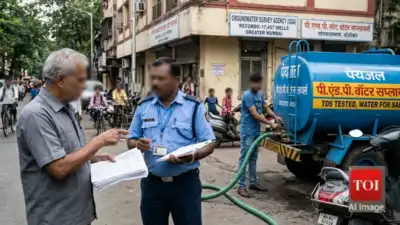
The complaints were submitted by groundwater activist Sureshkumar Pukhrajji Dhoka.
Three communications issued by the Maharashtra Pollution Control Board (MPCB) on August 14, August 20 and September 7, 2026, have brought the issue back into focus. The correspondence forms part of a paper trail spanning 2020 to 2026 involving pollution-control authorities, groundwater agencies and district administrations. The scale of the monitoring challenge is reflected in Brihanmumbai Municipal Corporation Insecticide Branch correspondence dated April 24, 2026, which recorded 17,457 wells across Greater Mumbai: 10,250 in the western suburbs, 4,879 in the eastern suburbs and 2,328 in Mumbai City. An RTI reply from the branch recorded 619 wells with CGWA NOC records. Separately, an Insecticide Branch letter dated October 15, 2024, identified 385 wells as being used for tanker sales and sought action to assess and recover applicable environmental compensation. In a separate reply dated September 1, 2026, the Central Ground Water Board (CGWB) said it had examined Dhoka’s representation alleging large-scale unauthorised groundwater extraction, commercial tanker operations and non-compliance with CGWA NOC requirements in Mumbai City and Mumbai Suburban districts. In February 2022, Dhoka approached the MPCB over the issue. On March 29, 2022, the Central Pollution Control Board’s regional directorate in Pune forwarded the representation to the MPCB, seeking necessary action and an action-taken report. Earlier, in December 2020, the CGWA had set out the respective roles of pollution-control authorities and district collectors in proceedings concerning environmental compensation and enforcement against unauthorised groundwater extraction. The regulatory framework cited in the supplied material includes the CGWA’s 2020 guidelines, the Maharashtra Groundwater (Development and Management) Act, 2009, and a National Green Tribunal order dated March 2, 2017, concerning groundwater extraction and compliance with the law.
The correspondence establishes that the grievances were referred, but the subsequent findings and action taken remain to be confirmed from official records. For Mumbai, where groundwater is an important resource, the public-interest concern is whether commercial extraction and tanker-based supply are adequately monitored and confirmed violations dealt with under the applicable law. You Can Also Check: Gold Rate in Mumbai | Silver Rate in Mumbai | Bank Holidays in Mumbai | Public Holidays in Mumbai | Mumbai AQI | Weather in Mumbai | Petrol Price in Mumbai | Diesel Price in Mumbai | CNG Price in Mumbai | LPG Price in Mumbai Stay updated with the latest Mumbai news.
The complaints were submitted by groundwater activist Sureshkumar Pukhrajji Dhoka, who says he has pursued the issue for more than two decades. MUMBAI: Who is checking Mumbai’s wells used for commercial groundwater extraction and the supply or sale of groundwater through tankers — and what action has followed complaints of unauthorised activity? The letters refer complaints to the concerned Brihanmumbai Municipal Corporation (BMC) ward offices for necessary action and seek communication of the action taken to the complainant and the concerned MPCB office. The central question is whether the complaints have led to field inspections, verification of permissions and enforcement wherever violations have been established. They allege unauthorised groundwater extraction for commercial use, tanker-based sales and non-compliance with applicable regulatory requirements, including Central Ground Water Authority (CGWA) no-objection certificates (NOCs). Commercial extraction without required permissions and the sale of groundwater through tankers raise related but distinct enforcement questions. Authorities need to establish which wells are involved, the purpose and scale of extraction, the permissions applicable to each activity and compliance with the conditions imposed. These figures do not establish that the wells were operating illegally. The existence of a well, a tanker-sale operation or an NOC record does not, by itself, establish whether all applicable requirements have been met. That requires verification of the relevant permissions and inspection findings. The three MPCB letters referred Dhoka’s complaints to the concerned BMC ward offices and sought communication of the action taken. The critical issue is whether the referrals resulted in inspections, verification of permissions, notices or other enforcement measures. The ward-level inspection reports and action-taken records would establish whether unauthorised commercial extraction or tanker-supply activity was found and, if so, what action followed. The complaint and a related grievance were forwarded to both district collectors for further necessary action. The requirements applicable to individual wells must be assessed under the relevant legal provisions and permissions. The BMC ward offices, MPCB, CGWB, CGWA and the district collectors concerned need to clarify the status of the complaints. Key records include well-wise inspection reports, verification of applicable permissions, findings on commercial extraction and tanker supplies, and details of any notices, directions or environmental compensation assessed and recovered. Forwarding a complaint is neither proof of a violation nor evidence that enforcement has been completed. Dhoka has offered to provide supporting documents for independent journalistic verification. The question is no longer merely which authority received the complaints, but what the authorities inspected, what they established and what action they took. Download the TOI App.