
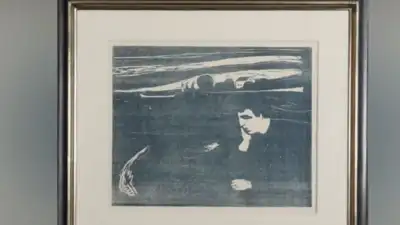
The artwork is expected to sell for between £50,000 and £80,000 at auction. The pencil-signed print, titled Melancholy III, was bought in 1969 and remained with the same family for 57 years before being identified for sale. Catherine Southon Auctioneers & Valuers will offer the artwork as a leading lot in its Fine and Decorative Art Auction on 28 October 2026. The print comes with its original sales receipt from Norway, which records the purchase price as 42,000 Norwegian kroner. Auction house records show that the print measures 37.8 by 47.2 cm and is printed on thick, cream-coloured wove paper.
A rare early woodcut by Norwegian artist Edvard Munch, bought by a family in Norway nearly six decades ago, has resurfaced from a private collection in England. It has remained in private hands since it was bought. It has been kept in good overall condition.
It is listed under reference numbers Woll 203 and Sch 144. The print uses shades of greyish blue and was made before the final version described in Gerd Woll’s catalogue raisonné, a detailed record of an artist’s works. Specialists noted that it was produced before the foreground figure was fully outlined and the background rocks were completely drawn. These details make it a rare early version of Munch’s printmaking work.
The scene in Melancholy is based on events in Munch’s life during the summer of 1891 in Åsgårdstrand. This coastal resort lies south of Oslo, and Munch spent his summers there between 1889 and 1906. The image shows art critic Jappe Nilssen, a close friend of Munch, sitting alone on a rocky shore in deep sadness. Nilssen had suffered an unreturned love for painter Oda Lasson, who was married to artist Christian Krohg. In the background, two figures representing Lasson and Krohg walk along a pier towards a small boat, preparing to travel to a nearby island. Munch placed Nilssen in the foreground, bent forward in a pose similar to Auguste Rodin’s The Thinker. His posture reflects feelings of loneliness, rejection, and emotional pain. Munch first created the scene as a pastel drawing in 1891. He later developed it in five oil paintings made between 1891 and 1896. Early versions were titled The Yellow Boat or Jappe on the Beach. Art historians widely describe the composition as one of Munch’s earliest Symbolist works. It turns personal emotional pain into a landscape scene and came before his famous 1893 painting The Scream.