
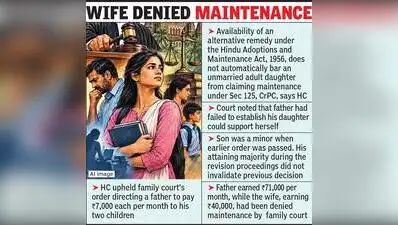
Nagpur: The Nagpur bench of Bombay high court recently upheld a family court order directing a father to pay monthly maintenance of ₹7,000 to his unmarried adult daughter. It ruled that an alternative remedy under the Hindu Adoptions and Maintenance Act cannot, by itself, defeat her claim under Section 125 of the Code of Criminal Procedure (CrPC).
Justice Mehroz Pathan dismissed a criminal revision filed by the father challenging Nagpur family court’s Dec 7, 2019, order. The family court had declined maintenance to the wife, who earned ₹40,000 a month as a teacher, but directed the father, also a teacher earning ₹71,000 monthly, to support their two children, including a minor son, by providing ₹7,000 per month maintenance to each. Relying on Supreme Court’s judgment in Abhilasha versus Parkash, the father maintained that an unmarried Hindu daughter seeking maintenance after attaining majority must establish her inability to maintain herself through proceedings under the 1956 Act. They cited a Supreme Court ruling that had upheld maintenance for an unmarried daughter through a combined reading of Section 125 of the CrPC and Section 20(3) of the 1956 Act. The judge said the father could raise the change in circumstances through an application under Section 127 of the CrPC before the appropriate forum.
“The father has failed to show that his daughter is able to maintain herself,” the court observed, while explaining why the family court’s decision did not warrant interference. The children, through counsel SA Sahu, opposed the challenge, arguing that forcing the daughter to initiate fresh proceedings after years of litigation would cause further hardship. HC agreed that the availability of another legal remedy did not automatically bar the daughter’s maintenance claim. On the son’s claim, the judge noted that he was a minor when the family court passed its order. His subsequently attaining majority during the revision proceedings did not retrospectively invalidate that decision.