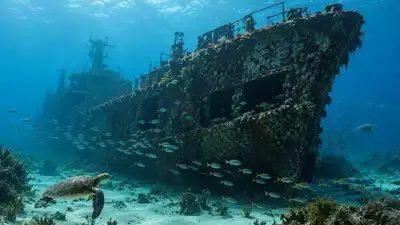
Representative AI image of a decommissioned supply ship resting on the Atlantic seabed as an artificial reef. (Image Credits: ChatGPT)
In August 2026, Delaware added the Calcasieu Pass, a 180-foot retired menhaden fishing vessel, to its artificial reef network off the Delaware coast. The vessel was built in 1982 as an offshore oilfield supply ship and was later converted into an Atlantic menhaden fishing vessel in 1989. The project was spearheaded by Coleen Marine, a Norfolk, Virginia-based marine contractor who had handled numerous deployments across Delaware’s permitted reef sites, including the Reedville in 2020. Redbird Reef is perhaps the most recognisable of these sites, and is approximately 16 miles offshore from the Indian River Inlet. The site covers 1.3 square miles of the ocean floor and contains more than 700 retired New York City subway cars. The wider programme has used more than two million tons of rock, 100,000 tons of concrete, 86 tanks and armoured personnel carriers, more than 1,350 subway cars and 32 retired vessels.
The objective of the deployment was to create marine habitat and expand opportunities for recreational fishing and diving, according to the Delaware Department of Natural Resources and Environmental Control (DNREC) . Subsequently, it spent more than three decades in the menhaden reduction industry, operating from Reedville, Virginia, before it was repurposed to rest beneath the waves. However, establishing the structure led to addressing the geographical limitation of the mid-Atlantic seabed that is dominated by sand and mud, unlike regions with extensive natural rocky outcrops or coral reefs. Only through artificial structures are surfaces created where invertebrates can establish communities, providing food and shelter for fish. The organisms colonising the Calcasieu Pass are expected to include mussels, barnacles and corals.