
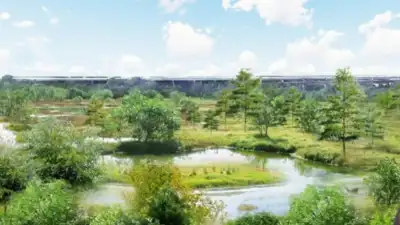
Pennsylvania’s Department of Environmental Protection named the FDR Park Tidal Wetland project a winner of the 2026 Governor’s Award for Environmental Excellence. The 33-acre project sits in the south-western corner of Franklin Delano Roosevelt (FDR) Park. Work on the site began in 2022. To create the new habitat, workers planted 7,000 native trees, along with thousands of native shrubs and coastal grasses. By 2026, the new wetland was working as a key piece of natural infrastructure.
A major change in South Philadelphia has won state recognition. Workers turned an abandoned, illegal dumping site into a thriving tidal wetland. The award honors its role in building healthier and more sustainable local communities. It was carried out through a partnership between Fairmount Park Conservancy, Philadelphia Parks and Recreation, and the Philadelphia Department of Aviation. Crews cleared decades of dumped trash, fill material, and thick patches of invasive plants. They then built working tidal channels that connect to local waterways. It was designed to soak up extra stormwater, filter pollution, trap sediment, and store carbon.
The wetland restoration was part of a larger master plan for the 348-acre park. A $1 million state grant from the Redevelopment Assistance Capital Program also helped pay for soil excavation, tide gate replacements, and trail construction. The area had fallen into disrepair. It was an unmanaged zone where people often dumped trash illegally, and it was overgrown with non-native plants. Park advocates led community meetings. At those meetings, local residents often named habitat restoration, better water access, and new walking trails as top priorities for the space. The project engineers did not rely only on concrete drainage pipes. Instead, they designed the site to work as a natural sponge for South Philadelphia. This is a low-lying part of the city that is prone to bad local flooding. Fairmount Park Conservancy stated that the new wetland collects and manages heavy runoff during major rain events. The marshland holds extra water, which stops the surrounding parts of the park from flooding. This keeps sports fields and public walkways dry and open to visitors. Funding and support for the project were tied to environmental mitigation work required for expansion projects at nearby Philadelphia International Airport, which is three miles to the west.