
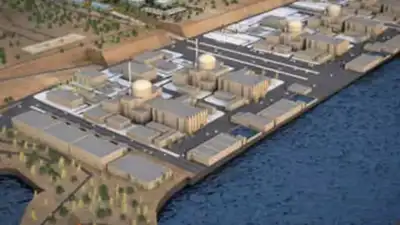
An image of the proposed plant at Jaitapur, shared by French envoy Emmanuel Lenain. (Courtesy: Twitter)
Its proposed 9.9GW capacity could generate more than three times Greater Mumbai’s annual electricity requirement. A nuclear-energy awareness campaign led by Goyal estimates that Jaitapur’s six proposed reactors could generate 78.05 billion units annually, assuming a 90% capacity factor. Greater Mumbai’s estimated electricity requirement in 2025-26 was 24.6 billion units. The Centre said in February 2026 that commercial discussions with France remained under way. Maharashtra’s electricity requirement stood at 202.87 billion units in 2025-26, according to the campaign note, while peak demand touched a record 32,317MW on May 13, 2026. The note estimates that local generation from Tata Power’s Trombay station accounted for 23.3% of Mumbai’s annual requirement, leaving the balance to external supplies and the wider grid. The campaign projects Mumbai’s data-centre demand could exceed 5GW by 2028-29. The campaign estimates that delivering 5GW of continuous power would require 404 sq km for solar panels and battery storage, compared with 5.56 sq km for nuclear infrastructure. The campaign projects per-capita electricity availability of 3,000 units and claims domestic nuclear development could reduce dependence on imported fuels. Protests intensified between 2009 and 2013. Fisherman Tabrez Sajjad Kari died during police firing at Nate in April 2011. The state announced additional compensation of ?22.5 lakh per hectare in 2013. The campaign note says 938 hectares were acquired. Jaitapur’s environmental clearance dates to 2010.
Because it can generate electricity irrespective of weather conditions, goyal argues that nuclear power can complement solar and wind. You Can Also Check: Gold Rate in Mumbai | Silver Rate in Mumbai | Bank Holidays in Mumbai | Public Holidays in Mumbai | Mumbai AQI | Weather in Mumbai | Petrol Price in Mumbai | Diesel Price in Mumbai | CNG Price in Mumbai | LPG Price in Mumbai Stay updated with the latest Mumbai news.
Dr Neelam Goyal, known as “Bharat ki Parmanu Saheli”, is a nuclear-energy advocate, founder-president of APEAF and a researcher who says her work examines nuclear power’s socio-economic impact on public health and regional welfare. MUMBAI: Mumbai’s expanding data-centre industry and Maharashtra’s rising electricity demand have renewed the focus on the long-delayed Jaitapur nuclear power project in Ratnagiri. But commercial negotiations, regulatory clearances and Konkan residents’ concerns remain critical hurdles. Trained through a Department of Atomic Energy (DAE) postdoctoral programme, she campaigns for greater public awareness of nuclear technology and its potential role in India’s energy future while underlining the need for projects like Jaitapur. However, the projected output cannot meet current demand: the plant must first clear outstanding hurdles, be constructed and commissioned. These facilities support banking, telecom, cloud computing and artificial intelligence, all requiring reliable power round the clock. The figure is a projection, not verified current consumption. Its cost comparisons, however, depend on assumptions about storage, financing, construction and operating performance. Goyal highlights India’s thorium resources and advocates indigenous nuclear technology, drawing on Dr Homi Bhabha’s three-stage nuclear programme. She also envisages small modular reactors supplying electricity closer to consumption centres. Its projections of electricity supply over thousands of years and economic savings require independent technical and economic validation; they are not established outcomes. Landowners, farmers and fishing communities have opposed Jaitapur over compensation, livelihoods, environmental impacts and safety. Concerns over fishing grounds, mango and cashew cultivation, jobs and local infrastructure require transparent answers. Its present validity, applicable conditions and other required approvals need verification. Environmental monitoring, emergency preparedness and meaningful consultation with affected communities will be essential. For Mumbai, Jaitapur represents potential long-term power security. For Konkan, its credibility will depend on whether promised benefits reach local communities without compromising livelihoods, safety and the environment. Download the TOI App.