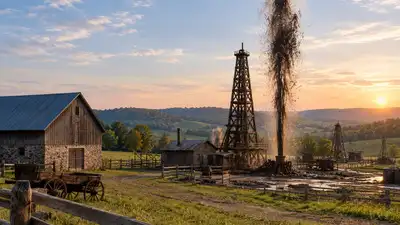
AI Representation: A period-style reconstruction of an 1860s Pennsylvania oil field, showing a wooden drilling rig and an oil gusher on farmland during the early oil boom. Image credits: Chatgpt
A farmer, born in 1801, whose land lay on a tributary of Oil Creek John Benninghoff was born on December 25, 1801, in Lehigh County, Pennsylvania, a date and place given by both the Erie Reader and the Mercer County PAGenWeb biography, which reproduces the 1888 History of Mercer County. Around 1831, the family moved from Clearfield County to Venango County, where he rented farmland for several years before buying his own and in April 1868 he sold his lands and moved to Greenville in Mercer County. The Erie Reader describes a 57-acre farm, the Mercer County PAGenWeb biography drawn from the 1888 History of Mercer County gives 235 acres and a Benninghoff family history on Pennsylvania Genealogy gives 300 acres. The same county history dates his oil interest from 1861 to April 1868. The Ocean Well and disputed production figures The Ocean Well, drilled on the slope of a hill in fall 1865, is cited by the Pennsylvania Department of Conservation and Natural Resources as a departure from the prevailing view that drilling needed flat land. Once the well began producing 300 barrels a day, operators rushed to lease parts of the farm and Benninghoff soon earned about $6,000 a day, the department reports. McLaurin’s Sketches in Crude Oil gives an initial flow of 600 barrels per day from September 1, 1865, but the Pennsylvania Geological Survey puts the flow of the Ocean well, completed in 1865 along Benninghoff Run, at 300 barrels per day. The park’s Benninghoff Farm Tableau has six derricks, each 35 feet high, along with an oil barge and an engine house, as the Pennsylvania Department of Conservation and Natural Resources describes it. Benninghoff City and Henry Harley’s two-mile pipeline route in late 1865 A settlement took its name from the Benninghoff farm. In late 1865, Henry Harley, a commission dealer, began laying two two-inch pipelines from Benninghoff City to his tanks at the Shaffer railroad yard, a distance of two miles, as the Early Oil Pipelines history at petroleumhistory.org describes. Image credits: Wikimedia Commons The pipelines threatened the livelihood of the teamsters who hauled oil by wagon and in late 1865 angry teamsters set fire to Harley’s wooden tanks at Shaffer. Income estimates of $50,000 a month and $6,000 a day The Erie Reader puts the family income at $50,000 per month. The Pennsylvania Department of Conservation and Natural Resources puts his earnings at about $6,000 a day, which would total $180,000 over 30 days at that pace. Wells on Benninghoff’s land produced between 25 and 300 barrels of oil per day, as recorded in John J. The January 16, 1868 robbery and conflicting accounts of the sum stolen Accounts of the robbery differ on the sum stolen. The History of Mercer County, reproduced by the Mercer County PAGenWeb biography, puts it at $250,000, the Erie Reader gives $260,000 and McLaurin’s Sketches in Crude Oil gives $265,000. The county history adds that none of the money was recovered and that the family spent $50,000 trying to capture the robbers, whereas the Erie Reader says the reward grew to $50,000. The same history records that Benninghoff sold his lands in April 1868, moved to Greenville and died worth around $400,000.
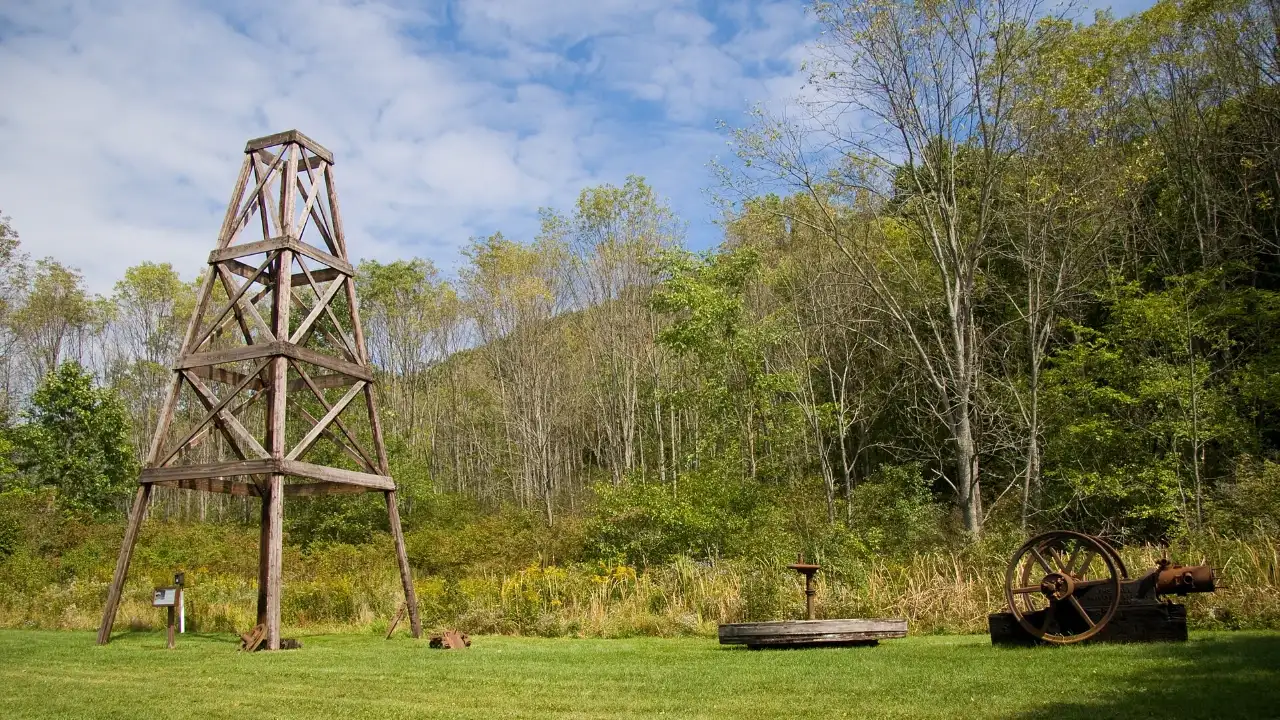
Income from such subdivisions was reported in newspapers, but it was not always accurate. The oil-producing area in northwestern Pennsylvania in the 1860s consisted of a series of farms. Landowners on the hills overlooking the creeks suddenly found themselves at the center of a drilling colony if they had even one productive well. Since land ownership provided individual access to the surface and minerals below it, operators usually had to obtain the land either via lease or purchase. The payments on lease could be made in cash or as a proportion of the oil extracted or both. Many holders subdivided their land to allow drilling from several operators at once. The case of a farmer near Oil Creek demonstrates how far off some numbers could be. His farm lay along Benninghoff Run, a tributary of Oil Creek, as the Erie Reader and the Early Oil Pipelines history at petroleumhistory.org both describe it. Sources disagree on the size of his farm. John J. A wooden oil derrick at Oil Creek State Park. Incendiary fires were also set at several other sites, including Benninghoff Run, where deaths resulted. Neither figure is a verified account. McLaurin’s Sketches in Crude Oil. You use AI every day. Now get your AI Quotient. Take the AIQ test.