
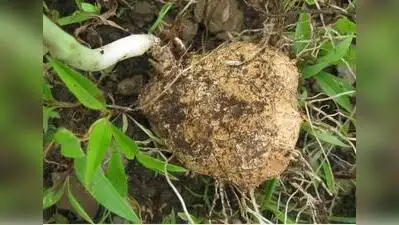
Geophytes survive unfavourable seasons by going dormant and resume growth when favourable conditions return
Pune: Researchers from Agharkar Research Institute (ARI) in the city recently discovered 305 species of geophyte plants thriving in the Northern Western Ghats and the Konkan region, all thanks to a remarkable ability – these plants store nutrients in underground organs such as bulbs, corms, tubers or rhizomes and can remain dormant for long periods to survive harsh conditions. Interestingly, 81 of these species that were discovered are found nowhere else in the world, the researchers said. The 305 species belong to 72 genera and 26 plant families. Of these, 140 are endemic at one or more geographical levels, including 81 restricted exclusively to the Northern Western Ghats and Konkan.
The findings, recently published in the journal ‘Phytotaxa’, highlight the region’s rich but poorly documented plant diversity and the need to protect the rocky plateaus and other habitats from mining, infrastructure development and land-use changes, said ARI’s S Balakumar and Mandar N Datar, who led the study along with Jahnavee Palsodkar and Anandi Korde from the Ecological Society. Study co-author Datar said the region’s geography and climate could help explain why so many species are restricted to small areas. So plants that cannot easily spread from one such habitat to another may evolve separately over time,” he said. The region also experiences a dry season that can last up to eight months, which the research team said favours plants capable of surviving underground for long periods, while limiting the survival of species that need more consistently moist conditions. Authors of the study said the plant diversity they recorded may not be the final count. However, harvesting the tubers can kill the plants, making sustainable use important for species with limited distributions, the study said.
They have been described as some of the toughest flora on the planet. They covered the northern stretch of the Western Ghats from Tapti river in the north, through Maharashtra and Goa, to Kali river in Karnataka, including the adjoining Konkan coastal strip. This is also the first comprehensive checklist of these plants for the region, drawing on published research, herbarium collections and field observations. “The Northern Western Ghats and Konkan form a relatively distinct region, while lateritic plateaus, rocky outcrops and hill forts create smaller, isolated habitats within it. The pattern of species discoveries indicates the flora remains incompletely documented, and further exploration, especially of lateritic plateaus and coastal Konkan habitats, could identify additional species. The research also notes that the underground parts of some of these geophytes have traditionally been used by local communities for food, rituals and medicine.