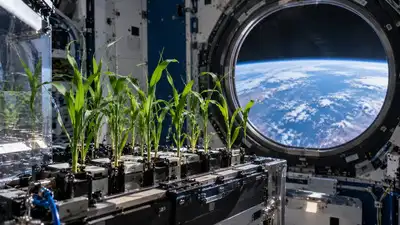
Representative AI image of wheat seedlings growing inside a simulated space-station environment. (Image Credits: ChatGPT)
Researchers have investigated different crops and growing systems to determine how plants respond to the conditions aboard the orbiting laboratory, according to NASA’s Station Science 101 . One such investigation aboard the International Space Station (ISS), known as PESTO, found that wheat plants grown in space turned out to be 10% taller than those on Earth. PESTO, short for Photosynthesis Experiment Systems Testing and Operations, was carried out during Expedition 4 aboard the ISS between 2001 and 2002. Though the wheat grown in space was 10% taller than Earth-based plants used for comparison, it wasn’t enough to verify whether a crop had more nutritional value or would produce more food. With more than 180 sensors implanted in its system, researchers monitored conditions including temperature, oxygen content and moisture around the plants.
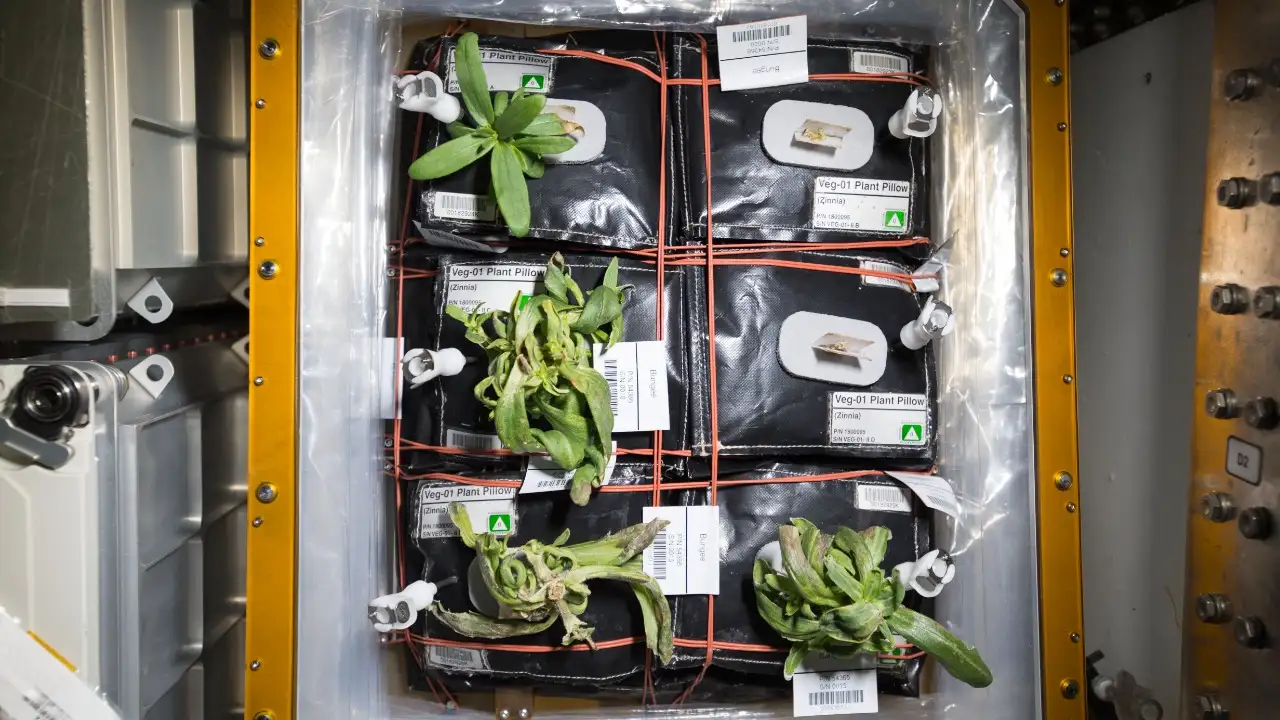
On Earth, gravity provided natural directional cues for plants to grow, but in the case of a weightless environment in space, that directional reference was lost. Growing plants in space, under NASA’s research, has examined how zero gravity affects development from the leaf structure down to its cellular anatomy, which drives photosynthesis. The findings are part of NASA’s wider initiative to understand whether crops can be grown during space missions of long duration. Crews may travel to the Moon or Mars, and this necessitates self-sufficient food production so they can sustain themselves during sojourns that can last for weeks, months, or years away from Earth. The wheat, identified as Triticum aestivum cultivar USU Apogee, was cultivated inside the station’s Biomass Production System (BPS) plant-growth chambers. Researchers examined gravity as one of the factors in wheat growth. This allowed researchers an opportunity to examine how plant structures respond and develop under microgravity. Height comparison alone wasn’t enough to determine crop yield and required careful interpretation. Another investigation aboard the ship, called the Seedling Growth investigation, found that seedlings were able to acclimate to the space conditions by altering the expression of certain genes related to stress. A separate investigation, Plant Gravity Sensing, examined changes in calcium levels within plant cells, which help plants detect gravity. NASA uses dedicated facilities aboard the ISS to come up with solutions on how to cultivate plants in environments underpinned by crew time, water supply, and equipment. The Vegetable Production System, known as Veggie, is a low-power growing chamber that can hold six plants and includes adjustable lighting and nutrient-delivery arrangements for crop experiments. The Passive Orbital Nutrient Delivery System, or Veggie PONDS, offers another arrangement by using holders with small water reservoirs. These systems allow researchers to test methods of delivering moisture to roots in an environment where conventional watering behaves differently from watering on Earth. Another problem was identified along the way: plants not only require water but air around their roots too, and water management continued to be a technical challenge. NASA’s Plant Water Management investigation tested a hydroponic method that would supply both, while the XROOTS study examined hydroponic and aeroponic approaches to growing plants without terrestrial soil, as the other facilities also do. The Advanced Plant Habitat provided a separate facility for controlled plant research. Within its enclosed growing chamber, the colours red, blue, green and broad-spectrum white LED lighting were used. Moreover, the system could impart information to researchers at NASA’s Kennedy Space Centre, where its operation is managed, reducing the routine attention that astronauts were responsible for.