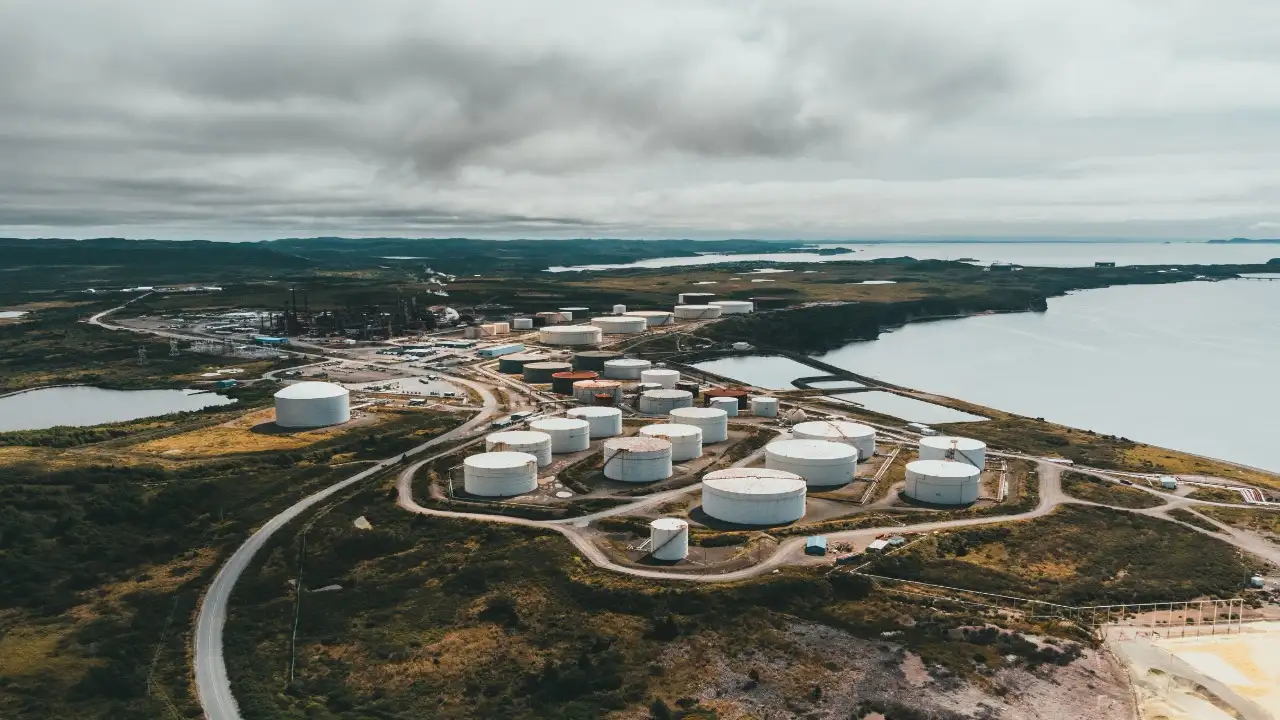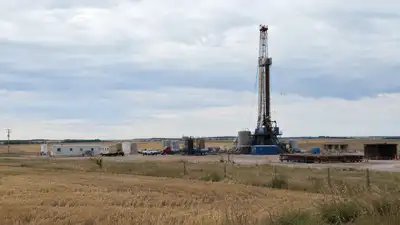
Representative image of North Dakota farmland and an oil field. (Image Credits: ChatGPT)
After unsuccessful attempts at drilling by Amerada Petroleum, the Clarence Iverson No.1 well began to produce oil on a farm near Tioga, North Dakota. The tipping point came on 4 April 1951, following months of unyielding results in extracting oil from the well. The well eventually produced 585,000 barrels of oil, according to the American Oil & Gas Historical Society’s account of the discovery. Leach’s earlier efforts included a deep well for Standard Oil Company of California; it reached 10,281 feet without finding oil and ended up costing the company more money. Army artillery, and, unaffected by his earlier failures, Leach continued investigating North Dakota and securing leases until he identified the Nesson Anticline, approximately 50 miles northeast of Williston, as a promising location for further exploration. The American Oil & Gas Historical Society records show that within two months, approximately 30 million acres had been leased for oil exploration.
Because the discovery had altered the economy of the entire region, however, there were consequences to be dealt with that extended beyond the farm. As a result, companies had moved to the Williston area in order to establish their foothold, and Standard Oil of Indiana was building a refinery designed to process 30,000 barrels daily by 1952. The selected site was the Nesson Anticline, and it would go on to bear the honour of hosting North Dakota’s first commercial oil discovery. The exploration began against a backdrop of uncertainty and scepticism, since companies had toiled away for years investigating North Dakota’s geology and never struck oil. Problems including granite and difficult formations hindered drilling operations until improvements in geological surveying and drilling equipment enhanced the depth and scope of exploration. On the Iverson family farm, explosives were part of the seismic exploration to investigate geological structures. The method was initially met with hesitation from a concerned Iverson, who worried about the dynamite detonation in his wheat fields. Subsequently, the discovery made the property a quintessential part of history in North Dakota’s petroleum industry. Years of exploration preceded the discovery Geologist Thomas W. Leach, who was chief geologist of an Oklahoma oil company at the time, can be credited with playing a central role in persuading the companies to continue their search. After World War II, he served as a Captain in the U.S.