
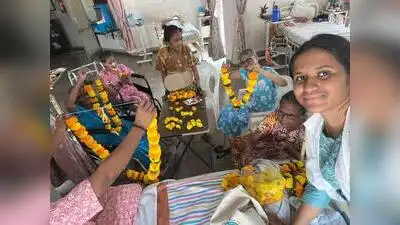
Patients at Shanti Avedna Sadan preparing garlands for the festive season
In Heartbeats of India’s First Hospice, a chronicle of its early years, Dr de Souza recalls that in the 1970s, about 75% of patients admitted to Tata Memorial Hospital (TMH), where he worked for thirty years, were in advanced stages of the disease, and most died despite treatment. For 18 days, in 2003, one of those beds was occupied by Jyotsna Arekar’s husband. Donations of provisions, diapers, medicines and even ice cream keep the hospice running; costs come to about Rs 40 lakh a month.
“Palliative care was not known in India before we started,” says founder Dr Luis Jose de Souza, better known as “Lucito”. “People only knew about conventional medical care,” he added. “He was 40 when he was diagnosed with lung cancer,” says Arekar, a cook, who learnt of the hospice through a doctor. Gifts of gratitude, however, are accepted only after a patient has passed, says administrator and trustee Sr Suma Maliakal, who stresses that patients pay nothing during stays that can last a couple of days or a few years. In the 70s and 80s, says Dr Suresh Advani, who worked alongside Dr de Souza at Tata Memorial and knew of his plans, end-stage patients were often told nothing more could be done; treatment was primitive and success rates low.
It began with an oncologist’s resolve to offer free palliative care to patients with advanced cancer, many of whom he had seen waiting out their time alone and in pain. Palliative care aims to relieve pain and manage symptoms; once offered only after treatment had run its course, it is now prescribed alongside it. Many begged not to be sent home, having no one to clean their wounds or care for them. What was needed, he realised, was a model of care that combined hospital and home. “I had three children to look after and no money. Arekar stayed with her husband at Shanti Avedna, leaving her school-going children in the care of neighbours in Kurla, and returning home every couple of days to cook for them. Fourteen years is the longest a patient has stayed. Most don’t make it past a year. Yet, for those who can’t afford or manage it, places like Shanti Avedna are a lifeline.
The hospice continues to hold an important place in cancer care today, not only for its facilities, but for having seeded the concept of palliative care in the country. Today, says Dr Boman Dhabhar, an oncologist at Fortis Healthcare, palliative care is recommended alongside treatment, and the hospice model is replicated at home.
Today, a gathering will once again assemble at Shanti Avedna in Bandra to celebrate the institution’s forty years of service to more than 40,000 patients across its centres in Mumbai, Delhi and Goa.