
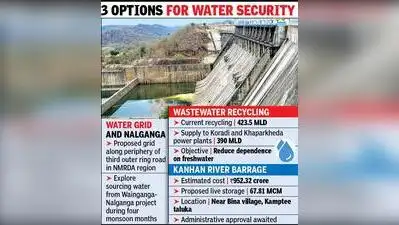
Nagpur: With Nagpur’s population expected to grow further over the coming decades, Nagpur Municipal Corporation (NMC) is preparing a detailed project report (DPR) to assess the city’s water requirements until 2047.
“The existing water planning takes into account a population of 30 lakh and a per capita requirement of 135 litres per day till 2031. We are now working on the city’s water demand till 2047, keeping future population growth in mind, and exploring three possible measures to ensure adequate supply,” Dani said. Based on the current planning population of 30 lakh and the prescribed norm of 135 litres per capita per day, the city’s calculated daily requirement works out to 405 million litres per day (MLD). However, Dani said NMC currently supplies around 770 MLD, a difference of 365 MLD over the calculated requirement.
The gap raises questions about actual consumption, distribution efficiency and water losses. However, the difference cannot automatically be classified as wasted or unaccounted for water. A detailed assessment of consumer demand, distribution losses and other requirements would be necessary to establish how the current supply is utilised.
The Rs94,912 crore Wainganga-Nalganga river-linking project envisages transferring surplus water from the Wainganga basin towards the Nalganga in the Tapi basin. Nagpur currently recycles 423.5 MLD of sewage water, including 390 MLD supplied to the Koradi and Khaparkheda thermal power plants. The third option is the proposed Rs952.32 crore Kolar-Kanhan barrage near Bina village in Kamptee taluka. The proposed 438-metre structure would have a live storage capacity of 67.81 million cubic metres (MCM). On Oct 29, Totladoh held 356.22 MCM, or 35.03% of its designed live storage capacity, compared with 94.05% on the corresponding date last year. The combined live storage of Totladoh, Navegaon Khairy and Khindsi stood at 477.71 MCM, or 37.87% of their combined designed live storage capacity.
You Can Also Check: Gold Rate in Nagpur | Silver Rate in Nagpur | Bank Holidays in Nagpur | Public Holidays in Nagpur | Petrol Price in Nagpur | Diesel Price in Nagpur | CNG Price in Nagpur | LPG Price in Nagpur Stay updated with the latest Nagpur news. However, the availability of water specifically for Nagpur’s municipal supply, the infrastructure required to transport it and the sharing arrangements would need to be established before it can be treated as a dependable alternative. The second option is to expand water recycling and explore water swapping. Increasing reuse for suitable non-potable purposes could reduce the demand for fresh water and help reserve more of it for domestic consumption. Its detailed project report and design have been prepared by the Central Designs Organisation, Nashik, and the proposal has been submitted to the state govt for administrative approval. Funding arrangements and land-related processes remain to be resolved. The long-term planning exercise comes amid a sharp decline in Pench reservoir storage. Download the TOI App.
the new exercise will project future population growth and the corresponding increase in demand, with the civic body exploring three options to strengthen long-term water security While the existing water supply planning is based on a population of 30 lakh till 2031.
Standing committee chairperson Shivani Dani Wakhare told TOI that NMC was examining the creation of a water grid along the periphery of the proposed third outer ring road in the Nagpur Metropolitan Region Development Authority (NMRDA) area, sourcing water from the proposed Wainganga-Nalganga project during the monsoon, and increasing wastewater recycling alongside a proposed barrage on the Kanhan river.