
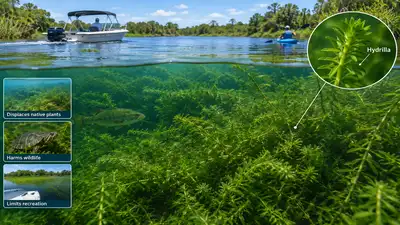
Representative Image of hydrilla overtaking a Florida waterway, displacing native plants and disrupting wildlife and recreational activities (AI-generated image)
Within about 40 years of its introduction, the plant had established populations in more than 70% of Florida’s watersheds, according to the University of Florida’s Institute of Food and Agricultural Sciences (UF/IFAS) guide, Hydrilla Integrated Management. The US Geological Survey (USGS) records Florida’s first observation in 1952 and says the plant is now established in 28 US states, as well as Guam and Puerto Rico. Aquarium plants should never be released into lakes, canals or rivers.
An aquatic plant imported for home aquariums became a major management problem in Florida after it entered the state’s freshwater systems in the 1950s. Hydrilla, a submerged plant native to parts of Asia, can grow rapidly, form dense mats near the water’s surface and spread through fragments carried between water bodies. Its spread has complicated boating, threatened native aquatic vegetation and created a costly, ongoing challenge for waterway managers. For boaters and aquarium owners, preventing further spread remains important. The FWC advises people to clean boats, trailers, live wells and gear before leaving a water body, and never to transplant hydrilla between waterways. Preventing a small fragment from reaching a new water body can help avoid another expensive infestation. You use AI every day. Now get your AI Quotient. Take the AIQ test.
How hydrilla affects native plants, waterways and wildlife
Hydrilla had established populations in more than 70% of Florida’s watersheds within 40 years of its introduction, according to the UF/IFAS guide. In its January 2026 revision, the USGS listed hydrilla as established in 28 states, in addition to Guam and Puerto Rico. Its database records the plant in 42 Florida drainage units, although a drainage-unit record does not necessarily mean that every water body in that area is infested. The USGS database records Florida observations from 1952 through 2026. The University of Florida’s plant directory reports growth rates of 1 to 4 inches per day. A 2012 study by Glomski and Netherland examined commonly cited growth rates and found that growth varied depending on whether researchers measured individual shoots or the expansion of the plant as a whole. The guide dates to 2014, so the experiment should not be interpreted as a newly conducted study. The plant can also grow in low-light conditions, requiring as little as 1% of full sunlight. It is frequently found at depths of around 9 feet and has been recorded at 45 feet in Kings Bay, Crystal River, Florida. The UF/IFAS guide says about 80% of its biomass is concentrated in the upper 2 feet of the water column. About 50% of fragments with just 1 whorl of leaves can regenerate into new plants. The UF/IFAS guide says the state spends millions of dollars each year managing the plant, but that figure is a broad estimate in a guide published in 2014, not a verified current annual expenditure. The guide’s estimated costs include $400 to $1,000 per acre for hand pulling and $100 to $500 per acre for herbicide treatments.
Because individual plants have both male and female flowers, was first detected in the Mid-Atlantic region, including Delaware and the Potomac Basin, a separate form, known as monoecious hydrilla. Management therefore involves balancing access for people with the protection of native vegetation and aquatic ecosystems. An aquarium owner released it into a freshwater body in the Tampa Bay area.
The UF/IFAS guide says the female, or dioecious, form of hydrilla reached Florida from Asia in the 1950s as an aquarium plant. The guide says each tuber may produce a plant capable of generating several thousand new tubers per square metre. The USGS says its surface mats block sunlight from reaching native plants and can obstruct boating, swimming and fishing. Florida’s Fish and Wildlife Conservation Commission (FWC) says a permit is generally required before people control or remove aquatic plants from state waters, unless a specific exemption applies.
The USGS database also records that plants imported for aquariums entered Florida’s inland waters after being discarded or planted into canals in Tampa and Miami. The plant spread quickly. Its distribution expanded from early records in the 1950s to much of the state by the 1990s. The Florida invasion involved the female form, which reproduces without needing a male plant. The USGS describes it as a separate introduction, while the UF/IFAS guide identifies Korea as its suspected origin. Hydrilla is a fast-growing submerged plant. Once the stems reach the surface, hydrilla forms a dense canopy that blocks light from reaching other submerged plants. Its ability to reproduce through several routes makes control more difficult. Hydrilla spreads through stem fragments, underground tubers and buds known as turions. The USGS identifies recreational boats, motors, trailers and live wells as common ways hydrilla fragments reach new water bodies. Fragments can take root and establish new colonies, often near boat ramps. Tubers can also remain dormant in sediment for years, allowing infestations to return after visible growth has been removed. Dense hydrilla growth can crowd out native aquatic vegetation and interfere with waterway use. Heavy infestations can also interfere with water withdrawals for irrigation and power generation. The UF/IFAS guide describes additional environmental effects. Dense growth can restrict water flow through rivers and canals, while the decay of plant material can contribute to sediment accumulation. Changes in light and oxygen conditions can affect other aquatic organisms. The guide also notes that hydrilla can provide a habitat for a cyanobacterium that produces a toxin associated with neurological disease in waterbirds, including bald eagles and American coots. The plant’s effects depend on the water body and the extent of the infestation. Its dense growth can provide habitat for some organisms while reducing the range of conditions available to others. Florida uses a combination of physical removal, herbicides and biological controls to manage hydrilla. These are historical estimates and should not be treated as current quotes. The guide also documents hydrilla populations resistant to the herbicides fluridone and endothall, highlighting the limitations of relying on chemical control alone. Biological control is another option. Triploid Asian grass carp, which are sterile, can be used to consume aquatic vegetation, but their possession and stocking are regulated and require the appropriate permits. Researchers have also studied insects that feed on hydrilla, although biological control does not necessarily eliminate an infestation. The agency also warns that possessing hydrilla in Florida without special permission is illegal.