
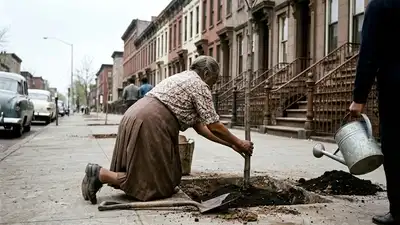
AI-generated representative image showing an elderly resident planting a young street tree on a Brooklyn brownstone block during the 1960s. Credits – Gemini
In 1966, Hattie Carthan, then in her mid-sixties and living on Vernon Avenue, helped organise the Bedford-Stuyvesant Beautification Committee. A block that lost its trees Carthan was born in Virginia in 1900, and her family moved to New York in 1928. She settled on Vernon Avenue in 1953, when the block still had a line of street trees. By 1964, only three of the original trees remained. In 1965, the association held a barbecue, selling plates for $1.25 and raising $200, enough to buy four trees. A deal with City Hall At the association’s second barbecue in 1966, Carthan invited Mayor John Lindsay. The Parks Department announced the partnership in 1967, describing it as a joint effort between community groups and city agencies.
They just thin out, and in the 1960s many blocks in Bedford-Stuyvesant, Brooklyn, lost trees that were never replaced.
Some neighbours called her a “tree nut,” but the first saplings gave the campaign a visible start. Seldom do street trees receive the recognition they merit. They make a row of brownstones feel more like a neighbourhood than a hallway, chill the pavement, and muffle the cacophony of a busy block. No one sends a notification when they pass away. One resident chose to act. Her campaign connected neighbourhood groups with city officials and turned tree planting into a broader community movement. She later helped protect a historic magnolia and establish an environmental centre. That year, she and seven neighbours formed the T&T Vernon Avenue Block Association after she sent postcards inviting residents to join the effort. Winning support took persistence. Some neighbours worried that leaves would mean more raking and extra rubbish, while others questioned the value of replacing the trees. Carthan argued that trees would improve the street’s appearance and property values. He agreed to support a tree matching program under which the city would plant six trees for every four planted by residents. The department’s contemporary announcement outlined the plan.
The Bedford-Stuyvesant Beautification Committee eventually brought together more than 100 block associations, and the movement planted more than 1,500 trees, including ginkgo, sycamore, honey locust and elm. In 1967, the city also budgeted $1.2 million for tree planting and care, although the available record does not establish that Carthan’s campaign directly caused the budget decision. In 1971, Carthan and her colleagues established the program with a grant from the New York State Council on the Arts. Planted in 1885, the Southern magnolia faced a threat when redevelopment plans put the neighbouring brownstones at risk. The city designated the magnolia a living landmark in 1970. Carthan also worked to secure the three neighbouring brownstones, negotiating the proposed purchase price down from $25,000 to $1,200. The Magnolia Tree Earth Centre was established in 1972 and incorporated as a nonprofit in 1973. Fundraising concerts featuring folk singer Pete Seeger in 1974 and 1977 supported the effort to establish a permanent neighbourhood institution. The buildings later became the center’s headquarters, which opened to the public after renovation in 1979.
The campaign grew beyond one block. The historical record of the Hattie Carthan Collection documents the committee’s reach and planting total. The Neighbourhood Tree Corps came later. It taught young people how to care for street trees, extending the campaign’s work to a new generation. AI-generated representative image showing a mature southern magnolia. Credits – Gemini The magnolia and the Earth Centre The magnolia on Lafayette Avenue became another focus of Carthan’s work. At a public hearing, Carthan argued that saving the tree could also preserve the buildings behind it: “If we save the tree, we save the structures behind it. She formed the Magnolia Tree Committee, raised money for a protective wall and campaigned for landmark status. The Brooklyn Botanic Garden’s history of Carthan and the magnolia documents the preservation campaign and the importance of the surrounding buildings.
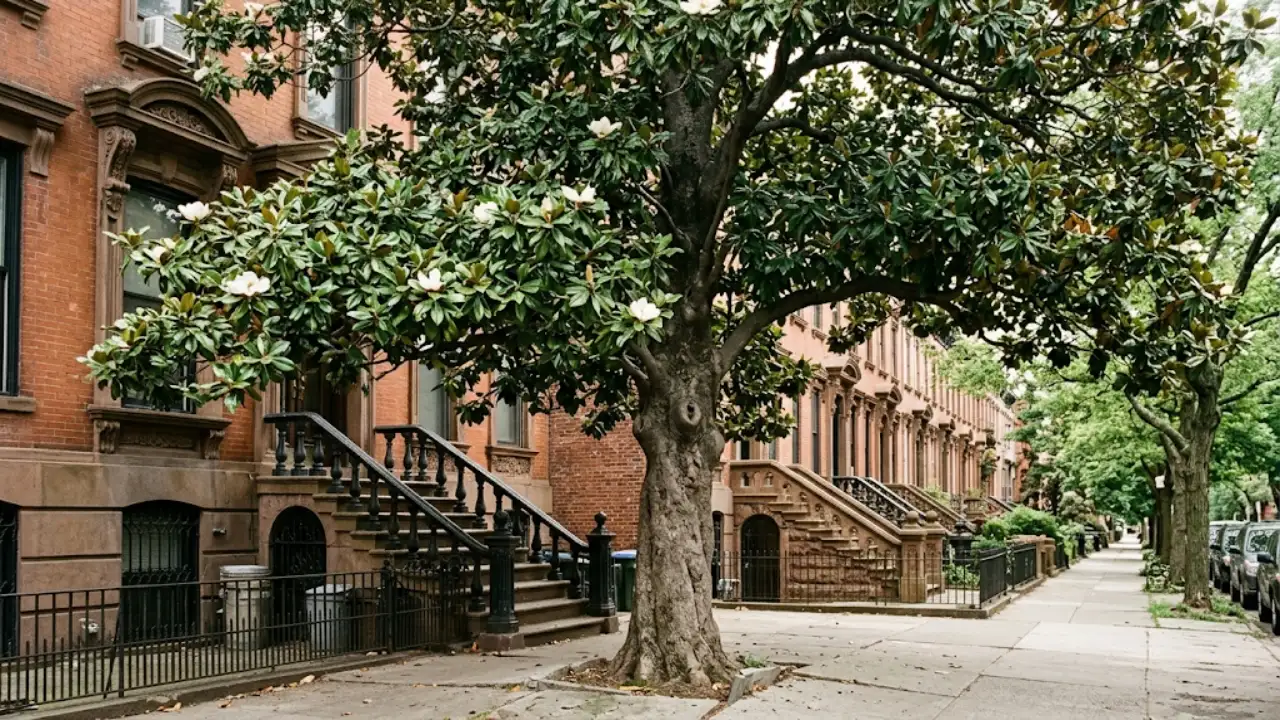
She died in 1984, but her work continued through neighbourhood planting and environmental education. In 1998, the garden beside the Earth Centre was named in her honour. Carthan also helped establish the Green Guerillas, a group involved in the community garden movement. Some trees planted during her campaign still stand, reflecting the lasting impact of a movement that began with a small block association and a handful of saplings. You use AI every day. Now get your AI Quotient. Take the AIQ test.