
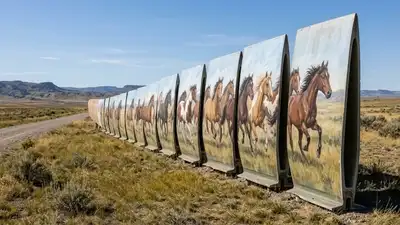
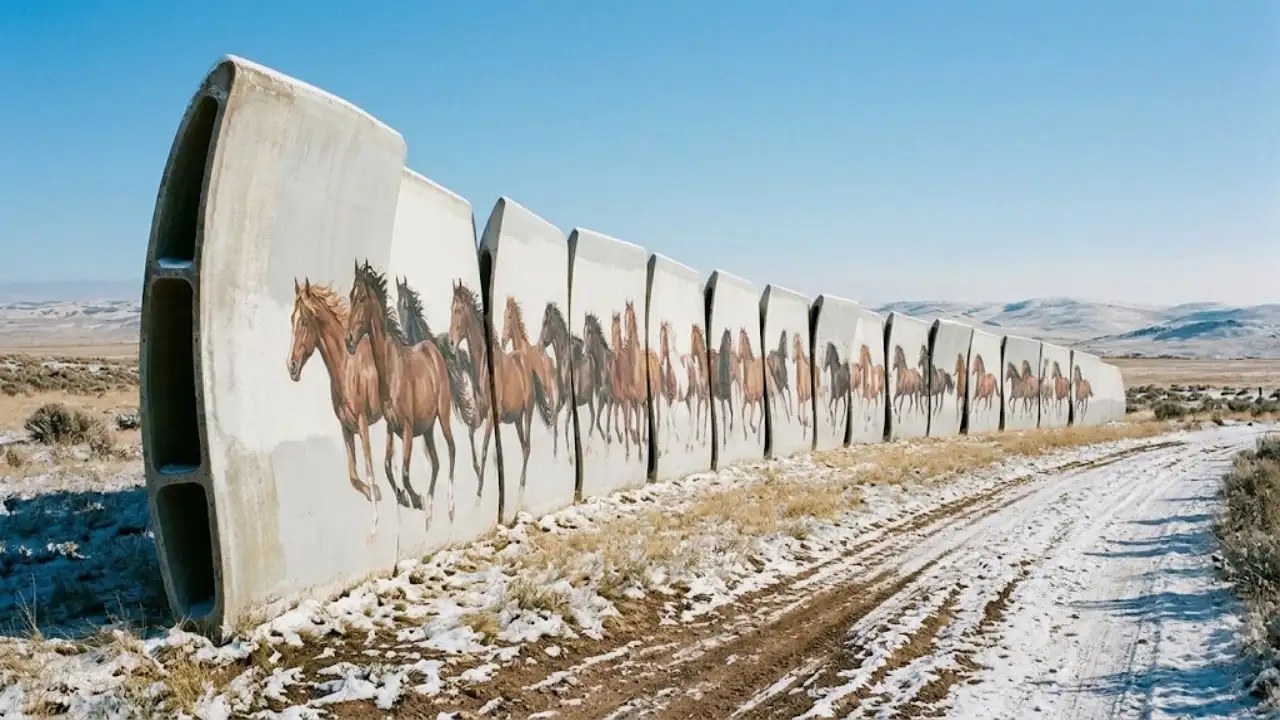
AI-generated representative image showing a herd of painted mustangs across reclaimed wind turbine blade sections forming the Windborne installation near Esterbrook, Wyoming. Credits – Gemini
The 12 sections represent the 12-step recovery process associated with the mission’s work with people experiencing addiction and homelessness. Navarro led painting workshops in Casper, and mission residents and community volunteers painted 40 running mustangs across the sections during the summer. The finished work was dedicated on October 3, 2026, with about 50 people attending.
A local pastor held a small protest at the entrance, called the sculpture a scam and said it spoils the view, and one other resident turned up in support of him. Navarro took the criticism calmly and said an artist cannot please everybody. Credits – Gemini Kathy Ahlenius, WYDOT’s winter research project manager, said the department had discussed using reclaimed turbine blades as snow fences before, but had not had funding for a test.
There is a lingering problem with clean energy: what to do with wind turbine blades when they reach the end of their working life. Made from durable composite materials, the blades are difficult to recycle and can extend for dozens of metres. In Wyoming, some retired blades have been buried or stockpiled, prompting efforts to find practical ways to reuse them. A local wild horse adoption and training ranch also contributed. Not everyone was pleased. AI-generated representative image showing the tall, curved fibreglass sections of Wyoming’s Windborne installation, repurposed as a painted Mustang mural and experimental snow fence. She hopes the winter weather near Esterbrook will provide enough snow for the team to assess how effectively Windborne controls drifting. The sections may need less maintenance than conventional wooden fences, but their performance must be assessed under real winter conditions.
WYDOT’s Winter Research Services team, established in 2004, studies blowing snow and advises on snow fence placement and winter road maintenance. The mural is the most visible part of Windborne, but the main practical question is whether the sections can catch blowing snow before it reaches the road. Its work includes monitoring conditions during storms to understand how snow drifts form. The department’s Winter Research Services page explains the team’s role and the benefits of snow fences.
The physical snow fence was installed near Esterbrook in Converse County, Wyoming, in late 2025. In 2026, sculptor Chris Navarro and community volunteers painted 40 running mustangs across the 12 sections, transforming the structure into a 120-foot public art installation. The finished work, named Windborne, was dedicated on October 3, 2026. Its sections stand about 8 feet tall, while the full arrangement extends 120 feet. The Wyoming Department of Transportation will monitor its performance during the winter of 2026 to 2027 to determine whether it can effectively control drifting snow. Wyoming passed House Bill 129 in 2020, directing the state to establish rules for using retired turbine materials in surface mine reclamation. In January 2025, the federal Office of Surface Mining Reclamation and Enforcement approved an amendment to Wyoming’s regulatory programme allowing inert, decommissioned blades and towers to be used as backfill in approved areas of surface coal mines. The rule took effect on February 12, 2025. Casper sculptor Chris Navarro, who has worked professionally as an artist for about 40 years, began exploring artistic uses for retired turbine blades nearly six years ago after seeing a photograph of blades being buried. Twelve sections were selected and planted upright on private ranch land near Esterbrook, along Wyoming Highway 94, with ReviablEnergy helping to install them. The sections stand about 8 feet tall and are arranged across a total length of 120 feet.
The artist’s official project page documents the installation’s dimensions and dedication. Why old blades cause so much trouble The difficulty of recycling retired blades has led to several disposal and reuse proposals. This limited use is subject to reclamation requirements; it is not a general approval to dispose of turbine materials anywhere in a mine. Separately, Jake Milne founded ReviablEnergy after seeing discarded blades at the Casper landfill and began looking for practical ways to reuse them. Their interests came together in Windborne, which combines Navarro’s artwork with the snow fence concept Milne wanted to test. Navarro has described the installation as his sixth idea for reusing a turbine blade. Building Windborne Vestas donated a retired turbine blade and helped with the technical design. A Vestas engineer assisted with cutting the blade into sections and recommended how to space them. The ranch owner agreed to host the test after the Wyoming Rescue Mission sought a snow fence to help keep its access road open during winter. The length describes the full fence and mural, not the length of an individual section. What WYDOT will be observing Windborne’s artistic message is already visible, but its value as a snow fence remains to be tested. The winter monitoring will show whether the retired blade sections can control drifting snow while giving a difficult-to-recycle material another use. The installation brings public art and a practical engineering trial together, although its long-term effectiveness will depend on how it performs in real winter conditions. You use AI every day. Now get your AI Quotient. Take the AIQ test.