Mumbai faces severe air pollution challenges, primarily driven by rapid urbanization and industrial growth that extends beyond city limits
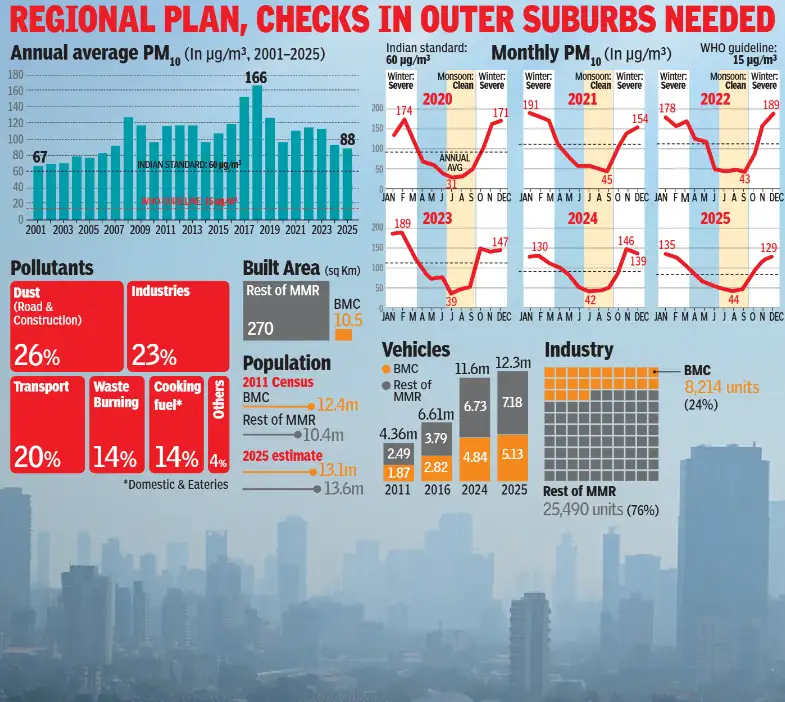
Ask any Mumbaikar, and they will tell you about the haze: a grey blanket over the skyline that was rare 20 years ago but is now routine. Until 2006, Mumbai’s annual average PM10 levels hovered around 60-80 µg/m³, low by Indian standards. After 2006, it climbed, reaching 166 µg/m³ in 2018. Official data show a decline since then, yet the city’s PM10 level in 2025 was 88 µg/m³, 1.5 times the national standard. In the peak months, PM10 levels run 3-4 times the national standard. In winter, Mumbai’s air can be 10-15 times what the WHO considers safe. In this airshed of 7000 sq km, the Brihanmumbai Municipal Corporation (BMC) controls just 6% of area. Since 2011, MMR has added at least 3.9 million people, with 3.2 million settling outside BMC. In 2011, more people lived inside Mumbai; in 2025 it has reversed. Since 2017, BMC has added about 10.5 sq km of new roads, bridges, buildings and other built-up areas. The rest of MMR has added 270 sq km. Registered vehicles in MMR have nearly tripled since 2011, from 4.36 million to 12.31 million. Of the 33,700 odd industrial units that the Maharashtra Pollution Control Board (MPCB) monitors in MMR, only 25% are in Mumbai; the other 75% are outside. However, the latest inventory of BMC, which can be used broadly for MMR, finds that dust from roads and construction (26%), industries (23%), transport (20%), waste burning (14%) and cooking fuels in homes and eateries (14%) together account for about 96% of the PM10 load. Put teeth into enforcement MMR has about 19,000 polluting industries, and they account for a third of the region’s pollution. Build without dust storms With more than 10,000 construction sites across MMR, dust cannot be controlled by just sending inspectors to sites. Public transport and EVs Nearly 65% of all trips in MMR are already made on public transport, the highest in India. Even so, the number of vehicles has nearly tripled since 2011. MMR can take the lead by banning new petrol or diesel vehicle registration from 2031. Satellite fire detections rose from 5,716 in 2022 to 7,810 in 2025. Clean cooking fuel About 45% of MMR’s population lives in slums and rural settlements, where solid fuels are still used alongside LPG; bakeries and eateries also burn wood and coal. Monitor with purpose 70% of continuous monitoring stations are in Mumbai and Navi Mumbai; vast areas in MMR are unmonitored.
Implement these, and Mumbai’s pollution can be more than halved in five years. (The writer is CEO, iFOREST, an independent environment research body) You Can Also Check: Gold Rate in Mumbai | Silver Rate in Mumbai | Bank Holidays in Mumbai | Public Holidays in Mumbai | Mumbai AQI | Weather in Mumbai | Petrol Price in Mumbai | Diesel Price in Mumbai | CNG Price in Mumbai | LPG Price in Mumbai Stay updated with the latest Mumbai news.
This is what Beijing’s “One Million Acres” afforestation project did to control dust. They are not imagining it. Ground monitors and satellites agree. But annual averages hide the worst of it. Mumbai’s pollution is seasonal: relatively low from June to September, when the monsoon scrubs the air, and high to severe from October to March. And our standard is lenient. Regional plan, checks in outer suburbs needed Q: Why has a city that once prided itself for clean air and mocked Delhi for its smog, deteriorated so rapidly? An airshed, not a city Mumbai’s pollution is influenced by its airshed, which covers, at a minimum, the Mumbai Metropolitan Region (MMR) and surrounding industrial belts. This geography is bounded by the Arabian Sea to the west and the Western Ghats to the east. During winters, when the air is clammy and cold, the Western Ghats partly wall off the east, trapping the pollution within this basin. Over the last two decades, while Mumbai grew, the rest of MMR exploded. Population. Built-up area. In eight years, an area the size of Nashik Municipality has been built outside Mumbai. Vehicles. But six in ten are now outside BMC. Industry. In short, massive urbanisation, motorisation and industrialisation have occurred, largely outside BMC. That is where the significant pollution spike comes from. Yet every winter, mainly BMC’s action is in spotlight. Without cleaning up MMR, Mumbai’s air cannot be cleaned. What pollutes Mumbai There is no pollution inventory for MMR. What MMR must do Think regional MMR needs a regional clean air plan and a regional air quality authority to coordinate action across municipalities, agencies and authorities. Unlike Delhi, where five states must agree on regional action, everything here is in Maharashtra’s hands. Develop implementable plans The current clean air plans of Mumbai, Navi Mumbai, Thane, Vasai-Virar, Ulhasnagar and Badlapur have weaknesses: vague actions and responsibilities, lack of targets and unrealistic timelines. The regional plan should have clear responsibilities, targets, budgets and deadlines. Don’t copy Delhi Mumbai should resist the temptation to import Delhi’s most visible responses, such as odd-even, cloud seeding and bans under GRAP. Such reactive measures hurt the poor and the environment without cleaning the air. Two shifts are needed: industries must switch to gas or electricity, and online monitoring must be strengthened. For example, the region has hundreds of small industrial boilers that burn two million tonnes of coal each year. Their pollution can only be reduced by shifting to cleaner energy and by using shared boiler facilities. Enforcement must improve at the same time. Many industries have continuous emissions monitoring systems (CEMS), but these are poorly operated. MPCB should verify CEMS data quality, use it for compliance checks and take strict action for non-compliance. Dust prevention must be built into project designs as a formal dust management plan approved by authorities. This must be complemented by online monitoring and independent third-party audits to check compliance. The region has two levers: increase the share of public transport further and electrify everything else. End waste burning While waste management has improved, burning of municipal waste and plastics is prevalent in and around Deonar, Dharavi and other slum-heavy wards, especially for recycling. There should be zero tolerance for waste burning. Control fires Forest and farm fires are increasing in MMR. The government must implement a fire-control plan. The shift to LPG and electric cooking is both viable and achievable with government support schemes. Green the region Road sweeping alone will not solve the dust problem. MMR must launch a greening scheme to plant grass along suitable road edges, green open land and expand tree cover and other greenery. The region needs a monitoring system that can pinpoint pollution hotspots, identify sources and guide interventions. This requires evenly distributed continuous monitors, a dense network of low-cost sensors and satellite monitoring. By triangulating data, targeted action can be taken in real time. Download the TOI App.