
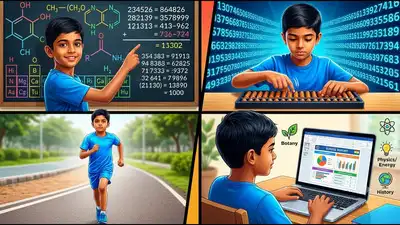
Salem’s Abyank Kannaa M.V. has reportedly set 21 records across academics, mathematics, memory, devotional activities and sports. His achievements include explaining complex science topics, solving advanced mathematical problems and completing a continuous 10-kilometre run in 59 minutes. (AI generated representative image)
He has reportedly set 21 national and international records across academics, memory, devotional activities, technology and sports within just three months. Abyank completed a continuous 10-kilometre run in 59 minutes, an accomplishment officially recognised by Kalam’s World Records. 5 Oct 2026 | 12:06 Abyank’s academic achievements cover several subjects that are usually introduced at different stages of schooling. He explained 47 Chemistry topics, covering areas such as Physical Chemistry, Organic Chemistry, elements and mixtures, in 35 minutes and 7 seconds, according to the India Book of Records. He solved 40 advanced arithmetic problems involving eight-digit numbers, covering addition, subtraction, multiplication and division, in 1 hour, 7 minutes and 36 seconds. Another unusual achievement involved recognising and reciting 50 randomly displayed numbers, each containing between 24 and 52 digits. He completed the task in 38 minutes, 15 seconds and 36 milliseconds. Abyank has also explained 100 Physics concepts, including electricity, sound, work, energy and force, in 1 hour, 3 minutes and 43 seconds.
A child who can explain complex science concepts, solve advanced mathematical problems and recite extraordinarily long numbers might already stand out in a classroom. But Abyank Kannaa M.V. from Salem, Tamil Nadu, has taken his abilities beyond the usual school environment. Among these achievements, one stands out for its physical demands. His achievements offer an interesting glimpse into the many ways children can explore their abilities when given opportunities to learn and practise. His mathematical abilities have also earned recognition. His achievements are not limited to calculations and memory tests.
His English-related achievements include reading 1,382 consonant-vowel-consonant words and explaining 24 advanced grammar concepts with examples. He was recognised by the India Book of Records for continuously chanting the Hare Krishna Mahamantra for 4 hours and 8 minutes. In mathematics, he solved 300 mixed-digit addition problems using the mental abacus method in 10 minutes and 52 seconds. He also completed 300 multi-digit subtraction problems in 14 minutes. His achievements further include independently creating an expert-level Microsoft Word school report using advanced layout features in 38 minutes. Perhaps the most physically demanding achievement on the list is his continuous 10-kilometre run. Abyank completed the distance in 59 minutes, with Kalam’s World Records officially recognising the achievement.
He has received recognition for explaining topics across Botany, Zoology, History and Human Anatomy. These records highlight an important distinction between remembering information and explaining it. The ability to put a concept into simple words is another skill that requires practice and understanding. Abyank’s interests also extend beyond academic subjects. Running for nearly an hour requires sustained physical effort. For a child, the focus should remain on age-appropriate training, adequate nutrition, hydration and recovery rather than simply chasing faster timings. Abyank’s accomplishments are worth celebrating, but they also offer a larger lesson about childhood. Children develop different interests and abilities, and not every child needs to excel in the same areas. Academic records, memory challenges and sporting achievements can be encouraging milestones. However, childhood must also leave room for friendships, play, rest and emotional development. The real value of such achievements lies not only in the records themselves but also in the curiosity, discipline and enjoyment of learning that can accompany them. Recognition is meaningful, but a child’s well-being should always remain more important than another certificate. Disclaimer: The achievements and timings mentioned above are based on records and information attributed to Kalam’s World Records and the India Book of Records. The article does not independently assess the child’s physical or academic abilities. You use AI every day. Now get your AI Quotient. Take the AIQ test Get the latest Lifestyle News and more. Download the TOI app.