
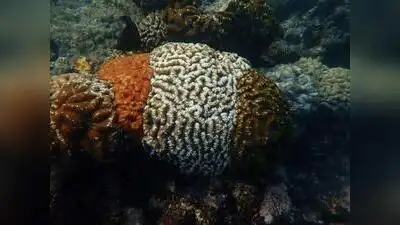
The Gulf of Mannar and Palk Bay reefs, already categorised as Endangered, face a similar escalation in risk
In India, the Andaman and Nicobar, Lakshadweep and Gulf of Kachchh reefs, historically classified as Vulnerable, are projected to become Critically Endangered.
It found that 96% of the assessed coral reef ecosystem units globally, accounting for 99.8% of the total assessed reef area, are projected to fall into the Critically Endangered category when future ocean warming and marine heat stress are factored in. All 13 coral reef ecoregions across India, Bangladesh, Sri Lanka, the Maldives and the Chagos Archipelago, spanning approximately 8,282.6 sq km, are projected to become Critically Endangered over the next 50 years under climate-change scenarios. Together, these reefs account for nearly 4% of the world’s coral reef area. The bleaching events of 1998 and 2016 underline how vulnerable these ecosystems are to rising sea temperatures.
Kolkata: India’s four major coral reef regions — the Andaman and Nicobar Islands, Lakshadweep, the Gulf of Mannar and the Gulf of Kachchh — are staring at a critically endangered future, with rising ocean temperatures and increasingly intense marine heatwaves threatening to push these fragile ecosystems towards collapse. A landmark global assessment, co-authored by scientists from the Kolkata-headquartered Zoological Survey of India (ZSI), has warned that none of the country’s coral reef regions will remain untouched by the escalating climate threat over the next five decades. The first-ever global assessment of coral reef ecosystems under the International Union for Conservation of Nature’s (IUCN) Red List of Ecosystems, unveiled at the UN Biodiversity Conference (COP17) in Yerevan, Armenia, has sounded an unprecedented alarm over the future of the world’s reefs. Unlike the conventional IUCN Red List, which assesses the extinction risk of individual species, the Red List of Ecosystems evaluates the risk of entire ecosystems collapsing. Four ZSI scientists — Dr C Raghunathan, Dr Tamal Mondal, Dr J S Yogesh Kumar and Dr Chandran Rethinaraj — co-authored the South Asian regional assessment. Their contribution draws on decades of work in coral taxonomy, underwater field surveys, reef mapping and marine biodiversity monitoring. Marine heatwaves and mass coral bleaching emerged as the most significant threats identified by the researchers. The threat is further compounded by coastal development, dredging, sedimentation, land-based pollution, marine debris and overfishing, all of which undermine the ability of reefs to recover from thermal stress. The researchers have stressed that improving water quality, enforcing stricter coastal zoning, promoting sustainable fisheries management and investing in reef restoration can help build resilience. However, such local conservation interventions, while essential, cannot independently counter the scale of the climate threat.