
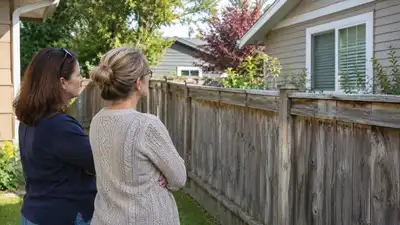
The dispute began after the sisters bought their home in 2019 (AI image)
On July 21, the Washington Court of Appeals upheld an order requiring them to remove a fence encroaching on one neighbour’s land. The dispute began after the sisters bought their home in 2019, according to the ruling . The survey, completed in October 2023, found that both fences stood a few feet west of the legally recorded property boundaries. In January 2024, the sisters filed a lawsuit naming both neighbours. In a sworn declaration filed in December 2024, Helene had acknowledged that the survey placed the fence between 1.83 and 4.06 feet west of the recorded boundary.
Because it differed from what she had said earlier, that statement became important. Because of information provided by the estate agent, emily also testified that she initially believed the fence marked the correct boundary. Two sisters in Washington, US, who went to court over fences separating their home from neighbouring properties have lost their appeal after judges upheld rulings in favour of both neighbours.
During the trial, Dement said an old, damaged fence had separated the properties before either side bought their homes. The sisters replaced it after moving in, according to him. She said the old fence had been repaired and rebuilt rather than removed. She also told the court that she did not know whether it extended onto Dement’s property.
Emily and Helene Hofbauer had challenged property boundaries in Kennewick following a survey that showed the fences did not match the official boundary lines. It also upheld legal-fee awards to both neighbours and granted them additional legal fees for the appeal. Their property stood between two other houses, with Kevin Dement living to the west and Jessica Horst to the east. Fences separated the three properties, but questions about their positions eventually led the sisters to commission a survey. This meant the western fence extended onto Dement’s land, while the eastern fence stood inside the sisters’ property. They claimed rights over the strip of land beside Dement’s property, arguing that they and previous owners had used it openly and continuously for years. The case also brought Horst’s fence into question, although the original complaint did not clearly explain what action the sisters wanted against her. He could not say whether the new fence followed exactly the same line as the previous one. Helene gave a different account. She later learnt that it was not on the legal property line.
Because their original complaint had not clearly made a claim against her, they argued that Horst should not receive fees. Because they had voluntarily withdrawn their claim before trial, they also maintained that Dement should not qualify for fees. The appeals court therefore left the earlier decisions unchanged and granted Horst and Dement reasonable legal fees for defending the appeal.
It found that Horst had successfully defended herself and won her ownership claim. The trial court concluded that the fence stood on Dement’s land and ordered the sisters to remove it. The sisters challenged the decision, arguing that the trial court had not properly considered whether removing the fence would cause unnecessary hardship. Washington law allows courts to make exceptions in certain circumstances rather than automatically ordering an encroaching structure to be removed. However, the person seeking an exception must provide convincing evidence supporting it. The appeals court found that the sisters had not done so. They had provided no evidence of the cost of removing or relocating the fence, or of the value of Dement’s land affected by it. The judges also rejected their argument that the trial court had improperly relied on a survey that was not admitted as evidence. The sisters separately challenged the legal fees awarded to both neighbours. The appeals court rejected both arguments. Dement was also treated as the successful party after the sisters withdrew their claim against him. The judges found that the lower court had properly examined the legal bills and assessed whether the amounts were reasonable. The ruling did not specify the final dollar amounts of the awards. You use AI every day. Now get your AI Quotient. Take the AIQ test.
It also rejected Helene’s attempt to take a position inconsistent with her earlier court statements.
How the two neighbours responded
Under Washington law, a person may claim ownership of another person’s land after possessing it openly, exclusively and continuously under certain conditions for at least 10 years. Because the fence had been there since 2007, she acknowledged that her fence extended onto the sisters’ land but argued that she had acquired ownership rights over the enclosed strip. Dement rejected the sisters’ claim and asked the court to order the removal of the fence from his property. Horst took a different position. Both neighbours relied on a legal principle known as adverse possession. Horst argued that she had met those requirements. The sisters admitted they could not produce evidence to challenge her claim, and the trial court ruled in her favour. It recognised her ownership of the disputed eastern strip and dismissed the sisters’ claim against her. The dispute with Dement continued. Before trial, the sisters withdrew their claim to his land after the court excluded their expert witness. However, Dement’s request for removal of the fence remained unresolved, so the case proceeded.