
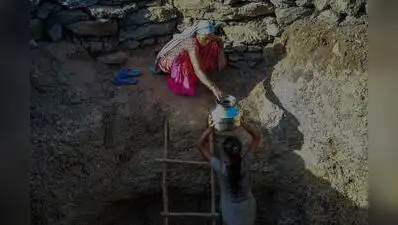
Gandhinagar: Gujarat faces a dilemma as a deficient monsoon tightens the squeeze on its water reserves, forcing the state to weigh drinking water security against mounting farmer demands for irrigation. As the clamour for water to save crops grows by the day, govt must decide how much water it can spare for agriculture without jeopardising drinking water supplies.
Senior officials said Gujarat could secure about 1 million acre-feet (MAF) of water from Madhya Pradesh’s Narmada share, potentially in exchange for electricity. As of Oct 28, North Gujarat’s 15 reservoirs held 29,659 million cubic feet (MCFT), or 43.5% of capacity, according to the state water resources department’s reservoir position report. Kutch was worse off, with its 20 reservoirs holding just 3,605 MCFT, or 31.4% of capacity. Saurashtra, another region where water availability is critical for agriculture and drinking needs, had 43,436 MCFT in its 141 reservoirs, equivalent to 47.5% of capacity. the region’s storage remains below half its capacity Although this was higher than the 33.8% recorded at the end of May. The report shows that 84 reservoirs had less than 25% of their capacity filled, while another 38 had storage between 25% and 50%. In all, 122 of the 206 reservoirs had less than half their capacity in storage. Central Gujarat’s 17 reservoirs were at 64.8% capacity, while South Gujarat’s 13 reservoirs held 76.7%. Sardar Sarovar Dam , the state’s principal water reservoir, was at 99.6% of its capacity, with 3,32,715 MCFT in storage. As of Oct 28, two dams in the state had an inflow of more than 100 cusecs, according to the water resources department report. Sardar Sarovar Dam had an inflow of 14,338 cusecs (outflow of 618 cusecs), while the Wanakbori dam had an inflow of 1,900 cusecs and an outflow of 200 cusecs.
Earlier this week, Gujarat govt declared four districts — Devbhumi Dwarka, Porbandar, Jamnagar and Kutch — drought-hit and announced several measures to aid farmers in these districts. You Can Also Check: Gold Rate in Ahmedabad | Silver Rate in Ahmedabad | Bank Holidays in Ahmedabad | Public Holidays in Ahmedabad | Ahmedabad AQI | Weather in Ahmedabad | Petrol Price in Ahmedabad | Diesel Price in Ahmedabad | CNG Price in Ahmedabad | LPG Price in Ahmedabad Stay updated with the latest Ahmedabad news.
“According to protocol, in a situation like the present one, water has to be reserved for drinking purposes. As of now, the attempt is to strike the right balance between allotting water for drinking and irrigation,” said a top source in the govt. “The situation in Kutch is particularly concerning, as storage was marginally lower than the 3,629 MCFT recorded on May 31 this year,” said a source. “These numbers indicate vulnerability of several local water systems despite a relatively comfortable statewide average,” an official said.
Chief minister Bhupendra Patel has held a series of meetings to assess the state’s water stock. He has also consulted chief ministers of states linked to the Narmada project to explore available options. This crucial relief measure could ease pressure but may not fully resolve the looming water crunch. However, the state is also exploring other options, such as receiving additional water from MP. Gujarat’s water storage remains unevenly distributed across the state, with North Gujarat and Kutch facing the greatest pressure as reservoirs in the two regions hold less than half their storage capacity, raising concerns over water availability for drinking and irrigation in the coming months. Central and South Gujarat presented a better picture. Download the TOI App.