
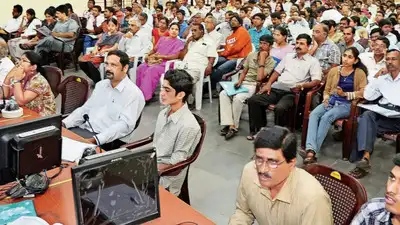
MBBS seat aspirants and their parents wait during a counselling session
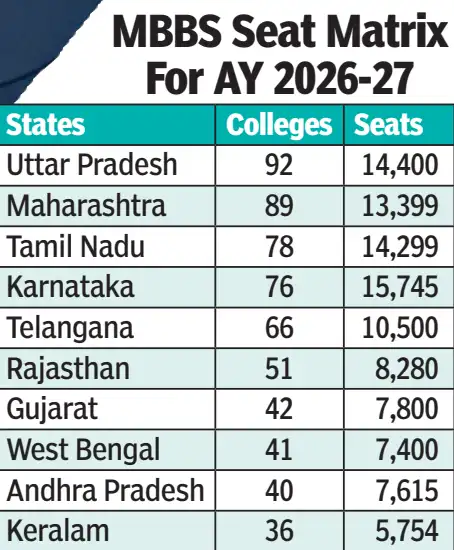
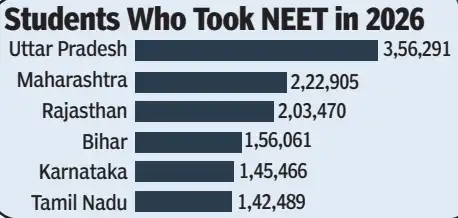
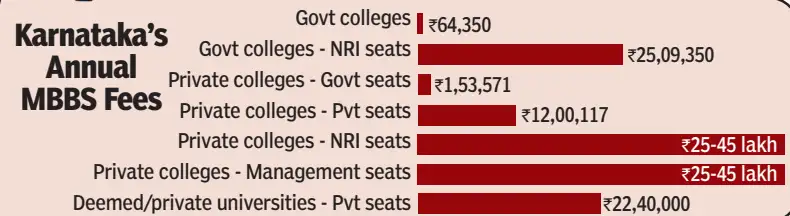
When nearly 23 lakh students this year competed for just 1.4 lakh MBBS seats in 839 medical colleges across the country, Karnataka had ended this year’s admissions cycle with no takers for 191 seats. Karnataka, which has the country’s largest MBBS seat capacity, added 1,650 seats this year. Yet, the high cost of private medical education — with annual fees ranging from Rs 25 lakh to Rs 45 lakh — appears to have left a section of that capacity unutilised. Some 2,000 MBBS seats remained vacant across India after this year’s counselling sessions, raising questions about whether the rapid expansion of medical colleges and seats is keeping pace with students’ ability to afford them. US election results: Flooding forces relocation of 21 polling sites in Florida US House election: Democrats need 3-seat gain to end Republican majority US Senate election: Can Democrats flip the Senate as Trump faces crucial test? In a last-minute decision, Centre’s Medical Counselling Committee on Oct 30 announced a nationwide special stray vacancy round of counselling to fill the vacant seats. Karnataka, with 1,45,466 registered medical seat aspirants, has the fifth highest number of candidates in all states. Interestingly, Karnataka has the highest number of MBBS seats in the country, 15,745 seats across 76 colleges. However, UP has 16 more colleges than Karnataka. It has 11,145 private MBBS seats, accounting for about 71% of its total capacity. A govt college in Karnataka has two fee quotas: normal seats have annual fees of Rs 64,350 and the NRI quota seat fees are Rs 25,09,350 annually. The govt seat fees are Rs 1,53,571, and private govt fees are Rs 12,00,117 annually. The NRI quota and ‘others’ aka management quota annual fees vary from college to college — as low as Rs 25,11,950 at Alva’s Institute of Medical Sciences and Research Centre or as high as Rs 45 lakh charged by MS Ramaiah Medical College, Sapthagiri Institute of Medical Sciences, and Sri Madhusudan Sai Institute of Medical Sciences and Research. This adds up to over Rs 2 crore for the 4.5-year MBBS degree. “I know of parents who are willing to sell their 60X40 site for Rs 2 crore, which they had purchased for Rs 40 lakh in 2010, to send their son to a MBBS college. Bengaluru medical colleges, especially Tier 1 colleges, charge exorbitantly high fees. While a govt MD/MS seat could range from Rs 40,900 to Rs 1,23,400, a dermatology seat at MS Ramaiah Medical College in management quota could cost as much as Rs 1,25,40,000 annually. Last year, fees for post-graduation in radiodiagnosis in this college were Rs 1,15,40,000 and general medicine Rs 1,00,40,000. The decision was made in 2025, despite criticism, to generate financial self-reliance and reduce heavy dependence on state grants, amongst govt institutions. The NRI seats in these colleges are charged at Rs 25.1 lakh annually. This year, 105 seats were available. “Many of them were offering the programme for Rs 75-80 lakh for 4.5 years, including hostel fees. Currently, a student needs to have 50 percentile (among the candidates who appeared for NEET) to be eligible for counselling.
We have been recommending that medical colleges must be watchful of the fees they charge,” said Dr Bhagavan BC, VC of Rajiv Gandhi University of Health Sciences, umbrella university for medical programmes in Karnataka. The cut-offs for colleges are proportional to the fees they charge,” said Dr Muniswamy Thimmegowda, parent. Many medical seat aspirants are opting for BDS instead, said career counsellor Al Khwaja, founder of Banjara Academy. “For students and parents who are obsessed with the doctor tag, BDS is becoming a more affordable option,” he added. The prospective students thus make very informed decisions,” said an official working in the medical education sector. “Karnataka is one of the few states with a quota called ‘others,’ which is for students who can afford to pay NRI quota fees but in Indian rupees,” he said. With this, the colleges will also not be burdened,” said Muniswamy. “Once eligibility criteria are brought down, then more students become eligible for counselling,” said Sujatha Rathod, director of medical education.
These vacancies highlight a growing affordability problem. The state is not alone. Karnataka has more MBBS seats than any other state, but its private-sector dependence is exceptionally high. Why Are Seats Going Vacant? “MBBS continues to be the most preferred profession for students, especially the creamy layer. It has been a societal norm. However, the high costs are a hindrance. In private colleges, govt and private seats are regulated by the state govt, but the colleges decide the fees for seats under NRI and ‘others’ quotas. However, smaller private colleges cannot afford to raise fees like that. Post-graduation in a specialised medical stream adds to the expenditure. An MD seat can cost as much even if the course duration is only half. This year, like last time, all dentistry seats have been filled. Karnataka’s decision to introduce NRI seats in govt medical colleges is an important factor in private colleges finding their management quota seats vacant. However, to avail NRI quota, students must pay fees through an account in a bank of a foreign country or an NRI/NRE account of an Indian bank. The below-average infrastructure in some of the private colleges is also a put-off for the seat aspirants. “Some of these colleges are new. They have suddenly got an increase in seats. Some of them do not have good facilities. Students, these days, unapologetically upload on social media about the condition of the colleges. In the students can pay fees under others’ quota in Indian rupees. “The time has come for private medical colleges to reduce their management quota fees. Colleges can moderately increase the other category of fees meanwhile. This year, Karnataka Examinations Authority conducted a record number of seven rounds of counselling, in its efforts to fill all the seats. Towards the end of the counselling, colleges reduced fees, in a last-minute attempt to get students. This was almost half of what they had officially communicated. Karnataka’s directorate of medical education has written to National Medical Commission to reduce the eligibility criteria for MBBS seats.
“Currently, a private college gives 40% seats to the govt at a highly subsidised rate. In engineering, AICTE eased the regulations so much so that some colleges increased seats in thousands. You Can Also Check: Gold Rate in Bengaluru | Silver Rate in Bengaluru | Bank Holidays in Bengaluru | Public Holidays in Bengaluru | Bengaluru AQI | Weather in Bengaluru | Petrol Price in Bengaluru | Diesel Price in Bengaluru | CNG Price in Bengaluru | LPG Price in Bengaluru Stay updated with the latest Bengaluru news.
We will have a review of the situation,” said Sharan Prakash Patil, medical education minister. NMC should bear in mind that the quality of education has to be sustained even while the seats are increased,” said an office-bearer of the Karnataka Private Medical and Dental Colleges Association. a solution could be uniform fees for all seats in a college While the member said reducing fees is out of question. The RGUHS VC said, “It is up to the colleges’ consortium to decide if fees can be brought down for management quota.
Given the state govt’s promise to open a medical college in each district and with at least two more colleges in the pipeline, admissions next year seem to be going the complicated way. “Next year, more govt colleges are expected to open. We are not worried about that as govt seats will fill up quickly. We will have to discuss whether we need to have a moratorium on private colleges. there are many suggestions afloat, “Things are worrisome While the state is still awaiting a decision on this. Is MBBS going the engineering route? These colleges are now finding their seats going vacant. The sudden increase in seats in MBBS is also taking a similar route. The cost of running a medical college is huge. It is the fees collected from management quota that sustains a college. The govt, realising it, has started NRI quota in its own colleges. What could be done instead, is to have a uniform fee for all seats in the same college. With this, the college would be able to manage its finances, and the cost of education could be controlled,” he added. We can also check on various other models of charging fees as in some of the deemed universities, which have uniform fees for all medical seats. Download the TOI App.