
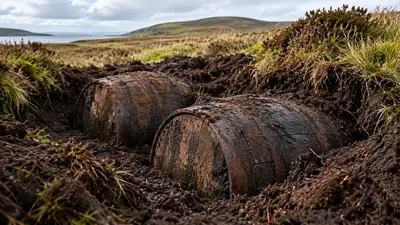
Representative image of two whisky casks in a peat bog. Image Credits: ChatGPT
Only 456 bottles came out of it, which made the release rare from the very beginning. In 2014, a team led by then distillery manager Mickey Heads buried two casks of mature whisky near the distillery. Most of us have probably lost something in the dirt at some point.
The Islay distillery buried two casks of whisky in a peat bog close to its site and left them there for nearly three years, according to The Spirits Business. It might have been a ring at the beach, a charger in the garden or something else altogether. Ardbeg did something similar, but on purpose. The whisky then became the distillery’s first NFT, a digital token linked to a physical bottle. The team treated the process as a flavour experiment. The idea was the brainchild of Dr Bill Lumsden, who led whisky creation at Ardbeg at the time. The ground in question was a peat bog, and that matters. The University of St Andrews peatlands exhibition explains that peat is formed when waterlogged soil inhibits the decomposition of plant material.
They were both second-fill bourbon casks, which are basically oak casks that had previously held bourbon and had already been used once to mature Scotch.
US Midterm Election Results 2026
A 1995 review in the journal Forestry by J.R.
The same trade report said the time spent underground was said to give the whisky earthy, mossy, and herbal flavours rather than the smoking intensity that is Ardbeg’s trademark. It is hard to say exactly what the bog changed. But tasting notes aren’t lab results. Mosedale discussed the effect of oak properties on flavour. The review also explains that their scientific understanding of how cask properties shape maturation is incomplete, but that choosing casks for the effect on flavour was still possible. This makes a buried cask hard to judge. The whisky also had extra years maturing in a warehouse after the dig, so the bog cannot take all the credit for the work.