
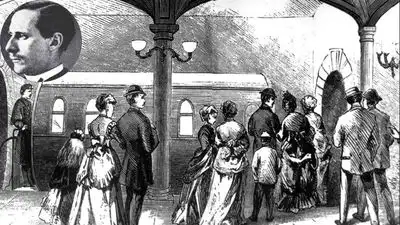
Inventor Alfred Ely Beach secretly constructed an underground railway beneath Broadway. Image Credit: American Physical Society (APS)
In 1870, New York City witnessed a unique experiment in public transport when inventor Alfred Ely Beach secretly constructed an underground railway beneath Broadway. The 312-foot tunnel carried a single passenger car propelled by air pressure rather than conventional steam engines. Designed as a solution to Manhattan’s growing traffic congestion, the railway attracted considerable public attention, with 400,000 people paying to experience its ride during the first year. Beach had proposed an underground railway beneath Broadway as early as 1849, initially considering horse-drawn carriages as an alternative to noisy steam-powered trains, according to PBS. Beach demonstrated his concept at the American Institute Fair in 1867. His wooden tube, approximately 6 feet in diameter and 100 feet long, accommodated a small passenger vehicle carrying 10 people.
Despite its popularity and ambitious plans for expansion, the pioneering project remained confined to a single block and eventually disappeared from the city’s transport history. The story of New York’s first pneumatic subway began with Alfred Ely Beach, an inventor, patent lawyer and publisher who had become increasingly concerned about congestion along Manhattan’s streets. By the late 1860s, however, he had become interested in pneumatic transportation, which used air pressure to move vehicles through enclosed tubes. The idea offered a possible solution to the problems associated with conventional railway systems, particularly smoke, noise and the limited space available above ground. A powerful fan propelled the car through the tube, demonstrating that the principle could work. The demonstration helped convince Beach that a similar system could operate beneath Broadway. However, obtaining permission for construction proved considerably more difficult.
His efforts eventually succeeded in 1873, when a bill authorising the extension was approved and signed into law by Governor John A Dix. The Panic of 1873, triggered by a major financial crisis, weakened investor confidence and undermined the funding Beach needed to continue construction. The Museum of the City of New York notes that the railway was largely forgotten following the destruction of the building above it in a fire in 1898. Workers excavating for a new railway in 1912 encountered the sealed passage beneath Broadway, according to PBS.
However, the inventor continued to face political resistance. Tweed remained determined to prevent the project from advancing, using his influence over the state government to obstruct legislation supporting expansion. Beach spent years attempting to secure approval for a larger underground network. The victory came at an unfortunate moment. The Museum of the City of New York explains that declining public interest and the stock market crash contributed to the withdrawal of financial support. Without sufficient backing, the proposed expansion could not proceed. Its rediscovery came decades later. Inside, Beach’s passenger car remained remarkably well preserved. Its preserved car and tunnel became reminders of an early attempt to rethink urban transportation. Beach’s experiment also anticipated the broader shift towards subway systems that would eventually transform New York. You use AI every day. Now get your AI Quotient. Take the AIQ test.
The tunnel measured approximately 312 feet, covering little more than one city block. The Museum of the City of New York notes that the blower weighed approximately 48 tons. It featured upholstered seats for 22 passengers, according to the museum. When demand exceeded that capacity, a larger platform car accommodating up to 30 people could be used. On 26 February 1870, Beach finally revealed his underground railway to the public. PBS reports that 400,000 visitors paid 25 cents each to experience the railway during its first year.
Because it placed the construction project close to the centre of New York’s political establishment, the location was significant. Because the experience was unlike anything New Yorkers had encountered before, the opening immediately attracted attention, partly.
Beach obtained permission for what appeared to be a pneumatic postal delivery system, according to the American Physical Society. Political opposition from William M Tweed, the powerful leader associated with Tammany Hall, obstructed Beach’s subway plans. Tweed favoured elevated railway construction and was reluctant to support a competing underground transport system. The arrangement allowed him to construct a tunnel beneath a rented storefront opposite City Hall, concealing the passenger railway he actually intended to build. Beach’s undertaking proceeded beneath the streets while officials remained unaware of its true purpose. The Museum of the City of New York explains that the railway was constructed beneath Broadway between Warren Street and Murray Street. It was primarily intended to demonstrate the feasibility of pneumatic passenger transportation rather than establish a complete citywide network. Its relatively limited length nevertheless allowed Beach to demonstrate how an underground passenger service might operate without disturbing traffic on the streets above. The railway’s defining feature was its unusual propulsion system. Instead of relying on a locomotive, it used a massive blower to push air through the tunnel and move the passenger car along its tracks. The American Physical Society describes the machinery as a giant fan powered by a steam engine. The blower, nicknamed the Western Tornado, supplied the force needed to propel the vehicle from Warren Street towards Murray Street. At the end of the journey, the car activated a mechanism that alerted the operator at the other station. The blower’s direction was then reversed, creating suction that pulled the car back towards its starting point. This arrangement allowed the railway to operate in both directions without requiring a conventional engine inside the passenger vehicle. Its powerful mechanism was central to the demonstration, showing how air could be used to move a passenger vehicle through a confined underground space. Beach’s passenger car was designed to provide a comfortable experience rather than merely demonstrate a mechanical invention. The American Physical Society describes the station as an elaborate space featuring chandeliers, a grand piano and a fountain containing goldfish. Its decorative interior included mirrors and separate waiting areas for ladies and gentlemen. The railway offered a ride between Warren Street and Murray Street before returning passengers to their starting point. The railway’s popularity also gave Beach an opportunity to argue that the system could become something more substantial than a temporary attraction. Beach wanted to extend the underground railway beyond its original block. His proposal envisioned a line running northwards towards Central Park, covering approximately five miles and potentially offering a practical alternative to Manhattan’s congested streets.