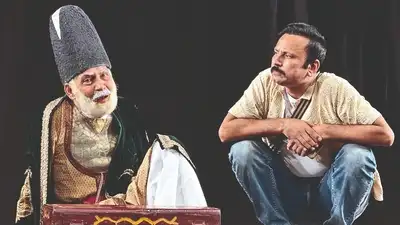
A still from the play
A middle-aged paan woman is singing unabashedly about being 16 years old. Born on December 27, 1797, the beloved Urdu poet finds himself transported to New Delhi in 2026 in this play, and is immediately flummoxed. But Ghalib is taken aback by both the suggestion and the fare – ₹100, ₹200, ₹500 to travel from one part of Delhi to another? For ₹5, he could have reached his hometown, Agra!
Mail us at [email protected] You Can Also Check: Gold Rate in Delhi | Silver Rate in Delhi | Bank Holidays in Delhi | Public Holidays in Delhi | Delhi AQI | Weather in Delhi | Petrol Price in Delhi | Diesel Price in Delhi | CNG Price in Delhi | LPG Price in Delhi Stay updated with the latest Delhi news.
He then encounters a couple of auto and e-rickshaw drivers who mock his “costume”, language and white, white beard. The latter becomes the subject of some obvious but well-timed jokes about the appearances of public personalities, including a remark that keeping one is “no longer an anti-national act”. The drivers scoff at his suggestion, while he mocks their language, saying, “ Agar Dilliwalon ka yeh haal hai, toh Yamuna paar walon ka kya hoga? ” The jokes, digs and puns are topical and sharp, blending seamlessly into the drama.
Next to her, a bent old man, stylishly dressed in a muslin angrakha over his crisp kurta pyjama , turns at the sound and asks the woman in proper Urdu why she is singing about being a teenager when she clearly isn’t one. Making a face, he then asks her to make him some paan and, utterly disgusted by her manners, introduces himself as Mirza Asadullah Baig Khan. From the obnoxiously colourful language of the paan woman, who tells him he can spit his paan on the walls, street or someone’s face in the absence of a spittoon, to the noise, vehicles and traffic around him, everything leaves him bewildered as he keeps asking: where is his Dilli ? Ghalib insists that the drivers take him to Ballimaran, where he famously lived, opening up further avenues for political digs. One offers to take him to the Ramlila ground instead, calling it the new protest site. Writer-director and actor M Sayeed Alam is incredible as Ghalib, with one of the play’s most memorable lighter moments coming when he tries to teach a driver how to pronounce Jama Masjid. Much of the drama’s strength lies in its use of timely political and NCR references to draw humour from Ghalib’s bewilderment. Amid the quickfire jokes, Ghalib also offers a lovely line on the beauty and impact of silence, contrasting the play’s humour with the lyricism of his works. The final two acts see Ghalib finally embracing the ‘new’ Delhi. He changes his get-up, adopts athleisure and swaps his cherished maroon tin suitcase for a tennis racket. The few actors in the play do more than a decent job, but much of its weight rests on Alam’s performance and vision, which he brings to life with easy charm. -Anvita Singh Want us to review your play? Download the TOI App.