
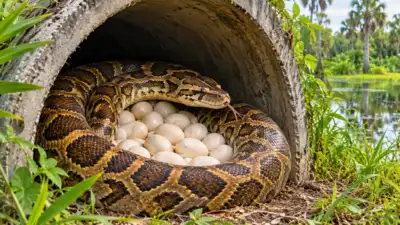
Image AI generated
The female laid 96 eggs inside an abandoned concrete pipe in the Greater Everglades Ecosystem, producing 83 hatchlings, making it the largest verified Burmese python clutch recorded at the time of the study. The pipe measured approximately 46cm in diameter and 6 metres in length. To understand how the female behaved during incubation, researchers installed wildlife cameras and temperature data loggers around the nest on 1 June 2022. The study reported that the female maintained incubation temperatures more than 5 degrees Celsius above the surrounding ambient temperature, recording approximately 33 degrees Celsius compared with 27.7 degrees Celsius in the surrounding environment. The researchers counted 96 eggs in the nest, making it the largest verified Burmese python clutch recorded at the time of the study. Of these, 83 successfully hatched. The researchers recorded 41 female and 41 male hatchlings, while the sex of one individual was not recorded. The study also highlighted that this clutch was considerably larger than the average clutch size reported for wild Burmese pythons in Florida, which was approximately 49 eggs. Researchers reported that her body mass declined from 67.8kg before nesting to 48.9kg afterwards, representing a loss of 27.9 per cent.
The researchers confirmed that the snake was using a process known as shivering thermogenesis to generate heat for the developing eggs.
Titled ‘ Wild Burmese python nest site selection, thermogenesis, and brooding behaviours in the Greater Everglades Ecosystem ’, the research documented the snake’s nesting behaviour, including how it generated heat by shivering while protecting its eggs, offering a rare account of the species’ reproduction in the wild, according to the study published in Ecosphere. Burmese pythons generally select thick undergrowth or piles of debris on protected forest floors for nesting, according to the researchers. The researchers explained that the snake’s movements were consistent with this behaviour, writing that they had confirmed the female was “exhibiting shivering thermogenesis”. The researchers said that further observations of wild nesting behaviour could help inform the development of new tools for managing the invasive population.
Researchers in Florida have documented rare egg-laying and hatching events in a wild Burmese python, revealing new details about how the invasive snakes reproduce and survive in human-altered environments. The study noted that this was only the second documented instance of a wild invasive Burmese python in Florida using a human-made structure to lay its eggs. Both recorded instances involved concrete culvert pipes. The equipment recorded the python’s movements and changes in temperature within and around the clutch. The observations showed that the female repeatedly adjusted her coils and contracted her muscles while remaining wrapped around the eggs. The cameras also recorded two instances of Virginia opossums entering the pipe and quickly leaving, apparently after encountering the brooding python. The findings also documented the physical demands of reproduction on the female. The study explained that egg production and heat generation during brooding were likely responsible for the loss. It also noted that Burmese pythons may reproduce every two to three years, suggesting that females can require considerable time to recover their physical condition between reproductive periods. The study also highlighted the importance of understanding how Burmese pythons use human-altered environments. Their ability to select nesting sites in disturbed areas, alongside their capacity to regulate egg temperatures through brooding, could influence their persistence in the Greater Everglades Ecosystem.
How long did the python brood its eggs before leaving the nest
The first eggs began hatching on 19 July, six days after the female stopped brooding. The majority of the eggs hatched between 19 and 22 July, although some hatchlings emerged later. The last hatchling emerged on 1 August, 13 days after the first egg began hatching, according to the study. They retrieved the remaining eggs and eggshells on 2 August to establish the final clutch size and hatching outcome.
Researchers checked the nest and collected hatchlings once or twice daily until no further eggs hatched.