
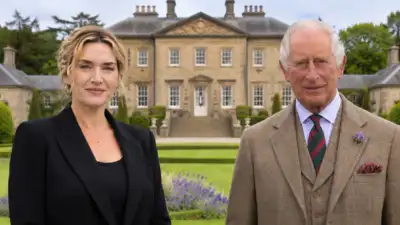
A historic Scottish mansion that was once threatened with being sold and having its valuable contents scattered is now welcoming more than 10,000 students every year for lessons in farming, engineering, traditional crafts and sustainable living. The estate’s work has also attracted the support of Oscar-winning actor Kate Winslet , who became an ambassador for the foundation in 2025 and later narrated a documentary about the King’s environmental philosophy. Spread across 2,000 acres, the property now combines heritage conservation with practical education, vocational training and community regeneration.
Dumfries House, an 18th-century property in East Ayrshire, has been transformed into an education and community hub under The King’s Foundation, the charity founded by King Charles III.
The estate faced an uncertain future in 2007 when the house and its contents were put up for sale at auction. Today, Dumfries House welcomes more than 10,000 students annually through educational programmes delivered by The King’s Foundation. The programmes are spread across several dedicated education centres on the 2,000-acre estate. MacRobert Farming and Rural Skills Centre The MacRobert Centre for Farming and Rural Skills was officially opened by King Charles in September 2023. A February 2026 report by The Scotsman highlighted the experiences of pupils from Auchinleck Primary School and Doon Academy. Lee McPhail, head teacher of Auchinleck Primary School, said he contacted Dumfries House in 2021 to establish a relationship between the school and the foundation. Her involvement became more prominent when The King’s Foundation and Prime Video announced in October 2025 that she would narrate Finding Harmony: A King’s Vision, a documentary exploring the King’s Harmony philosophy and his longstanding environmental interests. The estate’s development is continuing, with The King’s Foundation announcing plans for a new facility called The King’s Hall in January 2026.
One example reported by The Scotsman involved pupils learning to solder an electrical circuit to create a working light switch. There is no confirmed information establishing that she personally funds Dumfries House or directly finances its educational programmes.
The foundation says six of the traditional crafts taught through its programmes are included on the Red List of Endangered Crafts. Teachers said these experiences offered opportunities that pupils did not necessarily have access to in their regular classrooms. The actor said she shared King Charles’s interest in protecting the natural world and promoting sustainable communities.
Dumfries House is an 18th-century mansion located near Cumnock in East Ayrshire, southwest Scotland. Built in the 1750s for the 5th Earl of Dumfries, the property is known for its architecture, historic interiors and significant collection of furniture, including pieces made by renowned cabinetmaker Thomas Chippendale. There were concerns that the historic furniture collection would be separated from the property and sold individually. The then Prince of Wales, now King Charles III, led a consortium of organisations and individuals to purchase and preserve the estate. The acquisition prevented the historic collection from being dispersed and kept the property in Scotland for the benefit of the nation and its surrounding communities. The rescue was not intended to preserve the mansion as a private historic residence alone. The wider vision was to establish a public visitor attraction and create opportunities for economic, cultural and educational regeneration in an area affected by the decline of the coal mining industry. Over the following years, the estate underwent conservation and restoration work and developed into the headquarters of The King’s Foundation. The charity describes the property as a model of heritage-led regeneration, combining the preservation of historic buildings with education, employment and community development. These include school visits, practical workshops, vocational training and specialist courses for people interested in developing traditional and modern skills. Rather than relying entirely on classroom-based teaching, the foundation uses the property’s gardens, farms, workshops and natural surroundings to provide practical learning experiences. Students can explore subjects including farming and rural skills, science, technology, engineering and mathematics, fashion and textiles, horticulture, hospitality and traditional building crafts. The programmes also cater to different age groups, from primary and secondary school pupils to school leavers, adults seeking new careers and experienced craftspeople looking to develop their skills. The initiative aims to preserve skills that are becoming increasingly difficult to find while preparing a new generation of workers to maintain historic buildings and traditional industries. One of the most distinctive aspects of Dumfries House is the variety of practical learning facilities available to students. It was established to improve access to agricultural education and help address skills shortages in Britain’s farming and rural industries. Its facilities include teaching spaces, laboratory facilities and a working barn where learners can gain experience in livestock management and agricultural practices. Students learn about animal health, livestock handling, soil health, sustainable farming and food production. The programmes are designed for school pupils, school leavers and adults interested in agricultural careers, as well as people already working in the industry. The centre also provides opportunities for learners to understand how farming practices affect the environment and the wider food system. Valentin’s Farm and food education The estate’s education farm gives children an opportunity to understand where food comes from and how agricultural systems operate. Through practical activities involving animals, gardening and food production, students learn about animal care, farming and the relationship between agriculture and nature. The foundation also works to introduce young people to sustainable food systems through its horticulture and farm-to-fork programmes. These activities explore how food is grown, prepared and consumed, while encouraging children to understand food waste and healthier eating. Morphy Richards Engineering Education Centre The Morphy Richards Engineering Education Centre provides practical science, technology, engineering and mathematics education. Its workshops introduce pupils to subjects such as aerospace, green energy, environmental science and sustainable design. Students can take part in experiments and activities that demonstrate how scientific principles are applied to everyday technology. Such activities allow students to develop practical skills while exploring possible careers in engineering and technology. Fashion, textiles and traditional crafts Dumfries House also operates dedicated textile and craft training facilities. Through its Future Textiles programmes, students learn sewing, embroidery, garment construction and other textile skills. The initiative aims to address skills shortages in the textile industry while promoting more sustainable approaches to fashion and manufacturing. The estate also provides training in traditional building crafts, including skills needed to conserve historic structures. These programmes help preserve specialist knowledge while creating opportunities for people interested in careers involving heritage restoration. Hospitality and horticulture The foundation’s hospitality training connects food, nutrition and seasonal produce with practical skills required in the hospitality industry. Students learn about food preparation, cooking and hospitality operations, while horticulture programmes introduce them to gardening, growing vegetables and sustainable food production. Together, these programmes provide opportunities to learn skills that can be used in employment, further education or everyday life. Dumfries House’s educational work extends beyond individual courses and workshops. The foundation has developed partnerships with schools in the surrounding region, allowing pupils to participate in learning activities that complement their regular classroom education. The school subsequently became involved in the Harmony Project, which encourages children to explore the relationship between people, nature and their surroundings. The programme combines classroom activities with visits to the estate, helping pupils understand subjects such as sustainable farming, food production and environmental responsibility. The report also highlighted how practical workshops have benefited pupils at Doon Academy. Some students who had struggled with school attendance were able to complete five-day educational courses at Dumfries House. Activities included making wallets and purses using sewing machines and building electrical circuits. Students have also participated in environmental activities, including examining aquatic organisms collected from the River Lugar to understand the health of local ecosystems. The programmes demonstrate how practical education and time spent outdoors can help students engage with subjects in different ways. She also expressed an interest in supporting the foundation’s work with young people and its efforts to encourage a closer connection with nature. The documentary highlights the foundation’s work in the UK and internationally, with particular attention to Dumfries House as its headquarters and an example of heritage-led regeneration. Winslet described the project as an opportunity to bring attention to the importance of protecting the planet and building sustainable communities. Her role is as an ambassador and public supporter of the foundation.
Nearby New Cumnock has benefited from regeneration initiatives involving the restoration of its town hall and the reopening of its outdoor swimming pool in 2017. 15,000 people have been supported through its health and wellbeing work at the estate, according to the foundation. Kate Winslet joined The King’s Foundation as an ambassador on June 27, 2025, during the charity’s 35th anniversary year.
The estate’s transformation is also connected to the economic history of East Ayrshire. The King’s Foundation has attempted to use Dumfries House as a catalyst for wider regeneration. Its activities include heritage restoration, vocational training, employment opportunities and community programmes. The work has also extended beyond the estate itself. The foundation also operates a Health and Wellbeing Centre at Dumfries House, offering programmes designed to improve physical health, encourage healthier lifestyles and build social connections. Its approach reflects a broader effort to connect heritage preservation with the needs of local residents, rather than treating historic buildings as isolated tourist attractions.
The surrounding region was historically dependent on coal mining, and the decline of the industry affected employment and economic opportunities in nearby communities.
The proposed £6.5 million extension is expected to replace the existing Pavilion marquee venue and provide a permanent space for events, including weddings and private functions. The development is planned to include a public hall measuring 282 square metres, with the wider extension covering approximately 430 square metres. It is designed to accommodate events involving up to 200 guests. The foundation expects the venue to open in summer 2027.
Revenue generated through events and private bookings is intended to support the continued conservation and development of the estate, as well as its education and community programmes. You use AI every day. Now get your AI Quotient. Take the AIQ test.