
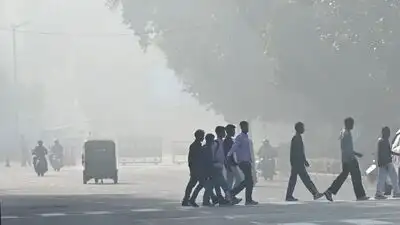
Delhi is facing hazardous air pollution, with an average Air Quality Index recorded at 364 currently.
NEW DELHI: Delhi continued to reel under hazardous air pollution on Saturday morning, with the city’s average Air Quality Index (AQI) recorded at 364 at 8 am, placing it in the ‘very poor’ category, according to data from the Central Pollution Control Board (CPCB). Misty conditions prevailed at New Delhi’s Safdarjung station in the early hours of Saturday, with the temperature recorded at 17 degrees Celsius at 5.30 am, according to the India Meteorological Department (IMD). Under the GRAP framework, an AQI of 301-400 is classified as ‘very poor’, while readings between 401 and 500 fall in the ‘severe’ category.
The four-stage emergency plan is implemented in Delhi and adjoining districts of Haryana, Uttar Pradesh and Rajasthan, based on pollution and weather forecasts issued by the IMD and the Indian Institute of Tropical Meteorology (IITM).
Earlier reporting noted: Delhi continued to grapple with hazardous air quality on Saturday morning, with the city’s overall Air Quality Index (AQI) standing at 364 at 8 am, according to Central Pollution Control Board (CPCB) data. Earlier reporting noted: According to the India Meteorological Department, misty conditions prevailed at New Delhi-Safdarjung, where the temperature was 17 degrees C at 5:30 am.
With Stage III restrictions now in force, measures under the earlier stages will continue, alongside additional curbs aimed at reducing vehicular emissions, construction dust and industrial pollution. Earlier reporting noted: With Stage-III measures now in force, the existing curbs will continue alongside additional measures, including stricter pollution-control steps.
Stage I is triggered when AQI ranges between 201 and 300, categorised as ‘poor’. Stone crushers and mining activities, which contribute significantly to particulate pollution, will also face shutdowns or operational restrictions. GRAP is a four-stage emergency framework implemented by the CAQM in coordination with the CPCB and state governments. Restrictions become progressively stricter depending on the severity of air pollution. Measures include controlling road dust, enforcing pollution norms and preventing open waste burning.