
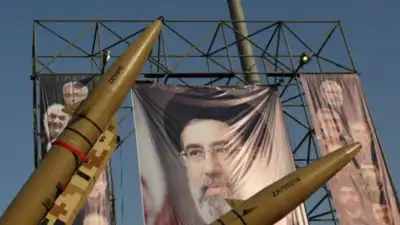
File photo: Iranian missiles are displayed next to a banner with a picture of Iran’s Supreme Leader, Mojtaba Khamenei, on a street in Tehran, Iran (Reuters).
IRGC spokesperson Brigadier General Hossein Mohebbi said Tehran was prepared to respond to threats without geographical limitations and would rely on asymmetric warfare to catch its adversaries off guard. Our duty is to demonstrate our capabilities on the battlefield,” Mohebbi said, according to Iran’s ISNA news agency. The remarks came a day after US President Donald Trump said American forces had carried out fresh, limited strikes on Iran, targeting an air defence system. Describing the operation as “minor”, Trump said the US military had destroyed an Iranian anti-aircraft installation shortly after it was built. “They knocked out — they built a little bit of an anti-aircraft device and we knocked it out in about 15 minutes, maybe five,” Trump told reporters after arriving in West Palm Beach, Florida, on Friday evening, according to the Associated Press (AP).
“The restriction has been lifted for us. However, we must demonstrate these capabilities in practice, and we should not merely make statements beforehand. Iran on Saturday said it has lifted restrictions on the range of its missiles and will demonstrate its ability to strike adversaries at unexpected locations, the Islamic Revolutionary Guard Corps (IRGC) said on Saturday, amid renewed military activity involving the United States in the Strait of Hormuz.
An American aircraft was also hit during the firing,” he said, according to ISNA. “We carried out some firing, and most of the explosions were related to air defense fire. No other incidents followed.
Responding to a question about the explosions and other incidents reported in the Strait of Hormuz on Friday night, Mohebbi said Iranian forces had carried out firing exercises, with most of the explosions resulting from air defence activity.