Industry players believe the initiative could make domestic production commercially viable
Gujarat, aspiring to emerge as a major container manufacturing hub since the Covid-19 pandemic exposed India’s dependence on foreign suppliers, is seeing renewed momentum in the sector. The Union cabinet has approved a Rs 10,000 crore incentive scheme for the container manufacturing. .
Shipping and waterways, domestic container traffic is projected to rise from 24 million TEUs in 2024 to 175 million TEUs by 2047, according to the ministry of ports.
Land costs should also be considered alongside manufacturing costs while designing incentives,” Joshi said. The push comes at a time when India’s containerised cargo movement is expected to grow substantially. This growth is expected to create sustained demand for containers, making domestic manufacturing capacity increasingly important. For Gujarat, the opportunity extends beyond manufacturing containers. The state’s established industrial base, proximity to major ports, engineering capabilities and access to steel and ancillary industries could help it develop an integrated container manufacturing ecosystem. What’s in the box The incentive’s economic benefits However, manufacturers say the success of the initiative will depend on how effectively the govt addresses the cost disadvantages faced by domestic producers. Container manufacturing requires adherence to stringent international quality standards, as shipping containers are used across global maritime networks. Established overseas manufacturing ecosystems benefit from economies of scale, integrated supply chains and lower production costs. Ashish Joshi, a container manufacturer from Kutch, welcomed the initiative but stressed the need for timely and practical implementation. “We appreciate this policy, but the govt needs to move quickly. Manufacturers elsewhere are continuously working to reduce production costs, while India’s policy is still in the pipeline. We expect the govt to introduce a simplified and transparent framework. Industry players believe that financial incentives alone may not be enough to establish a sustainable manufacturing base. Affordable industrial land, competitive input costs, reliable infrastructure, access to finance and a predictable policy framework will be equally important. With long-term policy support now on the table, Gujarat’s existing and prospective manufacturers see an opportunity to revive investment plans and tap the growing demand for containers. The state’s ability to translate this policy push into manufacturing capacity, however, will depend on execution, cost competitiveness and the creation of an enabling industrial ecosystem. The industry also wants supporting infrastructure PLI reset boosts MMF, technical textile investments Gujarat is positioned to benefit as global demand shifts from cotton-heavy consumption to synthetics and application-driven textiles used in healthcare, automobiles, infrastructure, defence and filtration
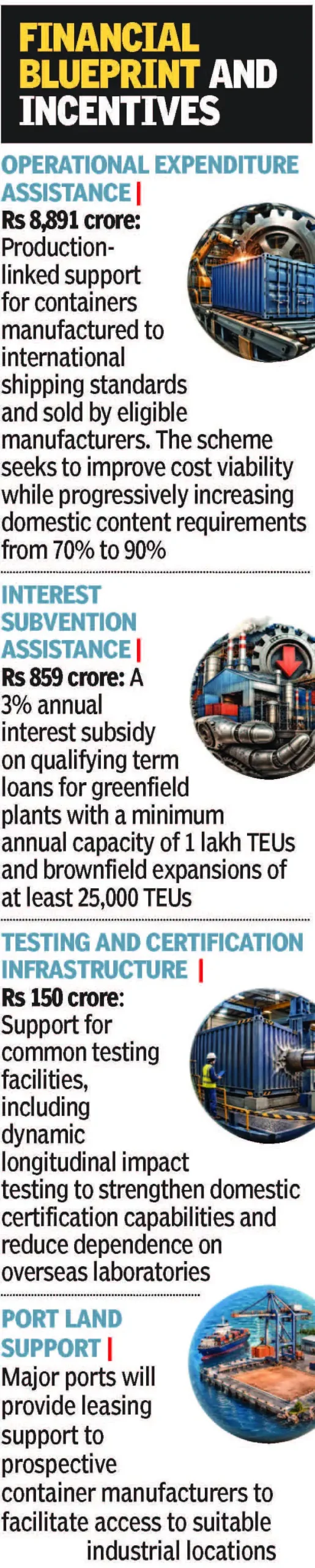
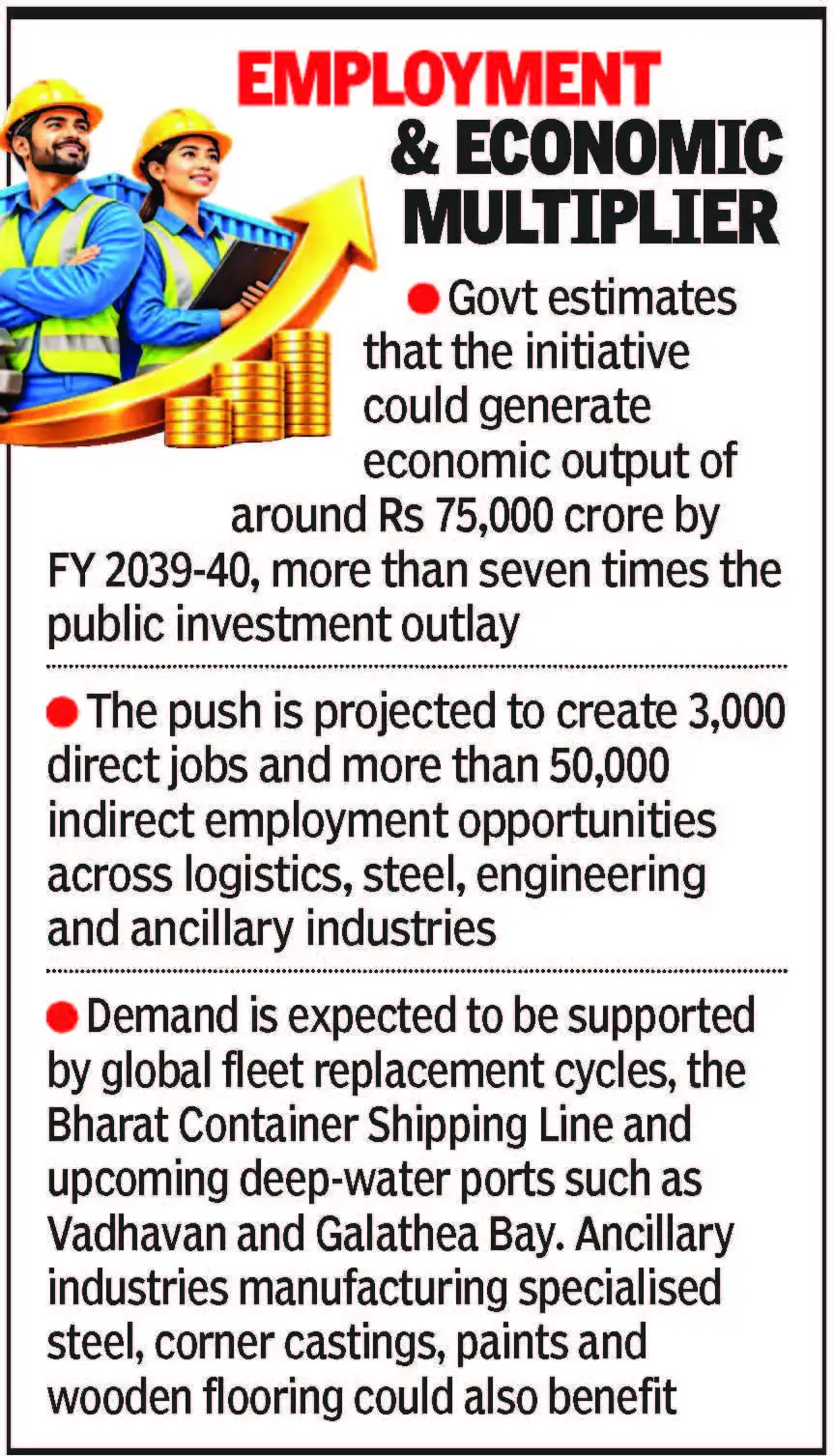

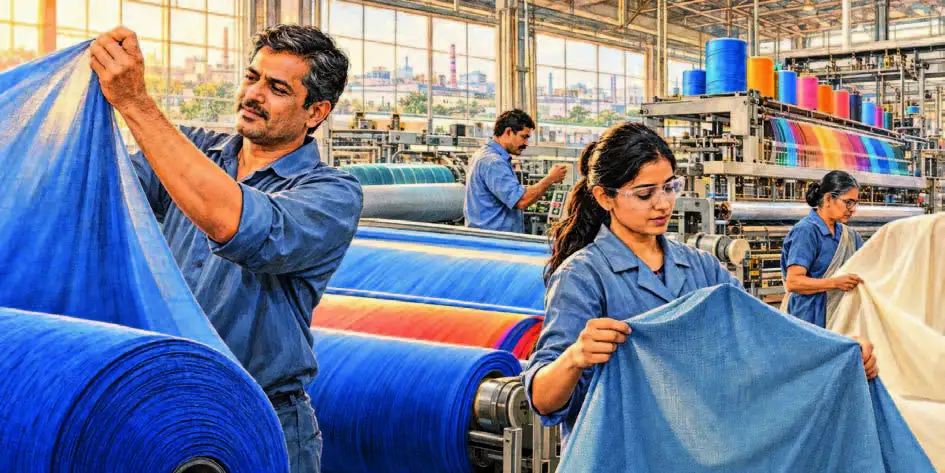
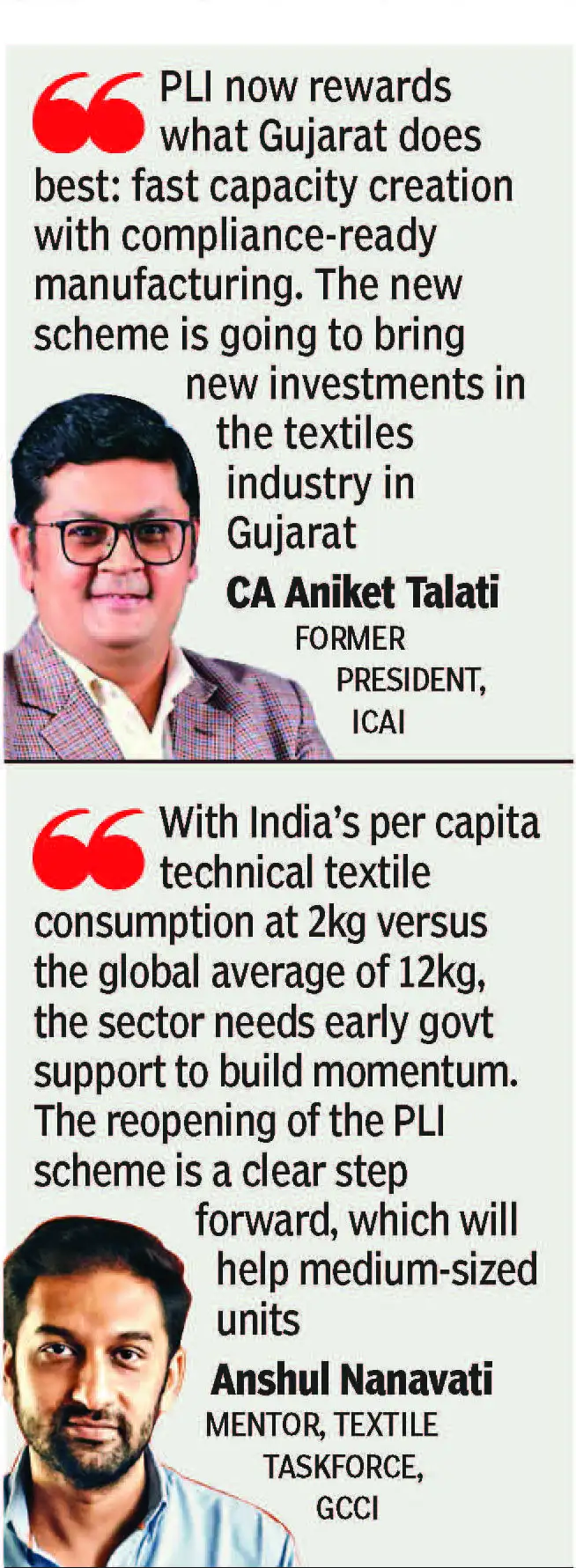
The approval of the Container Manufacturing Promotion Scheme (CMPS), announced in the Union Budget for FY 2026-27, has revived hopes for manufacturers who had nearly abandoned their plans. The scheme is expected to rolled out from the next financial year and continue until 2039-40. Govt plans to expand India’s annual container manufacturing capacity more than ten-fold, from an estimated 70,000 twenty-foot equivalent units (TEUs) to 7.5 lakh TEUs. The Centre’s Production Linked Incentive (PLI) scheme for textiles, recalibrated in Oct 2026 with a fresh application window and eased eligibility, is expected to accelerate Gujarat’s man-made fibre (MMF) and technical textile expansion as firms seek scale in export-facing product lines. The announcement reopens the portal for Round 4 from Nov 1 to Dec 31, 2026, lowers the minimum turnover threshold for Part 2 to Rs 100 crore, and extends the incentive tenure for new approvals up to FY 2033-34. The changes build on earlier relaxations that reduced minimum investment to Rs 150 crore under Part 1 and Rs 50 crore under Part 2, moderated incremental turnover targets to 10%, expanded the eligible product basket, and allowed execution through existing entities — moves that industry had sought to match project financing cycles. Gujarat Textile Policy 2024, running until Sept 2029, offers a slew of measures including subsidies on capital and interest, power tariff assistance and payroll-linked incentives, improving project viability and easing operating costs during ramp-up. The Viksit Gujarat Industrial Policy 2026, effective from June 1, 2026, further broadens combined assistance structures for MSMEs and large projects, linking support to taluka categories and thrust sectors, which industry expects will help spread MMF processing, technical textile units and ancillaries beyond established hubs.
The changes build on earlier relaxations You Can Also Check: Gold Rate in Ahmedabad | Silver Rate in Ahmedabad | Bank Holidays in Ahmedabad | Public Holidays in Ahmedabad | Ahmedabad AQI | Weather in Ahmedabad | Petrol Price in Ahmedabad | Diesel Price in Ahmedabad | CNG Price in Ahmedabad | LPG Price in Ahmedabad Stay updated with the latest Ahmedabad news.
“The Round 4 turnover cut is the difference between watching from the sidelines and actually underwriting a new line in Gujarat,” said a senior executive at an MMF fabric unit. State incentives soften capex and opex, and PLI pays for performance once volumes kick in,” said Hardik Shah, partner, Deloitte India. The shortage of shipping containers during the pandemic had disrupted India’s export-import trade, prompting manufacturers in Bhavnagar, Rajkot and Kutch to explore opportunities in manufacturing them. However, high production costs, infrastructure constraints and the absence of adequate policy support prevented the sector from taking off as expected. Industry players believe the initiative could make domestic production commercially viable and help India gradually reduce its dependence on imported containers. It aims to establish a globally competitive container manufacturing ecosystem through initial support for setting up manufacturing facilities, followed by production-linked incentives over the subsequent decade. The policy is also expected to attract fresh investment, with some large industrial groups reportedly exploring opportunities in the sector. Gujarat, home to synthetic fabric cluster in Surat and a growing technical textile base across Ahmedabad, Vadodara and Bharuch, is positioned to benefit as global demand shifts from cotton-heavy consumption to synthetics and application-driven textiles used in healthcare, automobiles, infrastructure, defence and filtration. State policies are expected to amplify the central push. “The stack works. Download the TOI App.