
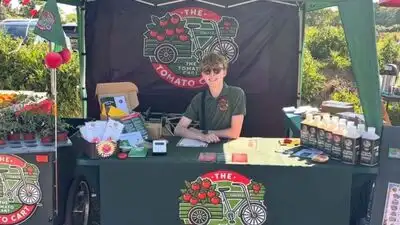
Meet Jacob, Founder of The Tomato Cart. Image Credit: The Shropshire Seaweed
Jacob Mann, 14, from Norwich, England, has turned his love of gardening into a growing business selling tomato plants, growing kits and tomato merchandise. Jacob now cultivates up to 7,000 tomato plants to meet demand, with his products attracting buyers as far away as Australia, BBC reports. BBC reported in March 2026 that he had initially sold approximately 14 plants before demand increased significantly. He had built up a greenhouse containing as many as 7,000 plants. The buyer was around 10,000 miles away, illustrating how a small business operating from Norwich can reach people well beyond its local community.
Because tomato plants need regular attention and the growing season is relatively short, managing that volume requires considerable work, particularly. BBC reported that his merchandise has attracted international interest, with a customer in Australia purchasing a crocheted tomato mascot.
He grows thousands of plants each year alongside his school work, the Shropshire Seaweed Company said. It all started from humble beginnings with a few seedlings and a home-made bicycle trailer, and has grown into The Tomato Cart, growing thousands of plants each year with customers from far and wide, even beyond the UK. He started with a family gardening competition during the Covid pandemic. Jacob’s interest in growing plants developed during the pandemic, when his family decided to turn their vegetable patch into a friendly competition. his continued to flourish, giving him an early indication that gardening was something he enjoyed and could do well While the other plots struggled. In a case study published by The Shropshire Seaweed Company, Jacob explained that the experience encouraged him to take growing more seriously. He subsequently began thinking about establishing his own garden centre one day, selling plants he had raised himself. The opportunity to start earning money came a few years later. When his brother began making money through a paper round, Jacob also wanted to earn independently. Rather than simply taking up a conventional job, he decided to build something around his interests. The early business was modest, but Jacob’s growing experience and customer interest helped it expand. He waters plants before school, and his parents help to ensure that his business obligations do not interfere with his education. He believes growing tomatoes, herbs or vegetables can help people understand where their food comes from and appreciate the process of producing it. Watching a plant develop from a seed into something edible is central to what he wants customers to experience. His business has also developed a partnership with The Shropshire Seaweed Company, whose organic liquid seaweed fertiliser he already used while growing plants. You use AI every day. Now get your AI Quotient. Take the AIQ test.
He collected a greenhouse found through Freecycle with his father just two days before his 13th birthday in December 2024. Because they were enjoyable to grow and could eventually be eaten, tomatoes became his starting point. Because he was so young, at first Jacob worried people might not take him seriously.
Jacob told the company that unpredictable British conditions, from freezing nights to heatwaves, made growing large numbers of plants difficult. Jacob has appeared on podcasts, in local newspapers and on radio programmes, according to the Shropshire Seaweed Company. He then saved his pocket money to purchase an old trailer base through Gumtree. Together with his father, he turned it into a specially designed cart that could be attached to a bicycle and taken to local markets and car boot sales. The business became The Tomato Cart, allowing Jacob to sell plants directly to customers around Norwich. Weather has also been a considerable challenge. Before installing greenhouse heaters, he sometimes had to bring plants indoors overnight to protect them from the cold. His early days of selling at markets was another obstacle. He was uncomfortable at first explaining his products to people and appearing in social media videos but through customer support, he slowly got more confident. For Jacob, selling plants is not simply about making money. One of the most rewarding parts of the business is hearing from customers who have successfully grown tomatoes using his plants. He enjoys seeing photographs of customers’ first harvests and hearing how their plants have developed. This feedback makes the time spent sowing seeds, watering plants and preparing them for sale worthwhile. His experience and growing knowledge also allow him to help customers select varieties suited to their gardens. With support and advice from Nick at JustSeed, he has developed a selection ranging from familiar favourites to less common tomato varieties. The business has also received attention beyond local markets. He also attended the RHS Sandringham Flower Show, where he met gardening personalities Rekha Mistry, Ade Sellars and Alan Titchmarsh. As the number of plants Jacob grows increased, he began looking for ways to reach customers outside Norwich. His business now operates through several channels, including markets, online sales and his own website. The Tomato Cart’s official website describes Jacob as a Norwich-area teenager selling tomato plants through a specially designed bicycle trailer. It also advertises home growing kits through Etsy, alongside local delivery and pre-orders. The expansion has helped him address a problem common to seasonal plant businesses. Tomato plants are mainly sold during a limited period of the year, leaving fewer opportunities to generate income during the colder months. The website also features a pizza-growing kit containing San Marzano tomato, basil and oregano seeds. The idea allows customers to grow ingredients associated with pizza from their own homes, including on a windowsill before moving the plants outdoors. Another unique addition is Adopt a Tomato, a collection of crocheted tomato keyrings sold with adoption cards. The products give the business a playful identity while allowing Jacob to continue selling something when his greenhouse plants are not ready for customers.
Jacob responded by developing products that customers could purchase beyond the main planting season. These include home growing kits, which contain seeds, compost, plant labels, pots and instructions written by him.