
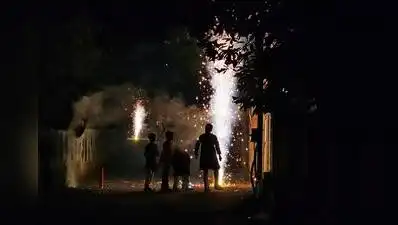
Residents continued to burst firecrackers in residential lanes and bylanes during Diwali celebrations despite court restrictions on their use
Pune: Diwali this year brought a sharp rise in air and noise pollution to the city.
Noise levels during celebrations showed a contrasting trend across areas, with night-time equivalent noise level (Leq) readings increasing at all seven monitored locations compared with last year, even as daytime readings declined at five locations, according to a Maharashtra Pollution Control Board (MPCB) comparison of Laxmi Pujan in 2025 and 2026. Among other monitoring stations, Laxmi Road recorded a 2.02% increase in night-time Leq, followed by Sarasbaug (1.49%), Shaniwarwada (1.32%), Khadki Bazaar (1.18%) and Shivajinagar (Sakhar Sankul) (0.27%). Daytime noise levels, meanwhile, declined at five locations, with Sarasbaug recording the highest reduction of 8.24% compared with last year. This was followed by Shivajinagar (Sakhar Sankul) (7.43%), Khadki Bazaar (7.08%), Laxmi Road (6.58%) and Aundh Gaon (1.52%). In contrast, daytime Leq increased at Shaniwarwada by 3.66% and University Road by 3.34%. Laxmi Road recorded the highest night-time Leq of 76.5 dB(A), exceeding the commercial-area limit. Khadki Bazaar followed at 76.4 dB(A), also above the commercial limit. Aundh Gaon recorded 75.5 dB(A), Shaniwarwada 75.2 dB(A) and Shivajinagar (Sakhar Sankul) 75 dB(A), exceeding the commercial-area benchmark significantly. Even University Road, which recorded the lowest night-time noise level among the locations listed, registered 69.7 dB(A) — 14.7 dB above the permissible limit for commercial areas. Under the Noise Pollution (Regulation and Control) Rules, the permissible night-time noise limit is 55 dB(A) in commercial areas, 45 dB(A) in residential areas and 40 dB(A) in silence zones. The methodology An MPCB official told TOI that the monitoring was carried out continuously over 24 hours, from 6am on Nov 8 (Laxmi Pujan) to 6am on Nov 9. The third round was scheduled for Nov 11, after which the board would analyse collected data. Laxmi pujan (Nov 8, 2026) night-time noise levels at all the locations for which readings were shared were considerably higher than the prescribed ambient noise standards. The directives stated that in accordance with orders issued by high court on Sept 22 and Oct 15 this year in a suo motu PIL, as well as per a Maharashtra Pollution Control Board (MPCB) notification dated Oct 3, 2024, the manufacture, sale, or use of firecrackers causing noise and air pollution is strictly prohibited.
Instruments were therefore used to record noise continuously over the 24-hour period, with the readings used to calculate the equivalent noise level (Leq) for the respective daytime and night-time periods. Another city resident, Monica Sharma from Kalyaninagar, said, “Residents of Kalyaninagar and Wadgaon Sheri struggled to sleep due to continuous loud firecrackers. The highest reported increase in night-time noise levels was at Aundh Gaon, though the board had not shared exact percentage variations for this location with TOI at the time of going to print.
Explaining the methodology, the official said isolated spot readings would not provide a representative picture of ambient noise levels. The official said MPCB’s overall monitoring exercise spans three days, including two days of festival monitoring and one day of standard noise-level monitoring. Bapat further said, “Delhi govt had implemented such a ban some time ago, and that it could be expanded to other cities across the country. Let us celebrate responsibly, respect court noise guidelines, and ensure loud celebrations end by 10pm, subject to applicable exemptions. ” According to Pune Municipal Corporation (PMC) officials, they had issued directives to citizens last week to keep noise pollution caused by firecrackers under control.
Leq, or equivalent noise level, is the average noise level recorded over a specified period. It takes into account variations in sound levels during that time, rather than relying on a single reading. However, it does not show how loud individual firecracker bursts were at their peak. Since decibels are measured on a logarithmic scale, a percentage change in the decibel reading does not mean the same percentage change in sound energy. The percentages shared by MPCB indicate changes in the recorded Leq figures. The actual change in sound energy would require a comparison of the decibel readings recorded in both years. The readings indicated substantial exceedances of the prescribed ambient noise standards, with the highest levels recorded at major commercial and traffic-dominated locations. The board attributed the higher ambient noise in these areas to a combination of vehicular movement, commercial activities and festive celebrations. However, the equivalent noise level (Leq), which represents the average sound energy over a specified period, does not independently establish the contribution of individual sources. It also does not convey the maximum intensity of sudden firecracker bursts. The readings were divided into two periods — daytime, from 6am to 10pm, and night-time, from 10pm to 6am. “Awareness being created against air and noise pollution by the authorities concerned is not effective on the ground. The entire supply chain of firecrackers should be targeted and steps such as a total ban should be taken. Official noise limits set by pollution control boards were openly disregarded, and continuous loud explosions could be heard late into the night across several neighbourhoods. The trend severely impacted senior citizens, children, pet owners and infirm individuals. The experience prompted many to push for stricter enforcement of guidelines already set by high court and the Supreme Court. Residents, pet owners, and senior citizens also expressed concerns about air pollution. Festivals are for everyone’s happiness. Citizens must not burst firecrackers on public roads, squares, lanes, footpaths, parks, terraces, balconies, and other public places in a manner that causes obstruction to citizens and traffic. Firecrackers must not be burst in the vicinity of hospitals, educational institutions, courts, and other notified silence zones, the directives added.
City resident and anti-noise pollution crusader Vidyanand Bapat, who had earlier this year taken up the cudgels against noise pollution caused by loudspeaker systems during Ganeshotsav, joined the clamour for a total ban on fireworks. Calls for total ban In the aftermath of firecracker norms being blatantly violated across the city for Diwali on Sunday, several residents and activists have called for a complete ban on the activity, citing that implementation of existing norms is not being carried out effectively. Only then can effective change be seen in reality,” Bapat told TOI on Monday. He added that noise levels were particularly high in the Peth areas on Sunday, and went on increasing in the evening to night hours. The noise pollution caused by firecrackers during festive celebrations was not isolated to old city areas, but left residents across the city distressed on Sunday.
You Can Also Check: Gold Rate in Pune | Silver Rate in Pune | Bank Holidays in Pune | Public Holidays in Pune | Petrol Price in Pune | Diesel Price in Pune | CNG Price in Pune | LPG Price in Pune Stay updated with the latest Pune news.
Gauri Kulkarni, a resident of Kothrud, said, “These norms were flouted not only in commercial zones, but also in residential zones as well as silence zones. Sound levels were very high. The adverse impact of high-decibel sound was evident even after shutting windows and closing doors. Download the TOI App.