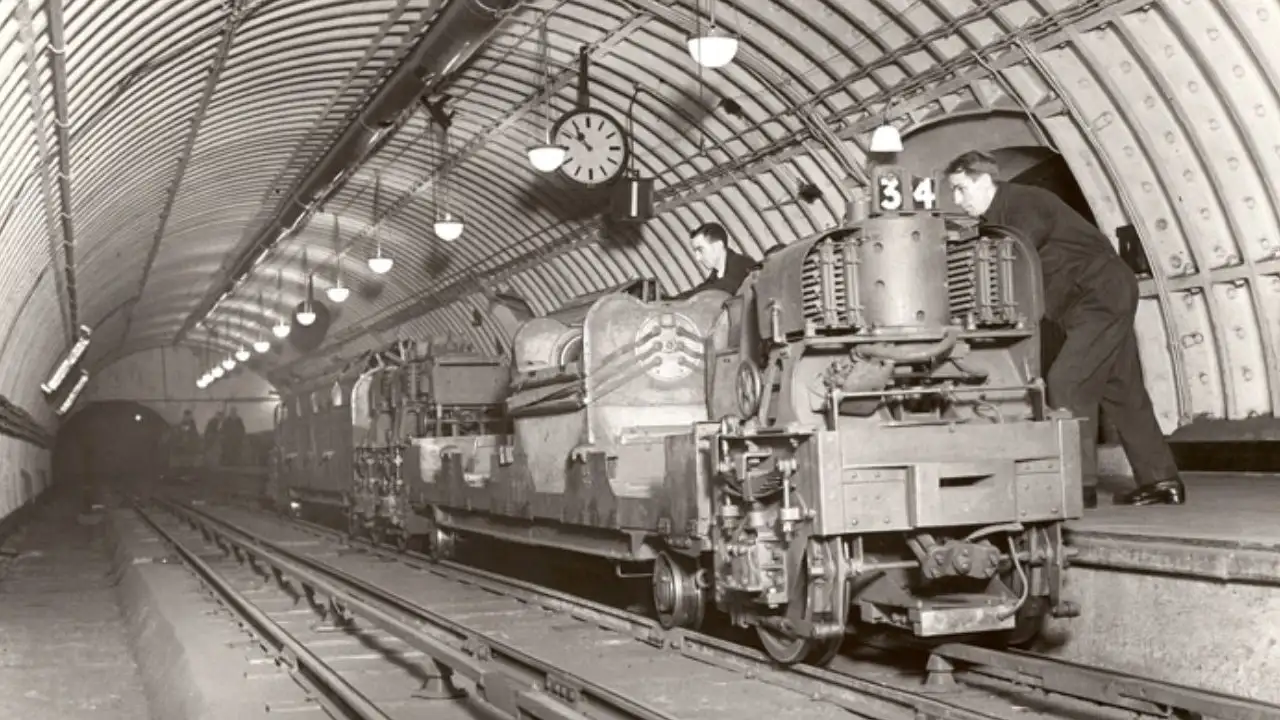
PC: The British Postal Museum & Archive
The electric line had driverless trains and ran through six and a half miles of tunnels, about 70 feet below ground. Parcel traffic began when the railway opened on 5 December 1927, while letter services started in February 1928. The system was suspended in 2003 after declining use and the closure of above-ground offices made it uneconomical to run, according to The British Postal Museum & Archive. The railway had served London from 1927 to 2003. A Departmental Committee was established in 1909 to examine the use of underground pneumatic and electric railways. In February 1911, it recommended an electric railway with driverless trains. The recommendations were accepted, and the Post Office (London) Railway Bill became an Act in 1913. The planned route consisted of six and a half miles of tunnels, at an average depth of 70 feet. PC: The British Postal Museum & Archive Work on the tunnels began in 1914, alongside the construction of a short experimental track with one car on Plumstead Marshes. Tunnelling was completed in 1917, but the Treasury would not permit the Post Office to order or install operating equipment during the First World War. Work did not resume until 1923. The railway opened on 5 December 1927, with parcels traffic running between Mount Pleasant and Paddington. The section from Mount Pleasant to Liverpool Street opened for Christmas parcels between 19 and 24 December, before a parcels service began there on 28 December. The Liverpool Street to Eastern District Office section opened for parcels on 2 January 1928. Its first service was for parcels, with letter traffic starting on 13 February 1928 when West Central District Office station opened. Western District Office followed on 12 March. New trains arrived in 1930. Each single-car train was 27 feet long and could carry four mail-bag containers, each holding an average of 15 bags of letters or six bags of parcels. The Post Office Underground Railway was renamed Mail Rail in 1987, marking its 60th anniversary. In 1993, a centralised computer-controlled system was introduced, allowing the entire railway to be operated from one location instead of separate control rooms at each station. The system was suspended in 2003 and remains closed. In 2011, museum curators retrieved examples of its rolling stock for a conservation project.
Because of excessive wear on the track, the original fleet of 90 trains had to be replaced within three years. London’s Mail Rail began as an underground railway designed to move post across the capital and was proposed after congested streets and fog delayed mail. It connected post offices and railway stations at eight points between the west and east ends of London. By the turn of the 20th century, congested streets and fog were causing delays to mail transported between London’s main Post Offices and railway stations. It was designed to connect the west and east ends of London, with eight stations serving post offices and various railway locations along the route at key points across London’s central areas. After the war, high prices delayed the project for several years. The railway did not begin carrying letters on the day it opened. The trains travelled through a nine-foot-wide tunnel with a double track. Near stations, the main tunnel divided into two smaller tunnels, each with a single track. By the late 1990s, trains stopped at only four stations: Paddington, Western Delivery Office, Mount Pleasant and the East District Office. More than six million bags of mail were carried underground each year, equivalent to four million letters every day. However, use declined, and above-ground offices closed. The railway eventually became uneconomical to operate. You use AI every day. Now get your AI Quotient. Take the AIQ test.