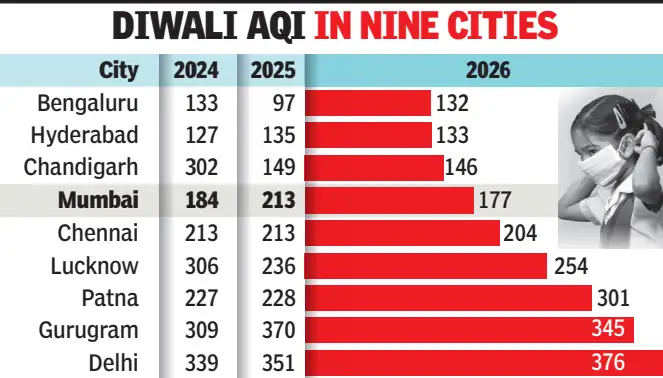
During the Diwali festivities in 2025, Mumbai’s air quality index (AQI) saw a moderate rise, reaching a peak of 200
Surendra Kumar Dhaka of the department of physics at Delhi University said, “An impending Western Disturbance could offer some temporary relief from persistent pollution across north India over the next 24-48 hours.
” Palak Balyan, Research Lead, Climate Trends, said, “The key takeaway is that a short-term pollution spike need not translate into a prolonged episode. If the system sustains its progression, associated changes in wind patterns, increased atmospheric mixing and the possibility of precipitation could help disperse or wash out pollutants, leading to an improvement in air quality. Region-specific air quality management and a clear understanding of the factors that support air-quality recovery can help cities build greater resilience and make clean-air interventions more effective. You Can Also Check: Gold Rate in Mumbai | Silver Rate in Mumbai | Bank Holidays in Mumbai | Public Holidays in Mumbai | Mumbai AQI | Weather in Mumbai | Petrol Price in Mumbai | Diesel Price in Mumbai | CNG Price in Mumbai | LPG Price in Mumbai
MUMBAI: The city handles Diwali pollution better than northern cities, recording a 46-64% rise in AQI, peaking at 200 in 2025, before sea breezes disperse pollutants within days. A three-year analysis of Central Pollution Control Board (CPCB) data from 2024 to 2026 by Climate Trends highlights the stark regional divide in how Indian cities recover from festival pollution. Delhi’s average Diwali AQI worsened each year, rising from 334 in 2024 to 348 in 2025 and 360 in 2026, remaining in the ‘very poor’ category. Gurugram recorded a peak AQI of 370, while Patna and Lucknow also struggled as festival spikes added to already high regional pollution levels. Firecrackers release a concentrated burst of PM2.5, PM10, SO2, NOx and metal-laden particles, mainly between 7pm and 2am. Chennai recovers within a week, even after festival AQI spikes of up to 139%. Hyderabad and Bengaluru largely remain in the moderate AQI range, with Hyderabad’s post-Diwali average falling to 67 in 2025.
Across the Indo-Gangetic Plain, cities remain shrouded in seasonal smog long after the firecrackers stop. Diwali falls in Oct-Nov, when India’s air quality typically deteriorates. Their dispersion is hampered by post-monsoon conditions: calm, cool nights, lower mixing heights and temperature inversions trap pollutants close to the ground. Southern and coastal cities show a cleaner pattern. Sea breezes, retreating monsoon showers along the coast and stronger winds over the Deccan plateau help disperse firecracker smoke rather than allowing it to linger.