
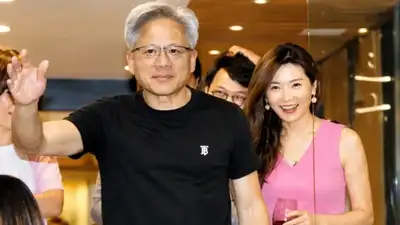
Nvidia’s extraordinary rise has been closely associated with Huang’s personality, vision and leadership
Both Huang, 63, and Powell, 48, are married to other people. She joined the company in 2008 and has spent nearly two decades rising through its ranks. She was promoted to senior director of artificial intelligence business development in 2016 before becoming vice president of healthcare in late 2017, according to her LinkedIn profile.
Because powell is a senior executive within Nvidia and, according to the newspaper’s sources, reports to Huang, the report is particularly significant. Citing five people who worked at the company, the newspaper reported that the two were seen being affectionate at a hotel in San Jose, California, during Nvidia’s annual GTC developer conference in March. The company has not publicly confirmed the allegations concerning Powell.
The latest development emerged in a report by The New York Times, which said Huang had an extramarital relationship with Kimberly Powell, Nvidia’s vice president of healthcare. The alleged relationship had been discussed within Nvidia for some time, according to the New York Times. Two people familiar with the incident told the newspaper that Huang and Powell were seen being affectionate at a hotel where Nvidia executives were holding meetings during the March conference. Three people briefed on the incident said Huang’s security personnel noticed the individual recording the encounter and subsequently isolated them. The newspaper said it had not seen the video itself, and the claims have not been independently verified.
The development has raised fresh questions about executive conduct and the company’s internal governance. Powell is not an outsider or a relatively unknown figure at Nvidia. She oversees initiatives involving the application of Nvidia’s chip technology to healthcare and higher education, particularly medical imaging. Powell also represents the company at international technology conferences. At the March GTC conference, she delivered a presentation on how artificial intelligence could help advance healthcare and biology, using cartoon depictions of Huang during her presentation. A bystander allegedly recorded the interaction on a mobile phone. The security workers then allegedly asked the bystander to sign a non-disclosure agreement. He then hung up. Nvidia declined to provide a statement, while Powell did not immediately respond to the newspaper’s request for comment. In that communication, he did not identify the woman involved. The absence of an official response has, however, added to the uncertainty surrounding the unfolding controversy.
The latest report follows Huang’s earlier admission to Nvidia’s board that he had been unfaithful to his wife. When contacted by The New York Times on Wednesday and asked directly about his relationship with Powell, Huang reportedly responded: “I don’t think you should be talking to me directly.
Its products have become critical infrastructure for the global AI industry, with estimates placing its share of the high-end AI chip market above 80%. Washington has restricted exports of its most powerful processors to China since 2022, seeking to prevent Beijing from gaining access to technology that could strengthen its military and technological capabilities. Huang has led the company for more than three decades and owns approximately 3.6% of its stock. He has more than 60 direct reports, with no obvious successor waiting in the wings.
The Wall Street Journal also reported that Nvidia was preparing to fire Huang, triggering a sharp reaction in the markets.
The board had met to discuss Huang’s future, marking a shift from its earlier expression of confidence in the chief executive and his leadership team, according to Reuters. The controversy is about more than the personal relationships of a billionaire executive. Nvidia dominates the market for high-end graphics processing units (GPUs), the specialised chips used to train and operate advanced AI systems. Huang, meanwhile, has repeatedly advocated relaxing export restrictions, arguing that maintaining Nvidia’s presence in China would help preserve American technological leadership. The second relationship allegation appears to have changed the atmosphere inside Nvidia’s boardroom. Analysts have identified CFO Colette Kress and senior engineer Ian Buck as possible candidates should the board decide to replace him. Nvidia’s extraordinary rise has been closely associated with Huang’s personality, vision and leadership. He has transformed a graphics-chip manufacturer into the central supplier powering the AI revolution. But that concentration of influence has also created a succession problem: A company worth trillions of dollars now faces questions about its future without an obvious successor.